Brepols Online Books Medieval Monographs Archive v2016 - bobar16mome

Collection Contents
9 results
-
-
Rois, reines et évêques. L'Allemagne aux Xe et XIe siècles
show More to view fulltext, buy and share links for:Rois, reines et évêques. L'Allemagne aux Xe et XIe siècles show Less to hide fulltext, buy and share links for: Rois, reines et évêques. L'Allemagne aux Xe et XIe sièclesL’Allemagne médiévale reste peu connue de nos jours. Pourtant, c’est une grande période de l’histoire germanique, marquée par la naissance de l’Empire, les particularités de l’Eglise impériale, la place des principautés au sein du royaume… La période ottonienne et salienne en particulier (Xe-XIe siècles) est un âge d’or pour le pouvoir des souverains et des évêques.
Le présent recueil propose d’introduire le lecteur dans la compréhension de cette époque en lui permettant de lire en traduction française (généralement pour la première fois) les Gestes des Saxons de Widukind de Corvey (livres 2 et 3), la plus ancienne vie de la reine Mathilde, la Chronique de Thietmar de Mersebourg (livres 3 et 4), la vie d’Henri II par Adalbold d’Utrecht, la vie de Conrad II par Wipo, les Gestes des évêques d’Eichstätt et une sélection de chartes germaniques de cette période.
-
-
-
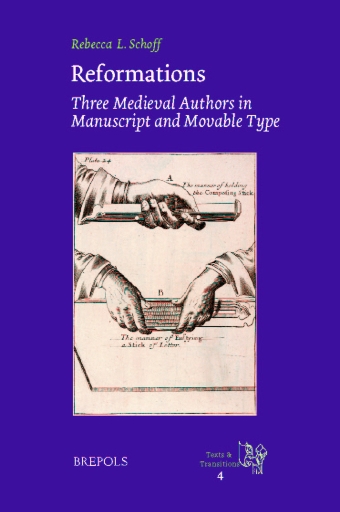
Reformations
show More to view fulltext, buy and share links for:Reformations show Less to hide fulltext, buy and share links for: ReformationsThis volume discusses the key shift from manuscript to print culture in the history of books, taking The Canterbury Tales, The Book of Margery Kempe, and Piers Plowman as models of the way in which a medieval text's unique tradition influenced its transition from manuscript to print. The forces of the Reformation era did not produce the same effect across the varied textual legacy of the Middle Ages. Every text that made the transition from manuscript to print brought with it a set of concerns, a tendency to address a particular readership in particular ways, a physical presence developed in manuscript culture, all of which might shape the pathways by which a text might arrive in print, and what it might look like when it got there. This study follows The Canterbury Tales, The Book of Margery Kempe, and Piers Plowman from their circulation in manuscript to their presentation in print, in order to track how each of them survived the metamorphosis of the relationship between writers and readers as the new technology was introduced. Taken together, the three case studies demonstrate to scholars of any medieval literature the variety of possible impacts made when texts composed in manuscript culture were prepared for printing. The great force exerted by the technological and cultural developments of the English Reformation, not least the more centralized legislative regulation of the press, has long been central to the study of the history of books. This volume takes into account the ways in which individual textual traditions pushed back or accelerated the forces of early modern reform, producing their own plural reformations.
-
-
-
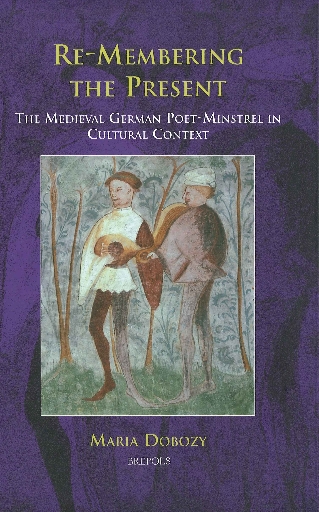
Re-Membering the Present
show More to view fulltext, buy and share links for:Re-Membering the Present show Less to hide fulltext, buy and share links for: Re-Membering the PresentThis book examines the social and cultural conditions that governed performance art in the German Middle Ages from 1170 to 1400. Poet-performers are central to understanding both literature and performance art because these entertainers, more than any other group, created, disseminated, and interpreted the medieval poetic oeuvre. Performance theory is used as a framework throughout.
Since no social history of poet-performers exists in English, part I presents a social history that re-examines what is known about social status, cultural image and employment. Part II investigates the affective nature of performance and focuses on poet-composer-performers. This study argues that performance techniques (gesture, voice, instrumentation) that create an electrifying experience for audiences determine the performer's lifestyle and also the thematic and rhetorical strategies of their compositions.
The itinerant poet-performer presented himself as a moral judge and critic of epoch-making political events. His performances transform time, place and people and thus become a socializing process that can change people's attitudes. Poet-minstrels were capable of re-membering the listeners' memories of the past during the intense present of the performance. Readings of several texts are offered, including romances, the political songs of well-known poet-performers (i.e. Walther von der Vogelweide) and the gnomic poets (Spruchdichter) whose songs have been neglected until recently. The songs are quite intricate and multivalent as they masterfully display an aesthetic totally integrated with their performative context.
-
-
-
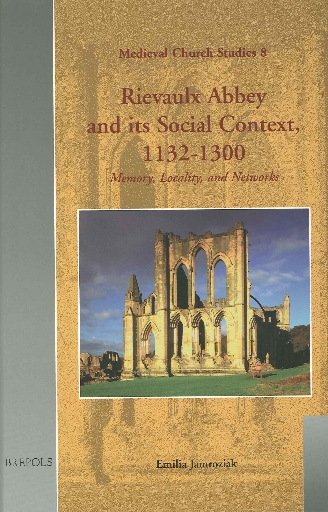
Rievaulx Abbey and its Social Context, 1132-1300
show More to view fulltext, buy and share links for:Rievaulx Abbey and its Social Context, 1132-1300 show Less to hide fulltext, buy and share links for: Rievaulx Abbey and its Social Context, 1132-1300Rievaulx abbey was one of the most prominent houses of white monks (Cistercians) in England, and became in the course of the twelfth and thirteenth centuries an important feature of the ecclesiastical and social landscape of Yorkshire. The present work is the first in-depth study devoted to Rievaulx's social history. The abbey's once extensive archives were largely destroyed after the Dissolution, but the surviving late-twelfth-century cartulary provides a fascinating insight into the process of creating institutional memory, preserving and shaping information about various neighbours of the abbey, and creating a 'map' of social networks that developed around Rievaulx. The complex picture of building and sustaining connections between the abbey and its lay patrons, benefactors and neighbours forms a core to this book. This study also examines how Rievaulx co-existed with other religious institutions in the area, and particularly the practical dimension of friendships between abbots, declarations of mutual support between monastic communities, and how these were reconciled with a fierce competition for land and donations. Contacts between Rievaulx abbey and the nearby archbishops of York and bishops of Durham were intense and these contacts demonstrate how important these prelates were as potential supporters, and how broader ecclesiastical issues influenced their relationships with Rievaulx. Whilst exploring the case of one particular monastery this book is an important contribution to the current debate on the shaping of Cistercian practice, and particularly the mechanisms for the interaction between laity and monastic communities, during the High Middle Ages.
-
-
-
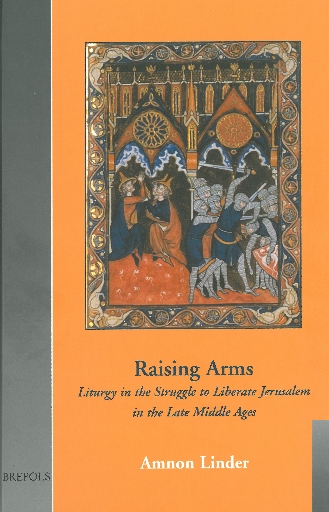
Raising Arms
show More to view fulltext, buy and share links for:Raising Arms show Less to hide fulltext, buy and share links for: Raising ArmsThis is the first full-scale study of the liturgical reaction of Christian Europe to the demise of the Crusader kingdom of Jerusalem. It surveys and analyzes the five main types of liturgy that were evolved during the last three medieval centuries in the struggle to liberate Jerusalem by means of new Holy Land crusades: the Clamor, the three principal Mass prayers, the dedicated war Mass, the English Trental of St Gregory, and the Bidding Prayers. The relevant texts - hitherto unedited, for the most part - have been identified in numerous manuscripts and are given here in critical editions, extensively annotated and commented. They constitute a new corpus of knowledge that bears on the cultural evolution of late medieval Europe in general and on specific fields of study in particular, mainly the Holy Land crusade and the crusading movement, the war liturgy, the Papacy, and several devotional practices that were introduced in this context. Their scope and novelty are such as to cast new light on several aspects of late medieval culture and to open new avenues of research.
-
-
-
Robert Grosseteste: New Perspectives on his Thought and scholarship
show More to view fulltext, buy and share links for:Robert Grosseteste: New Perspectives on his Thought and scholarship show Less to hide fulltext, buy and share links for: Robert Grosseteste: New Perspectives on his Thought and scholarshipIn Grosseteste we have on our hands a figure, not only of great complexity in himself, but of even greater complexity in the kind of evidence which we are required to use. It is worth remembering that, despite all efforts of the last half century, quite half of his works are still unpublished. When we turn to Grosseteste, we find a situation which is as different from this as it could well be. He presents a quite unique combination of problems. The range of subjects he studied, the way in which he studied them, and the order in which he studied them, seem to be - to a much greater extent than any of the great scholastic thinkers - to be an expression, not of any normal programme of university studies, but of his personality and of the obscure and varied background and circumstances of his life. His thoughts on the subjects which he chose to elaborate are markedly his own. In a word uniqueness of circumstances and personality.
-
-
-

Répertoire des textes latins relatifs au Livre de Ruth (VIIe-XVe siècle)
show More to view fulltext, buy and share links for:Répertoire des textes latins relatifs au Livre de Ruth (VIIe-XVe siècle) show Less to hide fulltext, buy and share links for: Répertoire des textes latins relatifs au Livre de Ruth (VIIe-XVe siècle)
-