


Antiquité Tardive - Late Antiquity - Spätantike - Tarda Antichità
Revue Internationale d'Histoire et d'Archéologie (IVe-VIIIe siècle)
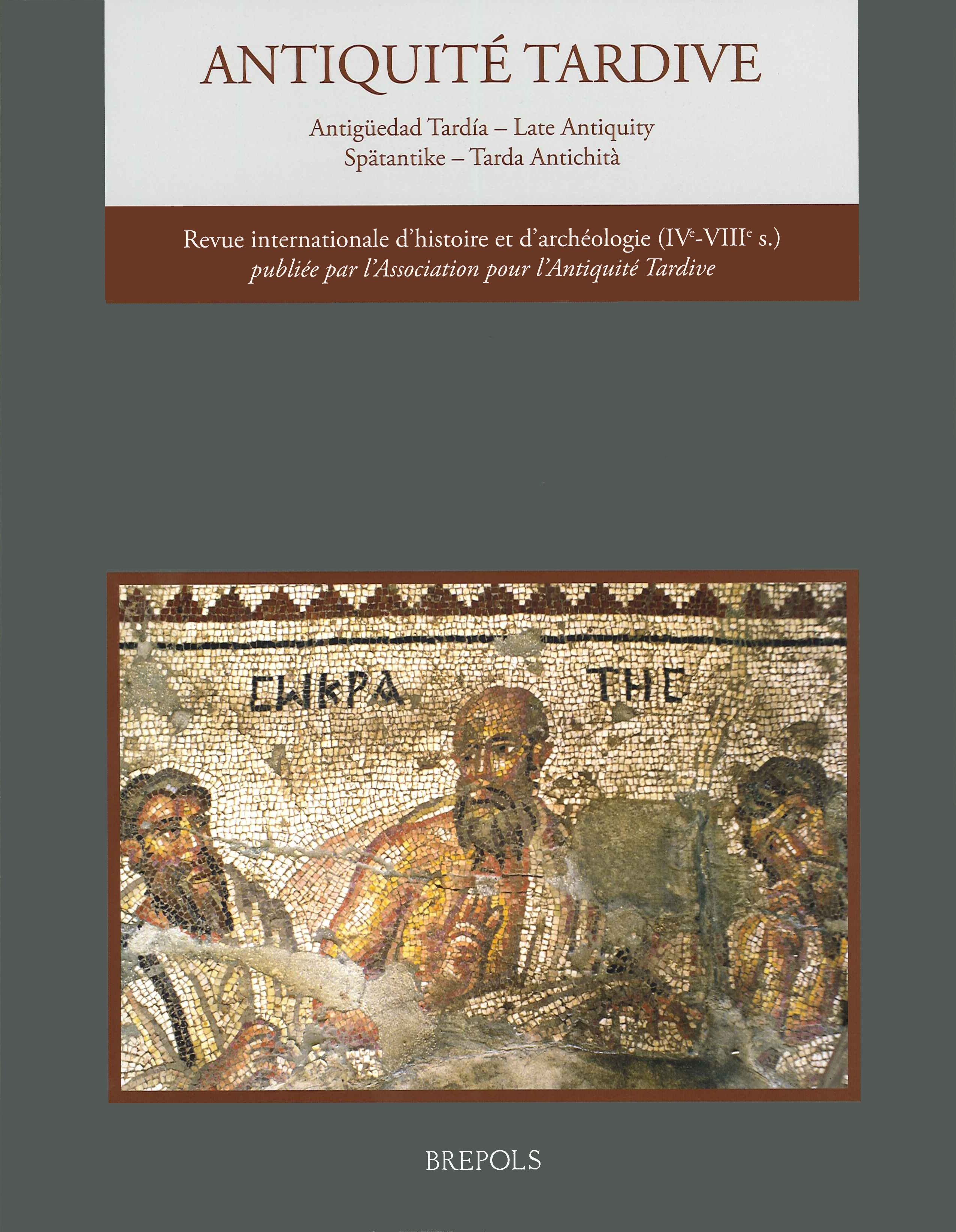
Volume 2, Issue 1, 1994
-
-
Front Matter (editorial information, title page, principales abbréviations, Table des matières, éditorial, erratum, in memoriam)
show More to view fulltext, buy and share links for:Front Matter (editorial information, title page, principales abbréviations, Table des matières, éditorial, erratum, in memoriam) show Less to hide fulltext, buy and share links for: Front Matter (editorial information, title page, principales abbréviations, Table des matières, éditorial, erratum, in memoriam)
-
-
-
Tetrarchie. Avant-propos : Il y a dix-sept siècles, la Tétrarchie
show More to view fulltext, buy and share links for:Tetrarchie. Avant-propos : Il y a dix-sept siècles, la Tétrarchie show Less to hide fulltext, buy and share links for: Tetrarchie. Avant-propos : Il y a dix-sept siècles, la TétrarchieBy: J. M. Carrié
-
-
-
L'évolution politique du règne de Dioclétien (284-305)
show More to view fulltext, buy and share links for:L'évolution politique du règne de Dioclétien (284-305) show Less to hide fulltext, buy and share links for: L'évolution politique du règne de Dioclétien (284-305)By: André ChastagnolAbstractWe have asked A. Chastagnol to open this historical section with a general discussion, which has its origins in the manuscript he prepared several years ago for the Staria di Roma (ed. Mondadori), and later revised and expanded. After describing the seizure of power and the creation of the diarchy (with Maximian as Caesar, then Augustus), the author stresses Rome's abandonment as a permanent center of power and the separation of the two emperors, who were without fixed residence and rarely saw each other. The ideological and religious substratum, frequently discussed following the research of A. Alföldi, J. Straub and W. Seston, is marked by the absence of solar references, which had been prevalent until then, and by the selection in 285 of Jupiter as the protector of Diocletian and Hercules as the divine « parent» of Maximian. This reinvestiture of traditional deities appears conservative. « Birth» within the divine order is commemorated by the natalis imperii. The imperial cult and the increasingly strict court etiquette underscore the notion of divinized imperial authority, perhaps reflecting Persian influence. According to the autor, the creation of the tetrarchy by the nomination of two Caesars resulted in part from continuing difficulties, especially the rebellion of Carausius in Britain. It occurred by means of a "single" ceremony, held simultaneously near Milan and Nicomedia. Constantius and Galerius (most often called Maximian) were stationed in the West and East respectively, and were linked by divine and family ties to the senior emperors (both married daughters of the Augusti). They were thus the heirs apparent. The peace which followed the Persian wars stabilized the regime and allowed Diocleatian to make major reforms influencing the future. The central administration, focused upon the princes residing in Asia, Illyricum, Italy and Gaul, and the regional administration, reorganised in smaller provinces grouped as dioceses, strengthened the decision-making process and facilitated communication. The public order was more coercive and taxes were heavier, although enforcement varied by region. Apotheosis occurred in the Vicennalia of 303, consecrating the regime and celebrated by the emperors' visit to Rome. In order to survive, the regime had to withstand the first succession in 305, caused by the voluntary retirement of Diocletian and his colleague Maximian, and then a second succession on the occasion of the Vicennalia of the former Caesars in 312. The choice of Maximin Daia and Severus as the new Caesars in 305 was unexpected, but recalled the Antonine system of adopting the « best ». However, heredity, initially denied to Constantine and Maxentius, soon asserted itself. [N. D., traduction David Parrish]
-
-
-
Les campagnes des tétrarques, 296-298. Notes de chronologie
show More to view fulltext, buy and share links for:Les campagnes des tétrarques, 296-298. Notes de chronologie show Less to hide fulltext, buy and share links for: Les campagnes des tétrarques, 296-298. Notes de chronologieAbstractThe study attemps to precise the chronology of the major campaigns of the Tetrarchs in 296-298. Galerius' initial defeat by the Persians is set in the very beginning of 297 and his subsequent victory over King Narses in Armenia, early in the autumn of the same year. Diocletian, accused by scholars of intriguing against Galerius, is cleared of all guilt thanks to a new interpretation of P. Argent. (= P.Strasbourg inv.) 480. The dating in the second half of 297 of the Egyptian rebellion led by L. Domitius Domitianus is sustained by new arguments against the recent attempts to set it in 296; the circumstances of the rebellion are brought in connection with the events on the Persian front. Maximianus' African campaign, preceeded by a march across Spain in the last months of 296, is shown to have started by some local fighting in Mauretania Tingitana early in 297. Several inscriptions, notably AE 1981, 777, ILS 546 and lAM 11,34 and 55, are discussed in this context.[Auteur]
-
-
-
A propos de Bleckmann, Die Reichskrise des dritten Jahrhunderts in der spätantike und byzantinische Geschichtsschreibung
show More to view fulltext, buy and share links for:A propos de Bleckmann, Die Reichskrise des dritten Jahrhunderts in der spätantike und byzantinische Geschichtsschreibung show Less to hide fulltext, buy and share links for: A propos de Bleckmann, Die Reichskrise des dritten Jahrhunderts in der spätantike und byzantinische GeschichtsschreibungAbstractByzantine historians remain understudied, although they can offer valuable help to ancient historians ; B. Bleckmann's book is an important advance into underexplored territory. The value of its contributions to narrative history, the austerity of a work focussed on the analysis of sources. without any concessions to fashion, and the relevance of its argument to other recent works, demand a detailed review. Among all Byzantine history writers, the most important contribution to ancient history is that of Zonaras for the period beginning in 229 (when Dio Cassius ends). B. gives new life to an ancient theory, uncovering in this author three sources of secular history for this period: two are of lesser interest, because they are preserved elsewhere, but the third - called Leoquelle, because it was used most notably by Leo the Grammarian - is very valuable, presenting reliable information not found elsewhere. According to B., this 'Leoquelle' can be identified partly with Peter the Patrician, and partly with the Anonymus post Dionem. B.'s achievement is to identify and evaluate the contribution of the 'Leoquelle', especially for the history of the third century. The analysis is presented in four principal chapters on the Roman-Sassanian wars, the Germanic invasions, the reign of Gallienus and relations between emperor and Senate. A fifth chapter advances into the fourth century ; B examines the relationship between Zonaras and Ammianus. A very detailed analysis of a host of points of detail results in an astonishingly consistent result. Not only is the initial hypothesis confirmed, but B. also succeeds in discovering, behind Peter the Patrician (who used Dio until 229) a source which can be very exactly characterised ; it was a high level work, pagan in sympathy, which reflects the ideology of the roman senatorial aristocracy and the attitudes of the end of the fourth century, written in Latin, whose traces are also to be found in the Historia Augusta, Ammianus, and the Epitome de Caesaribus. B. proposes to identify this as the Annales of Nicomachus Flavianus. This review only disagrees with B. on some minor points - most substantially, in suggesting that for the years 238-70, the Historia Augusta used Dexippus directly, and not via Nicomachus Flavianus. It also puts forward a stemma, illustrating the relationships between the principal sources ; and it also lays to rest three ghost historians whom several scholars unfortunately attempted to resuscitate, and about whom B. expresses due scepticism, Cordus, Onesimus and Eusebius 'of Nantes'. [Auteur, trad. Ch. Roueché]
-
-
-
Aur. Valerianus (293/305) et Fl. Severinus (333), commandants en Arabie, et la forteresse d'Azraq
show More to view fulltext, buy and share links for:Aur. Valerianus (293/305) et Fl. Severinus (333), commandants en Arabie, et la forteresse d'Azraq show Less to hide fulltext, buy and share links for: Aur. Valerianus (293/305) et Fl. Severinus (333), commandants en Arabie, et la forteresse d'AzraqAbstractThe three notes which comprise this study propose some new readings and interpretations of five inscriptions from Arabia. In note I, IGLSyr XlII, 9062, situated by the editor in the middle of the fourth century, is dated between 293 and 305. Three dedications to Constantine I and his sons from the oasis of Azraq are discussed in note II. Note III studies another inscription from Azraq which has a crucial bearing on our understanding of the strategic disposition in Arabia under Diocletian (ca 290) and which has been recently a subject of intense scholarly debate. A couple of new readings suggest a solution for most of the issues outstanding. [Auteur]
-
-
-
Le ricerche nel Palazzo di Diocleziano a Split negli ultimi 30 anni (1964-1994)
show More to view fulltext, buy and share links for:Le ricerche nel Palazzo di Diocleziano a Split negli ultimi 30 anni (1964-1994) show Less to hide fulltext, buy and share links for: Le ricerche nel Palazzo di Diocleziano a Split negli ultimi 30 anni (1964-1994)Authors: Jerko Marasović and Tomislav MarasovićAbstractWe asked Art Historian T. Marasović and Architect J. Marasović, now professors at the Universities of Split and Zagreb, to gather the main results of works done in Diocletian's Palace since 1964, while they were in charge at the Town Planning of Dalmatia and then at the Research Center for Mediterranean Architectural Heritage, founded in Split by their Universities. In a first part, they give an account of the documentation and especially recall of the general plan drawn at a 1 :200 scale under the direction of J. Marasović. A second part examines for each sector the progress of researches in the Palace, culminating with several campaigns of excavations that took place in southeastern sector, in collaboration with the University of Minnesota (see the account of Sh. McNally in this same Journal). They also mention the exploration of the perimeter, mainly the two towers to the North-East and North-West (the northwestern one has been renovated and hosts the Research Center for Mediterranean Architectural Heritage), and the discovery of a complex system of water canalizations, where a great amount of ceramics from different periods has been found. In a third part, they briefly describe new restaurations : - consolidation of the Imperial Appartments in southeastern sector, that was required for works to go on ; - renovation of southeastern tower, almost entirely preserved, and of the neighbouring part of southern front ; - valorization of the foundations which should be those of the ""Venus Temple"", located at ground level in the ex-Palazzo Cipci on Peristyle's western side ; - complete restauration of Town Museum, allowing to show remains of northwestern complex of the Palace ; - partial restauration of northwestern tower, because of a lack of information concerning upper levels. Finally, the bibliography is listing most of the articles and books published since 30 years (with some complements by S. McNally and N. Duval) [N.D. transl. by Pascale Chevalier].
-
-
-
Joint American-Croatian excavations in Split (1965-1974)
show More to view fulltext, buy and share links for:Joint American-Croatian excavations in Split (1965-1974) show Less to hide fulltext, buy and share links for: Joint American-Croatian excavations in Split (1965-1974)By: Sheila McnallyAbstractNous avons demandé à la directrice du team américain de décrire ici les buts, Ie déroulement et les principaux résultats des fouilles menées à Split, principalement dans Ie secteur sud-est du palais, par l'équipe qu'elle a dirigee, conjointement avec l'architecte Jerko et l'historien d'art Tomislav Marasović, pendant six ans. Ces fouilles ont fait l'objet de six volumes de rapports, parus d'abord en double édition (çroate et anglaise) puis en anglais seulement, à l'Universite de Minnesota. Mme McNally annonce un volume sur Ie palais. Après avoir rappelé les progrès dans la connaissance du palais depuis Ie XVIlle siècle, l'A. décrit Ie contexte du travail de l'équipe américaine qui a æuvré dans Ie cadre de programmes ambitieux pour revitaliser la vieille ville, surtout dans Ie secteur sud-est où les fondations insuffisantes des bâtiments modernes avaient empêché jusque là des recherches approfondies et où les difficultés techniques interdirent encore d'atteindre partout Ie sol vierge. Le programme représente, jusqúà maintenant, la seule tentative de fouille stratigraphique à l'intérieur du palais. [N. D.]
-
-
-
Emperor's Galerius's buildings in Romuliana (Gamzigrad, eastern Serbia)
show More to view fulltext, buy and share links for:Emperor's Galerius's buildings in Romuliana (Gamzigrad, eastern Serbia) show Less to hide fulltext, buy and share links for: Emperor's Galerius's buildings in Romuliana (Gamzigrad, eastern Serbia)Authors: Dragoslav Srejović and Čedomir Vasić
-
-
-
The representations of Tetrarchs in Romuliana
show More to view fulltext, buy and share links for:The representations of Tetrarchs in Romuliana show Less to hide fulltext, buy and share links for: The representations of Tetrarchs in RomulianaAbstractDr. Srejović, qui a rendu compte des développements récents des fouilles de Gamzigrad (v. supra), rassemble ici les témoins sculptés de l' iconographie tétrarchique trouvés dans les fouilles : 1) un fragment de tête de porphyre trouvé en 1962 près de la porte ouest (fig. 6) ; 2) un fragment de main avec Ie globe (fig. 7) trouvé en 1972 dans Ie monument principal (""palais""), qui peut appartenir à la même statue que la tête no 4 ; 3) trois pilastres (fig. 1 à 5, 8, 9) trouvés entre 1985 et 1987 dans la partie est de l' agglomération, présentant des étendards, des symboles de victoire et des bustes ou des figures en pied (non individualisés) de six Tétrarques appartenant à la premiére Tétrarchie (Dioclérien et Maximien) et à la seconde, d' après l' auteur qui propose une date analogue à celle de l'inscription des thermes de Dioclérien (mai 305-juillet 306). Sur Ie pilastre C, une Victoire couronne les personnages debout ; 4) une tête entière (qui orne la couverture de la revue ; cf. fig. 10-13) découverte en 1993 dans un établissement thermal à l' Est de l' agglomération, qui appartenait à une statue monumentale ou à un groupe (une Victoire couronnant l'empereur). Ce portrait, en pierre dure, est trés simplifié, mais il ne peut représenter que Galère dont les traits sont analogues à ceux des monnaies et à ceux mentionnés dans les textes (en dehors des indications polémiques de Lactance). Mais on doit avouer que l'individualisation des portraits des Tétrarques est une des plus grandes difficultés de l' histoire du portrait romain. Seules des têtes récemment acquises par Ie British Museum et Ie Louvre [sur lesquelles des doutes ont été exprimés], un buste d' Athribis en Egypte et des têtes d' Antioche et de Transdierna présentent des traits qui paraissent propres, avec une certaine similitude mais aussi des différences entre les trois dernières et celle de Romuliana. La couronne de la tête de Romuliana comporte des bustes (fig. 14-17) appartenant d' après l' A. à la première Tétrarchie. Ce type, qu' on retrouve sur les couronnes des prêtres du culte impérial (notamment en Asie Mineure et en Syrie) doit être d' origine orientale. Il peut étre daté approximativement par Ie triomphe collectif de 303 qui coïnciderait avec Ie début de la construction de Romuliana. [N. D.]
-
-
-
Taking sources on their own terms and on ours: Peter Brown's Late Antiquity
show More to view fulltext, buy and share links for:Taking sources on their own terms and on ours: Peter Brown's Late Antiquity show Less to hide fulltext, buy and share links for: Taking sources on their own terms and on ours: Peter Brown's Late AntiquityBy: Warren TreadgoldAbstractL'auteur suggère que les éléments de la société de l'Antiquité Tardive étudiés de préférence par Peter Brown et son Ecole - surtout l'importance des saints hommes, l'abstinence sexuelle et Ie rôle des cérémonies publiques - avaient une signification secondaire dans Ie cadre de cette société. Brown a surtout choisi dans les sources anciennes des traits de l'Antiquité Tardive qui semblent particulièrement piquer l'intérét du public cultivé et les a expliqués dans les termes que ce public trouve satisfaisants. Les anciennes sources sont ainsi interprétées d'après les critères de notre temps, et, ce faisant, leur témoignage sur l'Antiquité se trouve faussé. Cette réinterprétation ne peut contribuer à une synthèse cohérente et précise sur l'Antiquité Tardive. [Auteur]
-
-
-
Topografia de la Antigüedad tardia hispánica. Reflexiones para una propuesta de trabajo
show More to view fulltext, buy and share links for:Topografia de la Antigüedad tardia hispánica. Reflexiones para una propuesta de trabajo show Less to hide fulltext, buy and share links for: Topografia de la Antigüedad tardia hispánica. Reflexiones para una propuesta de trabajoAbstractOn occasion of the Meeting of the Association pour l'Antiquite Tardive in Barcelona (1993), we thought it appropiate to make a first approach to the problems of carrying forward a project on the topography of the Late Antique Spain. Since it is a very large subject, we decided to write these first reflections. Christian archaeology has always studied its monuments in an individual way, but maybe now is the moment for a more global vision and, at the same time, to see how Christianity transformed the rural and the urban landscape. Its analysis requires studying texts, inscriptions and monuments, and then evaluating each of the cities to be analysed and its territory. In this text we discuss the relation between urbs suburbium, territorium and, on the other hand, the problems of the administrative geography of the Iberian Peninsula and its possible transposition in the latest ecclesiastical geography. The written sources are classified and require a more specific treatment, since, in many cases, they are late texts. Epigraphy is a relatively reliable research tool but it presents lots of problems in its archaeological contextualization and chronology. The archaeological documentation is heterogeneous. The problem is very different when we are dealing with urban webs that have had a continuity, or when cities have been abandoned. The archeology of the rural landscape can offer many solutions or, at least, new visions of the transformation. [Author revised by D. Parrish]
-
-
-
La réutilisation des espaces publics à Arles : un témoignage de la fin de l'Antiquité
show More to view fulltext, buy and share links for:La réutilisation des espaces publics à Arles : un témoignage de la fin de l'Antiquité show Less to hide fulltext, buy and share links for: La réutilisation des espaces publics à Arles : un témoignage de la fin de l'AntiquitéBy: Claude SintèsAbstractSeveral sites excavated recently both inside and outside the city walls of Arles show evidence of reuse and reoccupation during the late Empire. Encroachments of these kinds appear at the end of the 4th and during the 5th century in public areas such as squares, places of entertainment and even the Augustan forum. The author presents the results of excavations in the "Van-Gogh Hospital" and the "City Hall" as well as a detailed discussion of research conducted in the "Roman Circus", where little houses were constructed around the building's perimeter, even using the vaulted chambers under the seating. Both the date of these parasitic structures and the squatters' need to have official permission to occupy public spaces suggest that Arles experienced a significant increase in population when the administrative and political capital of Gaul was moved from Trier to ArIes sometime between A. D. 394 and 408. [Author, trad. D. Parrish]
-
-
-
Imagery of the gods of the week in Roman mosaics
show More to view fulltext, buy and share links for:Imagery of the gods of the week in Roman mosaics show Less to hide fulltext, buy and share links for: Imagery of the gods of the week in Roman mosaicsBy: David ParrishAbstractD. Parrish, spécialiste de la mosaïque, après des travaux consacrés aux représentations de l'année, des mois et surtout des saisons, s'intéresse ici aux représentations des jours de la semaine, qui sont relativement rares sur mosaïque (pas plus d'une douzaine d'exemples), mais plus fréquentes en sculpture. Celles en mosaïque sont concentrées dans l'espace (partie occidentale de l'Empire) et dans Ie temps (fin du lle -llle s. jusqu'au début du IVe s., avec un seul exemple pour ce temps). On constate des variations dans la composition (qui sont généralement centrées, avec les bustes placés dans des hexagones ou des trapèzes) et surtout un choix varié et volontaire de la divinité centrale, Saturne, dieu typiquement africain à Bir Chana, mais plus souvent l'aimable figure de Vénus. La symbolique planétaire, qui peut se combiner avec la hiérarchie mithriaque, culmine dans Ie Septizonium de Septime Sévére à Rome où les figures des dieux planétaires accompagnent la statue monumentale de l'empereur en Sol. [N.D.]
-
-
-
Ampolle devozionali ed itinerari di pellegrinaggio tra IV e VII secolo
show More to view fulltext, buy and share links for:Ampolle devozionali ed itinerari di pellegrinaggio tra IV e VII secolo show Less to hide fulltext, buy and share links for: Ampolle devozionali ed itinerari di pellegrinaggio tra IV e VII secoloAuthors: Chiara Lambert and Paola Pedemonte DemeglioAbstractThe existing rich bibliography on the Ampullae... very often only deals with the iconographical aspects. This work is concerned rather with the geographical distribution of these objects in relation to the itineraries of pilgrimage. Their function, typology and chronology are recalled, and three principal groups are distinguished: Ampullae of St. Menas, the several Eastern sanctuaries, and the sites in the Holy Land. The predominant number of specimens of St. Menas, bears witness to the frequency of pilgrimages to the tomb of the saint's eponym, either starting from the Holy Land or from the low Danube, from Western Europe or from the Maghreb. This testifies to the persistence of contacts between West and East up to the disturbances of the VII th century. there follows a catalogue of specimens known at the present time, with the sites where they were found and/or are conserved, their datation and bibliography. [revised by D.Parrish] The present work re-examines the itineraries ad loca sancta fort he corresponding period: namely that of the Pilgrim of Bordeaux for the IV th century; that of the Anonymous Pilgrim of Plaisance (about 560/70) and the narration of the Frankish bishop Arculf (679/82) copied by the Irish abbott Adamnan. There emerges a preference for the land routes during the I V th century, and for the sea routes during the Vlth and Vllth centuries. Changes in the political-religious context in most of the East as well as in the Balkans must have had an influence in this sense, but one should probably also take into consideration personal motivations or chance occurrences. While the sanctuaries like St. Menas, which were often visited up to that time, decline around the middle of the Vllth century, Costantinople, rich with relics, from this moment exercices a strong attraction from this point onward. While the oldest accounts insist very little (or not at all) on describing the ways of reaching the Holy places, the increasing dangers now cause the whole voyage to be described in the devotion's itinerary. [revised by D. Parrish]
-
-
-
Les ateliers de sarcophages paléochrétiens en Gaule : la Provence et les Pyrénées
show More to view fulltext, buy and share links for:Les ateliers de sarcophages paléochrétiens en Gaule : la Provence et les Pyrénées show Less to hide fulltext, buy and share links for: Les ateliers de sarcophages paléochrétiens en Gaule : la Provence et les PyrénéesBy: Mat ImmerzelAbstractReferring to the work of recent decades, the author emphasises the importance of the contribution of K. Eichner in elucidating the process of manufacture of sarcophagi at Rome in the fourth century. The method is applied here to the sarcophagus "of Cassian" at Marseille, which is usually attributed to a local workshop of the fifth century, but which is here claimed to be a Roman work of the 380s. The study then examines south-eastern Gaul ; technique and style suggest that several later fourth century sarcophagi are of local manufacture. The recent identification of the marble of Saint-Béat (analysed by A. Costedoat) tends to confirm this hypothesis, but presents problems in the case of one piece which is certainly of Roman manufacture ; the presence of Roman workmen working on Pyrenanmarble - perhaps near the quarries -is one possibility, but it is also necessary to consider the identifications suggested by A. Costedoat with caution. Finally, the author reexamines the case of the late "Aquitanian" sarcophagi. Rather than locating the centre of production at Toujouse (as proposed by B. Briesenick-Christern) he presents the arguments in favour of Lugdunum Convenarum (Saint-Bertrand-de-Comminges) going a period from the end of the fourth to the end of the sixth century. In an appendix, P. Jongste reconsiders some of the difficult problems presented by marble analysis; re-examining the approach of A. Costedoat, he presents some critical observations and suggests the need for caution in assessing current results. [N. D., tract. Ch. Roueche]
-
-
-
Une grande dame, Chrodoara d'Amay
show More to view fulltext, buy and share links for:Une grande dame, Chrodoara d'Amay show Less to hide fulltext, buy and share links for: Une grande dame, Chrodoara d'AmayBy: Nancy GauthierAbstractIn the small town of Amay, on the river Meuse, not far from Liège (Belgium), wasfound, in the choir of the church, the sarcophagus of a lady who is designated as Sancta Chrodoara by the inscription on it and who is represented with an abbess stick in her hand. This major discovery was an incitment to carefully reviewing the other two documents concerning this person, i.e. the testament of Adalgyselus quiet Grimo who, in 634, left some properties to Saint-Georges church in Amay, where his (not namely designated) aunt had been buried, and the Vita S. Odae,from the early thirteenth century, which presented the holy woman as a rïch widow and the foundress of Amay. From this survey, it appears that Chrodoara belonged to one of the most powerful Frank families, akin to the Chrodoinides but also to the ancestors of the Carolingians, through the couple of Hugobertus and Irmina of Oeren and possibly through Arnulfus of Metz. The beginning of the cult is to be related to the eleuatio of saint's remains, in or around 730, by the bishop of Liège Florebertus who was himself somehow akin to Hugobertus' and Irmina's family, and consequently to Chrodoara. For epigraphic and stylistic reasons, the sarcophagus must be regarded as dating of this latter period. The exceptional beauty of this sarcophagus can be easily understood in view of the growing power of the carolingian dynasty just about to emerge from multiple intermarriages between these few families. [Auteur]
-
-
-
Le chef-lieu de la cité des Vellaves et les origines du siège épiscopal du Velay
show More to view fulltext, buy and share links for:Le chef-lieu de la cité des Vellaves et les origines du siège épiscopal du Velay show Less to hide fulltext, buy and share links for: Le chef-lieu de la cité des Vellaves et les origines du siège épiscopal du VelayBy: Françoise PrévotAbstractIn the absence of fresh discoveries, this article summarizes what is known at present and outlines remaining problems: what was the capital of the Vellaves? Where and when were the first bishops installed? Was the episcopal see transferred from Saint-Paulien to Le Puy as tradition says? Ruessium, capital of the Vellaves in the High Empire according to Ptolemy, should be identified with Saint-Paulien; despite its administrative importance, the city (a rival of Le Puy, an ancient settlement where there was a sanctuary of Celtic origin) did not undergo a truly monumental development. Saint-Paulien lost its status as a capital between the end of the 3rd and the beginning of the 10th century, but it is difficult to know exactly when. Archaeological research shows its decline from the 3rd century, and neither fortification walls nor ancient Christian traces have been found there. By contrast, Le Puy seems to have been fortified in the Late Empire. Christianity is attested there in the 5th century at the latest (sarcophagus of Roman-Aries type) and there were discovered vestiges of a pre-Carolingian structure at the site of the pagan sanctuary. The first historically attested bishop is Aurelius, who resided in Le Puy in 591. There is no record of a pontiff holding his see at Saint-Paulien and even the idea that there may have been one seems late: indeed, epigraphic and liturgical documents suggest that in the Carolingian period, when a cult was formed to honor the founding saints of the Vellave Church (Evodius, Scutarius, etc.), it was believed they had held their see in Le Puy. Apparently it was not before the 10th century that Saint-Paulien claimed to have received the first missionary of Velay, George, a companion of Saint Front of Perigueux. It may well be that no bishop ever held his see at Saint-Paulien and that Le Puy, probably fortified in the Late Empire, thus became the capital of the region and the episcopal seat. As an hypothesis, one may assign Saint-Paulien's eclipse to the 5th century, contemporary with that of Javols among the Gabales. [Auteur. Trad. D. Parrish]
-
-
-
Two Paleochristian Inscriptions from Briord (Ain). RICG, XV, 261-262 rediscovered
show More to view fulltext, buy and share links for:Two Paleochristian Inscriptions from Briord (Ain). RICG, XV, 261-262 rediscovered show Less to hide fulltext, buy and share links for: Two Paleochristian Inscriptions from Briord (Ain). RICG, XV, 261-262 rediscoveredBy: Paul ReynoldsAbstractLa courte note ci-dessous signale la redécouverte de deux épitaphes chrétiennes du début du VIe siécle, que F. Descombes, dans Ie Recueil des inscriptions chrétiennes de la Gaule (RICG), tome XV, nos261-262, avait cru perdues alors que l'une d'entre elles était conservée à la même place que lors des visites d'Allmer au XIXe siécle, c'est-à-dire servant de seuil à une maison du village. Le contrôle des originaux, encore plus usés qu'au XIXe siécle, et d'assez bonnes photographies permettent de compléter la description paléographique et de rectifier quelques détails de lecture. L 'auteur, qui a effectué ce travail de contrôle dans Ie cadre d'une thèse sur l'état économique et social de la Gaule du Sud-Est dans l'Antiquite Tardive et à l'epoque mérovingienne d'aprés l'épigraphie, a organisé son analyse suivant Ie plan des notices du RICG de façon qu' on puisse remplacer telles quelles les descriptions faites dans Ie recueil d' après les dessins du XIXe siécle.ll ajoute des conclusions sur la provenance possible de ces pierres dans l'optique privilegiee par sa thèse. [N. D.]
-
-
-
L'épigraphie des mosaïques d'églises en Syrie et au Liban. A propos de: P. Donceel-Voûte, Les pavements des églises byzantines de Syrie et du Liban. Décor, archéologie et liturgie
show More to view fulltext, buy and share links for:L'épigraphie des mosaïques d'églises en Syrie et au Liban. A propos de: P. Donceel-Voûte, Les pavements des églises byzantines de Syrie et du Liban. Décor, archéologie et liturgie show Less to hide fulltext, buy and share links for: L'épigraphie des mosaïques d'églises en Syrie et au Liban. A propos de: P. Donceel-Voûte, Les pavements des églises byzantines de Syrie et du Liban. Décor, archéologie et liturgieBy: D. FeisselAbstractThis selective review starts from the systematical inventory on which P. Donceel-Voûte entered 77 monuments from antic towns and mainly villages in Syria and Lebanon. The epigraphist will be interested in noticing the multiplication of the inscribed mosaics which have been found in regular excavations during the last thirty years, not to overlook those 'wandering' mosaics registered on the antiquary market. Here are reviewed, in geographical order, the main new inscriptions published in the above-mentioned work, with the addition of some still unpublished documents (see nos 19, 25, 32). Critical remarks are aimed at providing corrections or restitutions to several texts, sometimeso n points related to then terpretation of these monuments(see nos 45, 54). The commentary equally deals with the status of some dedicants, according to the stone epigraphy from the same villages (see nos 18, 39). A major emphasis is put on the prosopography of bishops mentioned on the mosaics, the provenance and date of which directly matter for restoring the fasti. More specially, a provisional updating of the Apamean episcopal list is proposed [Auteur. Trad. J.-M. C.].
-
Volumes & issues
-
Volume 32 (2024)
-
Volume 31 (2024)
-
Volume 30 (2022)
-
Volume 29 (2022)
-
Volume 28 (2021)
-
Volume 27 (2020)
-
Volume 26 (2019)
-
Volume 25 (2018)
-
Volume 24 (2017)
-
Volume 23 (2016)
-
Volume 22 (2015)
-
Volume 21 (2013)
-
Volume 20 (2013)
-
Volume 19 (2012)
-
Volume 18 (2011)
-
Volume 17 (2010)
-
Volume 16 (2009)
-
Volume 15 (2008)
-
Volume 14 (2007)
-
Volume 13 (2006)
-
Volume 12 (2005)
-
Volume 11 (2004)
-
Volume 10 (2003)
-
Volume 9 (2002)
-
Volume 8 (2001)
-
Volume 7 (2000)
-
Volume 6 (1999)
-
Volume 5 (1998)
-
Volume 4 (1997)
-
Volume 3 (1995)
-
Volume 2 (1994)
-
Volume 1 (1993)
Most Read This Month
