


Antiquité Tardive - Late Antiquity - Spätantike - Tarda Antichità
Revue Internationale d'Histoire et d'Archéologie (IVe-VIIIe siècle)
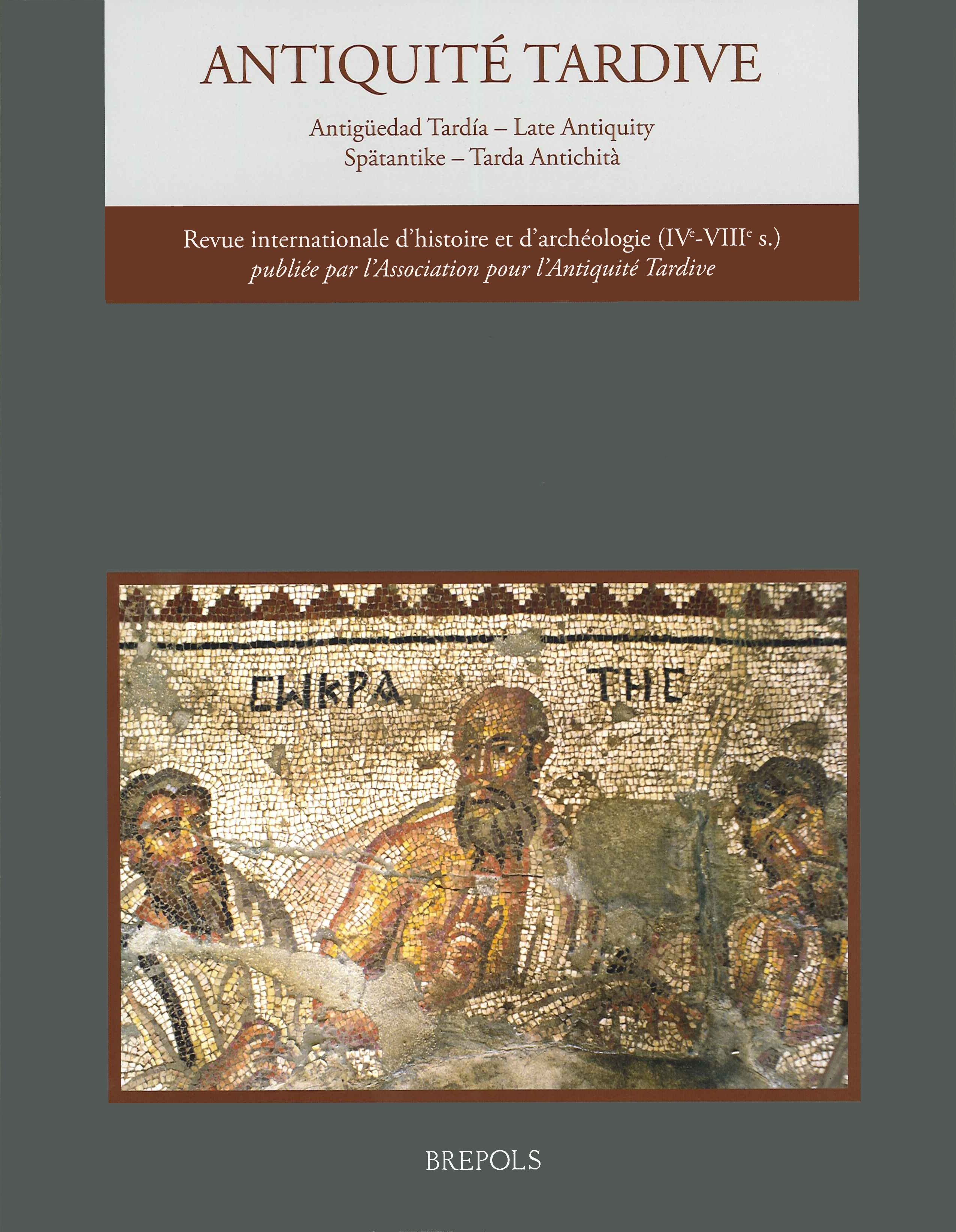
Volume 21, Issue 1, 2013
-
-
A new assessment of the original plan of the church of Orléansville (Chlef, Algeria), and thoughts on the beginnings of the Christian basilica type
show More to view fulltext, buy and share links for:A new assessment of the original plan of the church of Orléansville (Chlef, Algeria), and thoughts on the beginnings of the Christian basilica type show Less to hide fulltext, buy and share links for: A new assessment of the original plan of the church of Orléansville (Chlef, Algeria), and thoughts on the beginnings of the Christian basilica typeBy: Peter GrossmannAbstractThe present article focuses on the old bi-apsidal church of Orléansville of AD 324 and attempts to reconstruct the original plan of the church. By examining all existing plans of the church it appears that the two apses did not belong to the original structure. Out of this emerges the question, what did they replace? The columns of the four colonnades are quite equidistant, except the considerably wider distances between the final columns and the following eastern and western transverse walls, although the latter were not provided with antae as is typical in classical and late Roman architecture. Because of this it is suggested that the last columns of the four colonnades were not connected to the transverse walls but were turned to the sides to create a transverse colonnade at both ends. The aisles would thus surround the nave as an ambulatory on all the four sides.
A similar arrangement shows the first phase of the church in the Pachomian monastery of Pbow in Upper Egypt datable to before AD 347. Both churches demonstrate how a multi-aisled church from the pre-Constantinian period could have looked. It was similar to the Roman forum-basilica from which it typologically depends.
-
-
-
New archaeological research on the episcopal sees of western Betica
show More to view fulltext, buy and share links for:New archaeological research on the episcopal sees of western Betica show Less to hide fulltext, buy and share links for: New archaeological research on the episcopal sees of western BeticaAbstractThis paper presents a summary of the most recent information, some of it unpublished, resulting from archaeological research in the most prominent episcopal sees in urban areas of western Andalusia, Corduba, Hispalis and Astigi.
-
-
-
Visual culture and paideia: the triumph of the theatre, revisiting the Late Antique mosaic of Noheda
show More to view fulltext, buy and share links for:Visual culture and paideia: the triumph of the theatre, revisiting the Late Antique mosaic of Noheda show Less to hide fulltext, buy and share links for: Visual culture and paideia: the triumph of the theatre, revisiting the Late Antique mosaic of NohedaAbstractCet article propose une nouvelle perspective interprétative de la mosaïque de l’Antiquité tardive récemment découverte dans la ville de Noheda (Cuenca, Espagne). L’objectif est d’examiner l’agencement des panneaux qui composent le décor de la grande salle triconche du site et de proposer parallèlement une lecture alternative aux travaux antérieurs qui ont placé les scènes représentées dans le cadre des affrontements religieux païens ou encore dans celui d’initiations ou de significations allégoriques. Du point de vue adopté dans cette étude, on considère au contraire que cette mosaïque correspond au pavement d’une structure architectonique qui peut être identifiée à la salle de réception d’une uilla de l’élite théodosienne. À l’appui de cette nouvelle thèse, une attention particulière est portée aux liens de la structure narrative des panneaux à mosaïque, notamment ceux à caractère théâtral, ainsi qu’à une lecture de la paideía, le système éducatif ancient partagé par l’élite païenne et chrétiene. Par ailleurs, une identification soucieuse de certains traits iconographiques (gestes, attributs, procédés créatifs que l’on retrouve dans d’autres arts tardifs, etc.), permet d’envisager l’existence d’une comparaison visuelle et dialectique entre les trois principaux genres dramatiques de l’Antiquité tardive: mime, pantomime et tragédie. Enfin, est abordée la question de la construction d’un programme iconographique autour du triomphe du théâtre.
-
-
-
Pagans and Christians in the 4th century: points of disagreement with a doxa
show More to view fulltext, buy and share links for:Pagans and Christians in the 4th century: points of disagreement with a doxa show Less to hide fulltext, buy and share links for: Pagans and Christians in the 4th century: points of disagreement with a doxaBy: Stéphane RattiAbstractIn some recent publications the idea (in fact a doxa) that Pagans and Christians were not in conflict during the 4th century is badly weakened by new arguments that are worthwhile considering. We present here an overview of this new literature, together with our own work, and will attempt to place the controversy within broader perspectives.
-
-
-
New insights on the hoard of Nagyszentmiklós, following a major publication on the subject
show More to view fulltext, buy and share links for:New insights on the hoard of Nagyszentmiklós, following a major publication on the subject show Less to hide fulltext, buy and share links for: New insights on the hoard of Nagyszentmiklós, following a major publication on the subjectAbstractThe hoard of Nagyszentmiklós (present-day Sânnicolau Mare, Rumania), discovered in 1799, enriched the collections of Vienna with an unusual set of twenty-one gold vessels including jugs, plates and drinking cups, of which some were made into strange animal shapes and most of them were covered by figures in a vegetal back-ground. The new publication of Csanád Bálint is the result of a lifetime of research. Past works on the hoard concentrated on the question of its ethnic attribution. Cs. Bálint explains why most of the scholars discuss it now as the highest production quality of the Late Avar goldsmiths (around the 8th century AD). But the main contribution of Cs. Bálint is the interesting cultural questions that such a princely hoard buried by a largely settled semi-nomadic chieftain-type society dwelling on the borders of the Byzantine Empire implies. Contradicting most of his predecessors, he shows the weaknesses of the ‘migrationist’ theories that stressed the ‘Oriental’ character of this art and focuses on its development largely after the settlement of the Avars on the periphery of the Byzantine Empire, which provided much of the artistic and technical models for this assemblage.
-
-
-
Comptes rendus
show More to view fulltext, buy and share links for:Comptes rendus show Less to hide fulltext, buy and share links for: Comptes rendusAbstractHistoire et archéologie de l’Antiquité tardive
G. A. Cecconi, C. Gabrielli (dir.), Politiche religiose nel mondo antico e tardoantico (Sylvain Destephen) ; G. Dagron, L’hippodrome de Constantinople. Jeux, peuple et politique (Sylvain Destephen) ; R. M. Frakes, E. DePalma Digeser, J. Syephens (dir.), The Rhetoric of Power in Late Antiquity (Adam Kosto), R. Kosinski,The Emperor Zeno. Religion and Politics (Sylvain Destephen) ; P. Laurence, Le monachisme féminin antique : idéal hiéronymien et réalité (Sylvain Destephen) ; E. Luttwak, The Grand Strategy of the Byzantine Empire (Sylvain Janniard] ; R. J. A. Talbert, Rome’s World. The Peutinger Map Reconsidered (Sylvain Destephen)
Régions
F. Deroche, J. Leclant (dir.) Enceintes urbaines, sites fortifiés, forteresses d’Afrique du Nord (Hendrik Dey) ;G. Filoramo (dir.), Monachesimo orientale. Un’introduzione (Sylvain Destephen) ; A. M. Wasyl, Genres Rediscovered: Studies in Latin Miniature Epic, Love Elegy, and Epigram of the Romano-Barbaric Age (Maria Grazia Bajoni) ; E.J. Watts, Riot in Alexandria. Tradition and Group Dynamics in Late Antique Pagan and Christian (Jitse Dijkstra) ; T. Yashaeva, E. Denisova, N. Ginkut, V. Zalesskaya, D. Zhuravlev,The legacy of Byzantine (Liudmila Khrushkova)
Philologie et sources
M. Bouquet, B. Meniel (dir.), Servius et sa réception de l’Antiquité à la Renaissance (Jean-Louis Charlet) ; C. Corbo, Incertae personae e capacità successoria. Profili di una società e del suo diritto (Antonino Metro) ; S. Crogiez-Pétrequin, P. Jaillette (dir.), Société, économie, administration dans le Code Théodosien (Jean- Pierre Coriat) ; Ennode de Pavie, Lettres. Livres III et IV (Jean-Louis Charlet) ; Évagre le scholastique, Histoire ecclésiastique livres I-III (Michael Whitby), Robert Shorrock,The Myth of Paganism. Nonnus, Dionysus and the World of Late Antiquity (Laury-Nuria André) ; C. Ware, Claudian and the Roman Epic Tradition (Jean- Louis Charlet)
-
-
-
Back Matter ("Publications reçues par la Revue en 2013", "Instructions aux auteurs")
show More to view fulltext, buy and share links for:Back Matter ("Publications reçues par la Revue en 2013", "Instructions aux auteurs") show Less to hide fulltext, buy and share links for: Back Matter ("Publications reçues par la Revue en 2013", "Instructions aux auteurs")
-
Volumes & issues
-
Volume 32 (2024)
-
Volume 31 (2024)
-
Volume 30 (2022)
-
Volume 29 (2022)
-
Volume 28 (2021)
-
Volume 27 (2020)
-
Volume 26 (2019)
-
Volume 25 (2018)
-
Volume 24 (2017)
-
Volume 23 (2016)
-
Volume 22 (2015)
-
Volume 21 (2013)
-
Volume 20 (2013)
-
Volume 19 (2012)
-
Volume 18 (2011)
-
Volume 17 (2010)
-
Volume 16 (2009)
-
Volume 15 (2008)
-
Volume 14 (2007)
-
Volume 13 (2006)
-
Volume 12 (2005)
-
Volume 11 (2004)
-
Volume 10 (2003)
-
Volume 9 (2002)
-
Volume 8 (2001)
-
Volume 7 (2000)
-
Volume 6 (1999)
-
Volume 5 (1998)
-
Volume 4 (1997)
-
Volume 3 (1995)
-
Volume 2 (1994)
-
Volume 1 (1993)
Most Read This Month
