


Judaïsme Ancien / Ancient Judaism
Revue internationale d’histoire et de philologie / International Journal of History and Philology
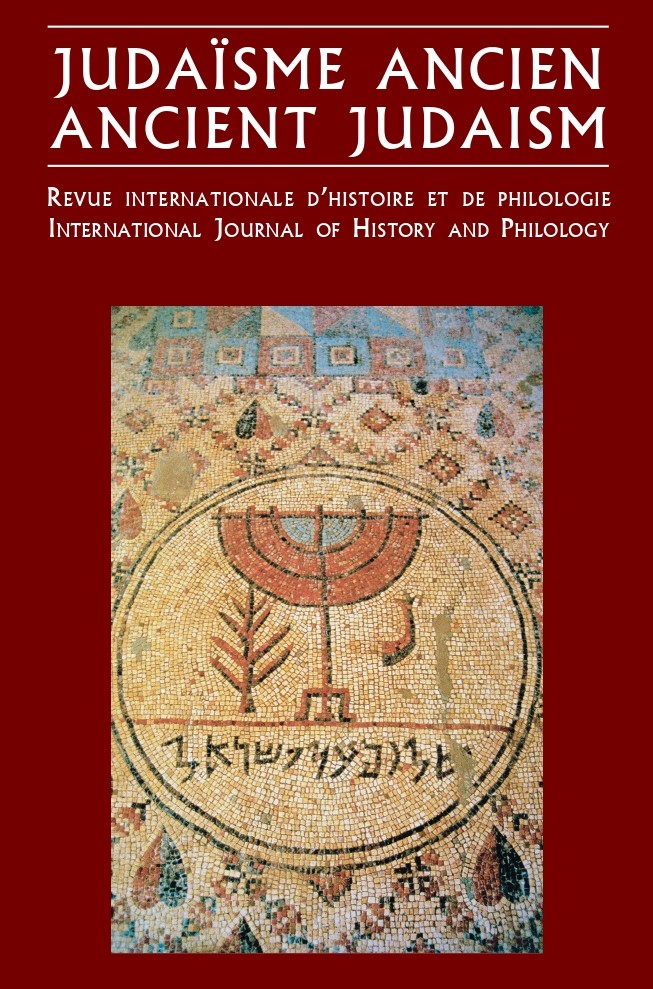
Volume 7, Issue 1, 2019
-
-
Shared Jewish Texts Related to the Samaritan Pentateuch
show More to view fulltext, buy and share links for:Shared Jewish Texts Related to the Samaritan Pentateuch show Less to hide fulltext, buy and share links for: Shared Jewish Texts Related to the Samaritan PentateuchBy: Eugene UlrichAbstractLes manuscrits de la mer Morte ont apporté une modification radicale aux opinions savantes sur le Pentateuque samaritain (PS). Les rouleaux juifs sur l’Écriture tels que 4QpaléoExm et 4QNbb présentent des ressemblances étonnantes avec des extensions majeures dans le PS. 4QPentateuque B et 4QPentateuque C contiennent des variantes individuelles en commun avec le PS, mais aussi des extensions majeures de type samaritain au-delà du PS. Trois éditions du Pentateuque - le vieux grec, le « pré-TM » et le « pré-PS » - ont circulé et ont été partagées en Judée du milieu du iiie siècle avant notre ère jusqu’à l’aube de l’ère chrétienne. Plutôt qu’un « Pentateuque samaritain » spécifiquement, il y avait un Pentateuque judéo-samaritain commun en plus de l’édition du TM. De plus, 4QJosuéa a très probablement raconté la construction du premier autel dans le pays d’arrivée, immédiatement à Gilgal, plutôt que sur le mont Garizim ou le mont Ébal au Nord. L’analyse critique du texte ainsi que la logique suggèrent que Gilgal était le cadre originel de l’autel, que l’attribution secondaire au mont Garizim a été approuvée par les Judéens ainsi que par les Samariens, et que l’attribution au Mont Ébal a été un changement anti-samaritain ultérieur dans le TM.
AbstractThe Dead Sea Scrolls have provided radical correction to scholarly views of the Samaritan Pentateuch (SP). Jewish scriptural scrolls such as 4QpaleoExodm and 4QNumb displayed surprising resemblance to major expansions in the SP. 4QPent B and 4QPent C contained individual variants in common with the SP but also Samaritan-like major expansions beyond the SP. There were three editions of the Pentateuch - the Old Greek, the “pre-MT,” and the “pre-SP” - circulating and shared in Judah from the mid-third century bce up to the dawn of the Christian era. Rather than a specifically “Samaritan Pentateuch,” there was a shared Jewish-Samaritan Pentateuch alongside the MT edition. Moreover, 4QJosha most likely narrated the building of the first altar in the newly-entered land immediately at Gilgal, rather than on Mount Gerizim or Mount Ebal in the north. Text-critical analysis as well as logic suggests that Gilgal was the original setting of the altar, that the secondary movement to Mount Gerizim was endorsed by Judeans as well as Samarians, and that Mount Ebal was a subsequent anti-Samaritan change in the MT.
-
-
-
Editorial Attitudes Toward Legal Material in Samaritan and Qumran Traditions
show More to view fulltext, buy and share links for:Editorial Attitudes Toward Legal Material in Samaritan and Qumran Traditions show Less to hide fulltext, buy and share links for: Editorial Attitudes Toward Legal Material in Samaritan and Qumran TraditionsBy: Sarianna MetsoAbstractCet article oppose l’approche juridique samaritaine à celle d’autres scribes du Second Temple, en se concentrant sur les traditions juridiques du Lévitique. Tout d’abord, la nature et le caractère critique de la tradition du Lévitique samaritain par rapport aux autres livres du Pentateuque samaritain sont décrits. Puis, on se demande pourquoi les scribes samaritains semblent avoir abordé le matériel juridique différemment par rapport à de nombreuses autres parties du Pentateuque. Ensuite, l’approche juridique samaritaine est comparée à l’approche éditoriale des scribes associés à la communauté de Qumrân. L’article se termine par une esquisse de la trajectoire du développement juridique juif pendant la période du Second Temple, en positionnant des travaux tels que PS-Lev, 4QPentateuque, 11QTemple, D et S sur cette trajectoire. On fait valoir que ce qui distingue les œuvres sur le continuum est la façon dont l’autorité révélationelle était perçue dans les communautés qui ont produit les œuvres et, par conséquent, quel type de modification était légitime.
AbstractThis article contrasts the Samaritan legal approach with the approach of other Second Temple scribes, focusing on the legal traditions of Leviticus. First, the nature and text-critical character of the Samaritan Leviticus tradition vis-à-vis the other books of the Samaritan Pentateuch is described. Then the question is addressed of why the Samaritan scribes seem to have approached the legal material differently compared to many other parts of the Pentateuch. Next, the Samaritan legal approach is compared to the editorial approach of scribes associated with the community at Qumran. The article will conclude with a sketch of the trajectory of Jewish legal development during the Second Temple period, positioning works such as SP-Lev, 4QPent, 11QTemple, D and S on that trajectory. An argument is made that what distinguishes the works on the continuum is how revelatory authority was viewed in the communities that produced the works and, therefore, what kind of modification was legitimate.
-
-
-
Samaritan Ethnicity in Josephus: Rhetoric and Historicity
show More to view fulltext, buy and share links for:Samaritan Ethnicity in Josephus: Rhetoric and Historicity show Less to hide fulltext, buy and share links for: Samaritan Ethnicity in Josephus: Rhetoric and HistoricityBy: Reinhard PummerAbstractLa Guerre des Juifs et les Antiquités judaïques de Flavius Josèphe contiennent plusieurs textes au sujet des Samaritains : de son récit sur les origines de cette communauté aux récits de la destruction de leur temple sur le mont Garizim et de leur destin au temps de la suprématie de Rome. Il leur attribue divers noms et, parfois mentionne qu’ils font partie de la communauté juive, parfois il les dépeint hors de cette communauté. Par ailleurs, il affirme qu’ils sont opportunistes parce qu’ils se disent juifs lorsque le peuple juif est prospère et il nie leur appartenance à cette communauté lorsqu’elle est en difficulté. On doit se demander alors ceci : est-ce que cette représentation de l’ethnicité des Samaritains relève de la rhétorique de Josèphe ou bien correspond-t-elle à la réalité historique ?
AbstractFlavius Josephus’ War and Antiquities contain a great deal of texts about the Samaritans, ranging from his narratives about the origin of the community to an account of the destruction of their temple on Mount Gerizim and their fate in the time of the Romans. He gives them different names and sometimes he counts them among the Jews, other times he depicts them as outside the fold. And again at other times he accuses them of opportunistically claiming to belong to the Jewish people when the Jews are prospering but denying any kinship with them when they are in difficulties. We have to ask then: How far is this image of Samaritan ethnicity due to Josephus’ rhetoric and how far does it correspond to historical reality?
-
-
-
Where Should the Temple Stand: In Jerusalem or on Mount Gerizim?
show More to view fulltext, buy and share links for:Where Should the Temple Stand: In Jerusalem or on Mount Gerizim? show Less to hide fulltext, buy and share links for: Where Should the Temple Stand: In Jerusalem or on Mount Gerizim?By: Magnar KartveitAbstractLa conversation dans l’Évangile de Jean, chapitre 4, entre la Samaritaine et Jésus sur le lieu de culte approprié est connue dans des textes antérieurs samaritains et juifs. Le commandement de construire un autel sur le mont Garizim fut ajouté au Pentateuque samaritain au tournant de notre ère ou un peu plus tard. Il a des précédents dans les inscriptions du iie siècle avant notre ère trouvées sur le mont Garizim. Dans le Pentateuque, le « commandement de centralisation » dans le Deutéronome ne spécifie pas un emplacement spécifique, mais il existe en deux versions différentes : « le lieu que le Seigneur choisira » dans le TM, et « le lieu que le Seigneur a choisi » dans le PS. Chaque version suppose néanmoins un emplacement : Jérusalem ou le mont Garizim. On dit dans Néhémie et dans beaucoup d’autres livres bibliques en hébreu que le lieu était Jérusalem ; les Samaritains ont exprimé clairement leur compréhension dans les inscriptions sur le mont Garizim et dans le dixième commandement du Décalogue. Le « commandement de centralisation » a corrigé la loi sur l’autel en Exode 20 en limitant le culte à un seul lieu, et le PS a également corrigé le libellé de la loi de l’autel dans le même sens. Tout cela est une pensée ancienne, différente de la nôtre. Mais c’est aussi un moyen ancien de formation de l’identité.
AbstractThe conversation in John 4 between the Samaritan woman and Jesus on the correct place of worship is here followed back into earlier texts from both sides, Samaritan and Jewish texts. The commandment to build an altar on Mount Gerizim was added to the Samaritan Pentateuch around the turn of the era or slightly later. It has precedents in the inscriptions from the second century bce found on Mount Gerizim. In the Pentateuch, the ‘centralization command’ in Deuteronomy does not include a specific location, but comes in two different versions: “the place that the Lord will choose”, MT, and “the place that the Lord has chosen”, SP. Each version entails a location: Jerusalem or Mount Gerizim. That the place was Jerusalem is said in Nehemiah and many other Hebrew Bible books. The Samaritans made their understanding clear in the inscriptions on Mount Gerizim and in the tenth commandment of the Decalogue. The ‘centralization command’ corrected the altar law in Exodus 20 by limiting worship to one place only, and the SP also corrected the altar law’s wording to the same effect. All this is ancient thinking, different from ours. But it also is an ancient way of identity formation.
-
-
-
The Sacred Sites of Gilgal, Mt. Gerizim, and Mt. Ebal and their Sacred Rites: Evidence from the Masoretic Text, the Samaritan Pentateuch, and the Dead Sea Scrolls
show More to view fulltext, buy and share links for:The Sacred Sites of Gilgal, Mt. Gerizim, and Mt. Ebal and their Sacred Rites: Evidence from the Masoretic Text, the Samaritan Pentateuch, and the Dead Sea Scrolls show Less to hide fulltext, buy and share links for: The Sacred Sites of Gilgal, Mt. Gerizim, and Mt. Ebal and their Sacred Rites: Evidence from the Masoretic Text, the Samaritan Pentateuch, and the Dead Sea ScrollsBy: Gary N. Knoppers
-
-
-
L’ivresse de Noé et la malédiction de Canaan
show More to view fulltext, buy and share links for:L’ivresse de Noé et la malédiction de Canaan show Less to hide fulltext, buy and share links for: L’ivresse de Noé et la malédiction de CanaanBy: Thierry MurciaAbstractAfter the Flood, Noah planted a vineyard, drank of its wine and got drunk. He was uncovered within his tent when Ham, his son (Canaan’s father), entered and saw his nakedness. But when he awakened from his wine, Noah said: “Cursed be Canaan!” (Genesis 9:20-27). This story of Noah’s drunkenness and of the curse of Canaan remains an exegetical jigsaw. What does the expression “to see his nakedness” really mean and why was Canaan, the son of Ham, cursed instead of the real offender? In this brief study, I examine the various assumptions that have been ever proposed since the Antiquity to explain this narrative. For many scholars, the expression “to see the nakedness of someone” is a euphemism for sexual intercourse. And, for a few of them (and in my opinion) the two words (in Hebrew) - חם אבי - “Ham, the father of” just before “Canaan” at the beginning of this episode, are an ancient interpolation. In the primeval story, Canaan was the Noah’s youngest son (Gen 9:24) and he was the offender. When the redactor embedded this narrative in the Book of Genesis he harmonized with the more traditional Biblical genealogy of Noah’s descendants.
AbstractAprès le déluge, Noé planta une vigne, but de son vin, s’enivra et se dénuda. Son fils Cham (le père de Canaan) entra alors dans sa tente et vit sa nudité. Mais, une fois tiré de son ivresse, Noé dit : « Maudit soit Canaan ! » (Genèse 9,20-27). Ce récit de l’ivresse de Noé et de la malédiction de Canaan reste un casse-tête exégétique. Que signifie réellement l’expression « voir sa nudité » et pourquoi Canaan, le fils de Cham, a-t-il été maudit à la place du coupable véritable ? Dans cette étude concise, l’auteur examine les différentes hypothèses qui ont déjà été proposées depuis l’Antiquité pour expliquer ce récit. Pour la plupart des commentateurs, l’expression « voir la nudité de quelqu’un » est un euphémisme pour désigner une relation sexuelle. Et pour quelques-uns - dont l’auteur - les deux mots (en hébreu) -חם אבי - « Cham, le père de », situés juste avant « Canaan » au début de cet épisode, sont une ancienne interpolation. Dans le récit primitif, Canaan était le plus jeune fils de Noé (Gn 9,24) et il était l’offenseur. Quand le rédacteur inséra cet épisode dans le Livre de la Genèse, il l’harmonisa avec la généalogie biblique, plus traditionnelle, des descendants de Noé.
-
-
-
Faith in a Silent God: The Characterization of Hannah in Pseudo-Philo
show More to view fulltext, buy and share links for:Faith in a Silent God: The Characterization of Hannah in Pseudo-Philo show Less to hide fulltext, buy and share links for: Faith in a Silent God: The Characterization of Hannah in Pseudo-PhiloAbstractLe caractère biblique d’Anne dans Liber Antiquitatum Biblicarum est un exemple révélateur de la façon dont le Pseudo-Philo transforme ses héros en modèles de foi radicale en Dieu. Pourtant, l’ampleur de la réécriture de son histoire par LAB n’a pas reçu toute l’attention qu’elle mérite. La caractérisation d’Anne dans LAB est remarquable car elle est une femme opprimée dans un récit dominé par des personnages masculins. Sa situation, telle que décrite par le Pseudo-Philo, dépasse de loin la situation désastreuse du personnage biblique d’Anne dans les premiers chapitres de 1 Samuel. En effet, sa situation exige une plus grande foi en Dieu que toutes les autres figures masculines du récit, à l’exception peut-être d’Abraham dans l’épisode de la fournaise ardente (LAB 6). D’un point de vue sociologique dans l’Israël ancien, Anne se trouve à l’opposé des dirigeants masculins dans le LAB : elle est stérile, une seconde femme sans enfant, sans aucun rôle de leadership. Pourtant, les attentions multiples qu’elle reçoit de Dieu, sans jamais entendre une seule parole de sa part, lui donne une place d’honneur inattendue dans la liste des exemples de la vraie foi en Dieu en Israël. Bien que les exégètes aient remarqué l’importance d’Anne dans le récit, l’article offre un compte-rendu complet du modèle de foi qu’Anne incarne. Cet aspect est évident chez les autres dirigeants masculins dans le LAB, mais chez Anne, il est différent : non seulement Dieu ne lui parle jamais directement, mais elle n’a également jamais la possibilité d’entendre les paroles de Dieu rapportés par d’autres. Le récit du Pseudo-Philo est encadré par la parole divine indiquant la gravité théologique de la suppression de la parole divine pour Anne avant la naissance de Samuel. À travers Anne, le Pseudo-Philo livre un message poignant à un public juif en attente d’être délivré de l’oppression romaine : elle se tient aux côtés d’Abraham comme exemple éminent de foi radicale en Dieu qui semble être délibérément silencieux.
AbstractThe biblical character of Hannah in Liber Antiquitatum Biblicarum is a telling example of how Pseudo-Philo reworks his heroes into models of radical trust in God. And yet, the magnitude of LAB’s rewriting of her story has not received the attention it warrants. Hannah’s characterization in LAB is remarkable for the fact that she is an oppressed woman in a narrative dominated by prominent male figures. Her circumstances, as portrayed by Pseudo-Philo, far exceed the dire situation of the biblical Hannah in the opening chapters of 1 Samuel. Indeed, her situation demands greater trust in God than any of the male figures in the narrative, with the possible exception of Abraham at the fiery furnace (LAB 6). In terms of Israel’s social spectrum, Hannah lies at the complete opposite end of the male leaders in LAB; she is sterile, a childless second wife with no leadership role whatsoever. Yet the multifarious vindication she receives from God, without ever hearing a word from him, warrants her a place of unexpected honor on the list of Israel’s exemplars of true faith in God. Whilst previous interpreters have noticed Hannah’s importance to the narrative, my paper offers a comprehensive account of the pattern of faith that Hannah models. This pattern is evident in the other male leaders in LAB, but Hannah’s pattern is different in one significant aspect: God never speaks to her, nor does she hear his words secondhand. Pseudo-Philo’s narrative is framed by divine speech, indicating the theological gravity of the author’s removal of a divine word for Hannah prior to the birth of Samuel. Through Hannah, Pseudo-Philo delivers a poignant message to a Jewish audience awaiting deliverance from Roman oppression: she stands with Abraham as a preeminent example of radical faith in the God who at times seems deliberately silent.
-
-
-
Le conflit inter-judéen (halakhique) entre Jacques, Paul et Pierre dans la réception des Actes des Apôtres
show More to view fulltext, buy and share links for:Le conflit inter-judéen (halakhique) entre Jacques, Paul et Pierre dans la réception des Actes des Apôtres show Less to hide fulltext, buy and share links for: Le conflit inter-judéen (halakhique) entre Jacques, Paul et Pierre dans la réception des Actes des ApôtresBy: Simon C. MimouniAbstractThe reception of a religious text is a problematic that seems to be a theologian approach, it would undoubtedly be taken under a historian approach - the difference being especially in the sense or not that is given. The reception of the Apostolic Decree, a text with halachic significance and not at all ethical, as many exegetes want to make it, is a difficult question because it has taken many appearances. In this perspective, we must then place the problem in the framework of halachic practices of Jewish worship in general and the prophetic and messianic form represented by the Christian trend. The prescriptions of the Decree, according to all the appearances, have for primary objective to allow all the Judeans to cohabit between them at first and with the Christian Greeks in a second step, without risking thus to contact stains of alimentary order or sexual order. To understand the Decree, it is necessary to contextualize (date and location) the Acts of the Apostles - which is not easy to do in a precise way. We can, however, bypass the difficulty by considering that the Decree represents a tradition that predates the Acts of the Apostles - in any case, it must be contextualized according to the other testamentary (canonized) and extra-testamentary (not canonized) attestations of sacerdotal and synagogal obedience, christian and rabbinic.
AbstractLa réception d’un texte religieux est une problématique qui semble relever d’une approche théologienne, elle serait sans doute à reprendre sous une approche historienne - la différence étant surtout dans le sens ou non qui en est donné. La réception du Décret apostolique, un texte à portée halakhique et nullement éthique comme veulent le faire croire nombre d’exégètes, est une délicate question, car elle a prise de multiples formes. Dans cette perspective, il faut alors replacer la problématique dans le cadre des pratiques halakhiques du culte judéen en général et de cette forme prophétique et messianique que représente le courant chrétien. Les prescriptions du décret, selon toute apparence, ont pour objectif premier de permettre à tous les Judéens de cohabiter entre eux dans un premier temps et avec les Grecs chrétiens dans un second temps, sans risquer ainsi de contracter des souillures d’ordre alimentaire ou d’ordre sexuel. Pour comprendre le décret, il faut contextualiser (datation et localisation) les Actes des Apôtres - ce qui n’est pas évident à faire de manière précise. On peut cependant contourner la difficulté en considérant que le décret représente une tradition qui est antérieure aux Actes des Apôtres - en tout cas, il faut le contextualiser en fonction des autres attestations testamentaires (canonisées) et extra-testamentaires (non-canonisées), d’obédiences sacerdotale et synagogale, chrétienne et rabbinique.
-
-
-
Réflexions sur le judaïsme non-rabbinique, la rabbinisation et le judaïsme synagogal
show More to view fulltext, buy and share links for:Réflexions sur le judaïsme non-rabbinique, la rabbinisation et le judaïsme synagogal show Less to hide fulltext, buy and share links for: Réflexions sur le judaïsme non-rabbinique, la rabbinisation et le judaïsme synagogalBy: José CostaAbstractThe present article offers a survey of historiographical debates about Judaism in Late Antiquity and Early Middle Ages. A “new model,” resulting from over forty years of research, emphasizes both the persisting diversity of Judaism after 70 ce and the fact that it took many centuries for the rabbis to become the leading group of Jewish society. Some scholars connected to the new model consider Judaism as a whole and describe it as « irreducibly diverse » or « complex common », others focus on more specific issues (binitarianism, Judeo-Paganism, the antagonism between rabbis and priests). It is however clear that a satisfactory version of the new model has to deal with the ambiguous corpora (Targumim, Piyyuṭim, Hekhalot literature) and cannot neglect two concepts, which remain to be clarified: « non-rabbinic Judaism » and « rabbinization ». In a recent article, R. Boustan claimed that the notion of rabbinization may contribute to shed light on the complex relationships between rabbinic and Hekhalot literatures. In spite of being a valuable contribution to the issue, Boustan’s article is not fully convincing and some of the points it raises (the so-called perennialist tradition, the criticism of dichotomic approaches to Judaism, the very meaning of the notion of rabbinization) deserve a thorough discussion. Finally, it will be argued that the hypothesis of “synagogal Judaism”, presented for the first time in a book by S. Mimouni, published in 2012, could help to a better understanding of non-rabbinic Judaism and the process of rabbinization.
AbstractLe présent article propose un aperçu des débats historiographiques sur le judaïsme de l’Antiquité tardive et des débuts du Moyen Âge. Dans les dernières décennies a été élaboré un « nouveau modèle » qui souligne à la fois la diversité persistante du judaïsme après 70 de notre ère et le fait que les rabbins ont mis de nombreux siècles à obtenir une position hégémonique parmi les juifs. Le nouveau modèle a pris des formes variées selon les auteurs, certains d’entre eux adoptant des approches globales et décrivant le judaïsme comme « irréductiblement divers » ou « commun complexe », et d’autres insistant sur des phénomènes plus spécifiques (binitarisme, judéo-paganisme, antagonisme entre les prêtres et les rabbins). Il est clair cependant qu’il doit s’intéresser aux corpus ambigus (Targumim, Piyyuṭim, Hekhalot) et ne peut faire l’économie de deux concepts, encore assez flous : le « judaïsme non-rabbinique » et la « rabbinisation ». Dans un article récent, R. Boustan a proposé de comprendre les relations entre la littérature rabbinique et les Hekhalot dans le cadre du processus de rabbinisation. En dépit de sa valeur, cet article n’est pas pleinement convaincant et plusieurs points évoqués par l’auteur (la tradition pérennialiste, la critique des approches dichotomiques du judaïsme, le sens même de la notion de rabbinisation) méritent une discussion approfondie. Il est enfin indispensable de prendre en compte l’hypothèse du judaïsme synagogal, proposée en 2012 par S. Mimouni, pour mieux comprendre à la fois le judaïsme non-rabbinique et la rabbinisation.
-
-
-
Débat autour du livre de S. C. Mimouni, Le judaïsme ancien et les origines du christianisme. Études épistémologiques et méthodologiques, Paris, 2017 (Éditions Bayard)
show More to view fulltext, buy and share links for:Débat autour du livre de S. C. Mimouni, Le judaïsme ancien et les origines du christianisme. Études épistémologiques et méthodologiques, Paris, 2017 (Éditions Bayard) show Less to hide fulltext, buy and share links for: Débat autour du livre de S. C. Mimouni, Le judaïsme ancien et les origines du christianisme. Études épistémologiques et méthodologiques, Paris, 2017 (Éditions Bayard)Authors: Simon C. Mimouni and Pierluigi Piovanelli
-
-
-
Recensions
show More to view fulltext, buy and share links for:Recensions show Less to hide fulltext, buy and share links for: RecensionsAbstractWerner Eck, Judäa - Syria Palästina, Tübingen, Mohr Siebeck, 2014, XIV + 307 pages (Texts and Studies in Ancient Judaism 157).
Peter Schäfer, The Jewish Jesus : How Judaism and Christianity Shaped Each Other, Princeton/New Jersey - Oxford, Princeton University Press, 2012, xvii + 349 pages.
Peter Schäfer, Anziehung und Abstossung. Juden und Christen in den ersten Jahrhunderten ihrer Begegnung, Tübingen, Mohr-Siebeck, 2015, 120 pages.
Peter Schäfer, Zwei Götter im Himmel. Gottesvorstellungen in der jüdischen Antike, Munich, C. H. Beck, 2017, 200 pages.
David Hamidovic, L’insoutenable divinité des anges, Paris, Cerf, 2018, 368 pages.
Dominique Bernard, Les disciples juifs de Jésus du ier siècle à Mahomet. Recherches sur le mouvement ébionite (préface d’Alain Le Boulluec), Paris, Cerf, 2017, 1218 pages (Judaïsme ancien et christianisme primitif).
Francisco del Río Sánchez (éd.), Jewish Christianity and the Origins of Islam, Turnhout, Brepols, 2018, 191 pages (Judaïsme ancien et origines du christianisme 13).
-
-
-
Bulletin - Livres reçus à la rédaction
show More to view fulltext, buy and share links for:Bulletin - Livres reçus à la rédaction show Less to hide fulltext, buy and share links for: Bulletin - Livres reçus à la rédactionAbstractInformations sur les thèses et habilitations à diriger des recherches.
L’invention du protomartyr Étienne: sainteté, pouvoir et controverse dans l’Antiquité (ier-vie s.).
Thèse de Doctorat soutenue le 11 décembre 2017 par Damien Labadie à la Section des sciences religieuses de l’École pratique des hautes études, Paris.
-
Most Read This Month
