
Full text loading...



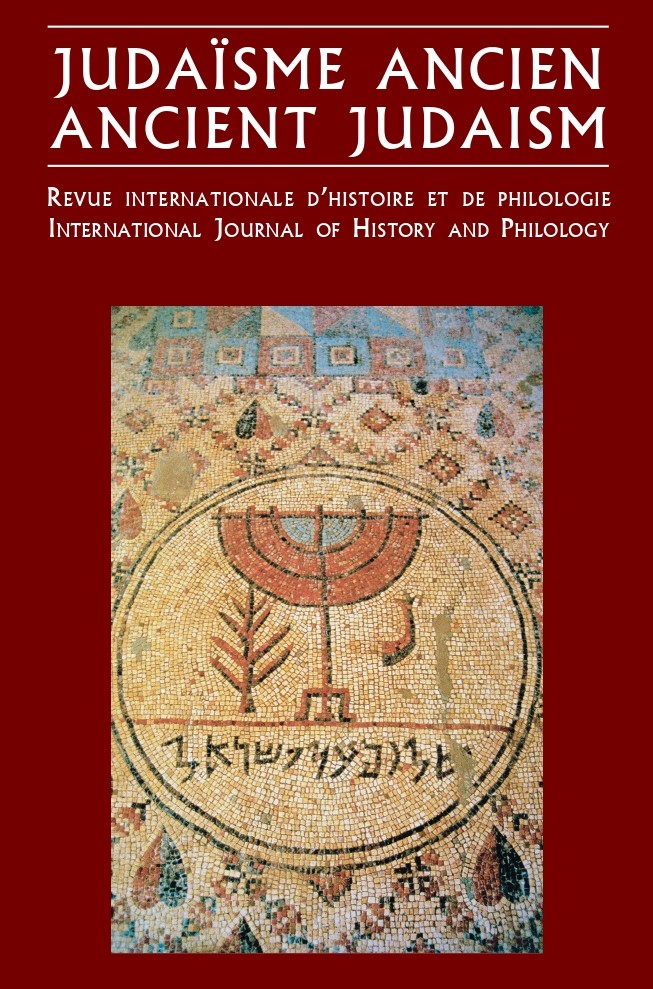
In a book published in 2012, Le judaïsme ancien du VIe siècle avant notre ère au IIIe siècle de notre ère. Des prêtres aux rabbins, Simon Claude Mimouni suggested a new model on Palestinian Judaism after 70, defining three Judaisms : rabbinic, Christian and synagogal. The present article deals with this new hypothesis of a third, synagogal Judaism. It goes back over the sources of this hypothesis, insisting notably on the important role of Goodenough and his followers, and intends to clear up its relation to other recent historiographical models. It tries to refute the counter-arguments that are likely to be raised against this hypothesis, using essentially rabbinic literature, but also archaeology and epigraphy. It shows how the synagogal hypothesis helps to give a better understanding of a number of issues tackled by rabbinic literature (Jewish binitarism, relations between light, emanation and hypostasis, Jewish deviance, biblical canon and translation of the Bible into Greek, qedusha prayer, circumcision and patriarch). It finally opens up new prospects on some points of the hypothesis, which is still under construction : the sources of synagogal Judaism, its two components, Aramaic and Hellenist, the role of priests, the period that goes before 70 and the Diaspora, mysticism and messianism.
AbstractDans un ouvrage paru en 2012, Le judaïsme ancien du VIe siècle avant notre ère au IIIe siècle de notre ère. Des prêtres aux rabbins, Simon Claude Mimouni a proposé un nouveau modèle sur le judaïsme palestinien d’après 70, celui des trois judaïsmes : rabbinique, chrétien et synagogal. C’est sur cette hypothèse d’un troisième judaïsme, qualifié de synagogal, que porte notre article. Il retrace les sources de cette hypothèse, en insistant notamment sur l’importance de E.R. Goodenough et de ses disciples, et tente de la situer par rapport à d’autres modèles historiographiques récents. Il s’efforce de lever les obstacles qu’elle est susceptible de rencontrer, essentiellement à partir de la littérature rabbinique, mais aussi de l’archéologie et de l’épigraphie. Il s’attache aux questions, abordées notamment au sein de la littérature rabbinique, que l’hypothèse synagogale contribue à mieux éclairer (le binitarisme juif, le motif de la lumière et le couple émanation/ hypostase, les déviances juives, le canon biblique et la traduction de la Bible en grec, la prière de la qedusha, la circoncision et le patriarche). Il ouvre enfin des perspectives sur certains aspects de l’hypothèse encore en élaboration : les sources du judaïsme synagogal, ses deux composantes araméenne et helléniste, le rôle des prêtres, la période d’avant 70 et la Diaspora, la mystique et le messianisme.