


Brepols
Brepols is an international academic publisher of works in the humanities, with a particular focus in history, archaeology, history of the arts, language and literature, and critical editions of source works.241 - 260 of 3194 results
-
-
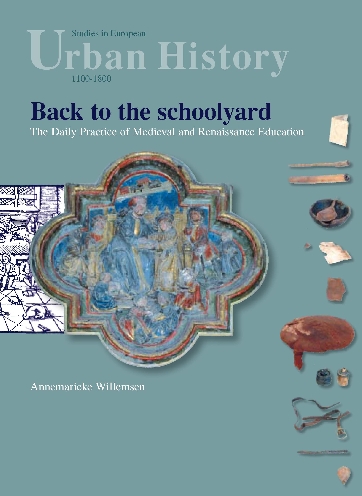
Back to the Schoolyard
The Daily Practice of Medieval and Renaissance Education
show More to view fulltext, buy and share links for:Back to the Schoolyard show Less to hide fulltext, buy and share links for: Back to the SchoolyardAfter about 1300, most schools in the Netherlands came under secular rule. It managed to create good and accessible schools, causing a hey-day for education in the fourteenth, fifteenth and sixteenth century. As a result, more than half of the children participated in basic instruction and literacy rate went relatively high. A contemporary Italian visitor noted with awe that ‘in the Low Countries everybody could read and write, even the peasants’. In the sixteenth century, the curriculum changed because of the Reformation and the availability of printed texts. In this book, the favourable situation in the Netherlands is compared with the rest of Western Europe.
Medieval and Renaissance schools have been studied before, but never from the perspective of those who experienced it on a daily basis. Recent excavations on the sites of late-medieval schools and boarding houses revealed the objects used by pupils and teachers for reading, writing, mathematics, and school life in general. Combining those finds with texts and hundreds of depictions of school scenes in manuscripts, frescoes, sculpture, stained glass and early prints, the practice of education could be reconstructed. The book gives a detailed overview of the material school culture, allowing a rare glimpse into a late-medieval classroom.
Dr. Annemarieke Willemsen (1969) is art historian and archaeologist and works as curator of the medieval department of the National Museum of Antiquities at Leiden. Earlier she published books on Roman and medieval children’s toys and on the Vikings in the Netherlands.
-
-
-
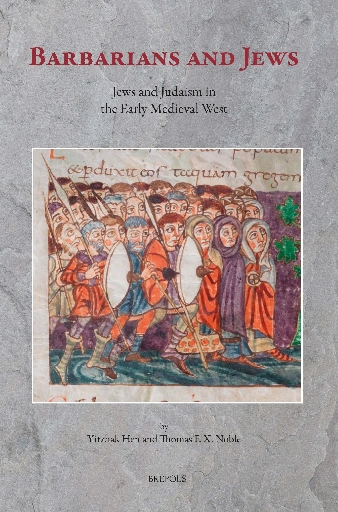
Barbarian and Jews
Jews and Judaism in the Early Medieval West
show More to view fulltext, buy and share links for:Barbarian and Jews show Less to hide fulltext, buy and share links for: Barbarian and JewsThe essays in this volume attempt to re-evaluate, understand and explain various aspects of Jewish history within the broader historical context of the post-Roman Barbarian world. They address a wide variety of topics, sources, and geographies, and together they provide a nuanced and more balanced history of the Jews in the early medieval West. Although written independently of one another by some of the most prominent historians of Late Antiquity and the early Middle Ages, the various essays collected here reveal a remarkable tension between the ‘imaginary’ (or ‘hermeneutical’) Jew and the ‘real’ one. As this volume demonstrates, Augustine’s positive theological understanding of Jews and Judaism was often overshadowed by anti-Jewish sentiments, and consequently anti-Jewish invective remained the drive wheel of Christian theology, especially in the context of debates and polemics among the Christians themselves.
-
-
-
Bassit 2 (Syrie) - Fouilles Paul Courbin (1971-1984)
Le tell du xvi e siècle av. J.- C. au vi e siècle ap. J.- C.
show More to view fulltext, buy and share links for:Bassit 2 (Syrie) - Fouilles Paul Courbin (1971-1984) show Less to hide fulltext, buy and share links for: Bassit 2 (Syrie) - Fouilles Paul Courbin (1971-1984)À 50 km au Nord de Lattaquié, le site côtier de Bassit a été étudié sous la direction de Paul Courbin : après l’acropole (1971-1972) (périodes hellénistique et romaine), et la nécropole du Fer (1973-1974), le « tell » a été fouillé de 1972 à 1984. Sont présentés ici une description détaillée de la stratigraphie et de l’architecture du « tell », des ensembles céramiques associés, ainsi que le corpus du mobilier datant du Bronze Récent I et II. Bassit est installé aux marges Nord du royaume d’Ougarit à partir du milieu du xvi e s. av. J.-C.. Les importations chypriotes sont nombreuses durant tout le Bronze Récent, mais la céramique égéenne apparaît très rare. Le site est détruit bien avant le passage des « peuples de la mer » (vers 1200). À l’âge du Fer, la fonction constante de Bassit est de contrôler l’accès maritime depuis Chypre et le cabotage littoral. Le commerce de la céramique chypriote domine le Fer I et II, celui des céramiques égéennes et étrusques, puis attiques, le Fer III. À l’époque hellénistique, la production d’amphores et de monnaies confirme l’identification de Posideion avec Bassit. L’époque romaine est également marquée par une importante production de céramique.
-
-
-
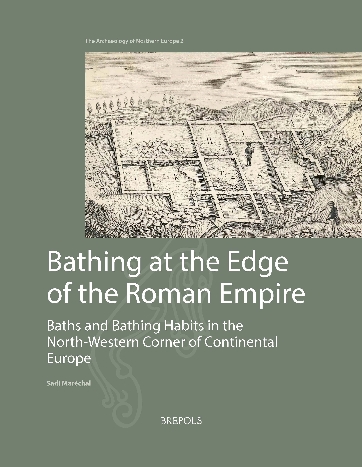
Bathing at the Edge of the Empire
Roman Baths and Bathing Habits in the North-Western Corner of Continental Europe
show More to view fulltext, buy and share links for:Bathing at the Edge of the Empire show Less to hide fulltext, buy and share links for: Bathing at the Edge of the EmpireRoman bathhouses are considered to be prime markers when studying romanization in the provinces of the Empire, as these very specific - and archaeologically recognizable - buildings, together with their associated ideas about the body and personal health, introduced a decidedly Roman habit into regions that had hitherto been unfamiliar with (communal) bathhouses and heating technology. While traditionally, studies into Roman baths and bathing have focused on large public baths in the cities of the empire, however, those from the area that now roughly corresponds to modern-day Belgium have often been neglected in recent research as this was an area with few important urban centres.
This book for the first time investigates the introduction, spread, and eventual disappearance of Roman-style baths and of bathing habits in this north-western corner of the Roman Empire. A detailed analysis of the architecture, technology, and decoration of both public and private baths is combined with a discussion on the role of bathing in the area’s romanization, and supplemented by a fully illustrated catalogue of all bathhouses in the area of study. In doing so, the volume sheds new light not only on the evolution of baths and bathing in this region, but also on their broader role in larger historic processes such as cultural change across the Empire.
-
-
-
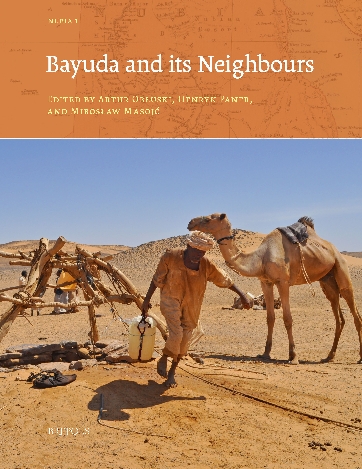
Bayuda and its Neighbours
show More to view fulltext, buy and share links for:Bayuda and its Neighbours show Less to hide fulltext, buy and share links for: Bayuda and its NeighboursThe Bayuda, although an arid desert located in modern-day Sudan, has nonetheless been inhabited, farmed, worshipped in, and fought over by humans from the Palaeolithic onwards. Yet despite the longevity of its human occupation, the region has only in recent years become the focus of more intensive scholarly research. This volume, the first in a series dedicated to exploring the archaeology and history of Northeast Africa, aims to build on this trend by drawing together the very latest archaeological research and data, and shedding light on how the Bayuda Desert and its environs were transformed into a cultural landscape. The contributions gathered here introduce, examine, and (re)assess a number of important issues, many of which are new in the archaeology of Nubia, as well as considering them against a broader comparative background. From climate change over the past millennia - and its far-reaching consequences in the present - through to an examination of the cultural influences of the Kingdom of Kerma, and from analysis of funeral rites through to interpretations of rock art, forgotten trade routes, and the commerce in cattle and slaves, this insightful volume offers a wealth of new information into the history of ancient Nubia.
-
-
-
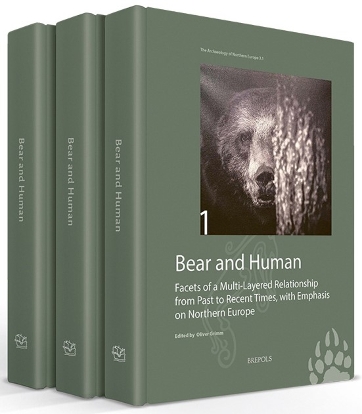
Bear and Human
Facets of a Multi-Layered Relationship from Past to Recent Times, with Emphasis on Northern Europe
show More to view fulltext, buy and share links for:Bear and Human show Less to hide fulltext, buy and share links for: Bear and HumanBears have, throughout human history, been admired and feared by humans in equal measure, with an interrelationship between the two species identifiable from pre-modern times through a wealth of material items, as well as from cult sites, sacral remains, images, and written sources. This unique interdisciplinary volume draws together sixty-four contributions by experts from across a range of fields in order to shed light on the complex connections between bears and humans in a period extending from the pre-modern into modern times, and across an area stretching from England into Russia. From bear biology (represented by work from the Scandinavian Brown Bear Research Project) and archaeo(zoo)logy to art history, and from history of religion to philology, the research gathered across this three-volume set explores a wide-range of subjects. Among them are the bear in biology, bears and animal agency, bear remains in graves and churches, the role of bears in religious beliefs (including berserker and bear ceremonialism), bears in literature, the philology underpinning why bear is a taboo word, and the image of the bear in rock art, as well as political iconography up to the present day. Together, these wide-ranging but closely thematic texts combine to produce a ground-breaking new work that will prove fundamental in understanding the human connection with this remarkable animal.
-
-
-
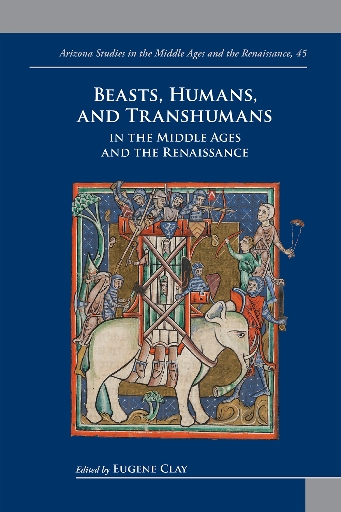
Beasts, Humans, and Transhumans in the Middle Ages and the Renaissance
show More to view fulltext, buy and share links for:Beasts, Humans, and Transhumans in the Middle Ages and the Renaissance show Less to hide fulltext, buy and share links for: Beasts, Humans, and Transhumans in the Middle Ages and the RenaissanceFrom shape-shifting Merlin to the homunculi of Paracelsus, the nine fascinating essays of this collection explore the contested boundaries between human and non-human animals, between the body and the spirit, and between the demonic and the divine. Drawing on recent work in animal studies, posthumanism, and transhumanism, these innovative articles show how contemporary debates about the nature and future of humanity have deep roots in the myths, literature, philosophy, and art of the Middle Ages and the Renaissance. The authors of these essays demonstrate how classical stories of monsters and metamorphoses offered philosophers, artists, and poets a rich source for reflection on marriage, resurrection, and the passions of love. The ambiguous and shifting distinctions between human, animal, demon, and angel have long been contentious. Beasts can elevate humanity: for Renaissance courtiers, horsemanship defined nobility. But animals are also associated with the demonic, and medieval illuminators portrayed Satan with bestial features. Divided into three sections that examine metamorphoses, human-animal relations, and the demonic and monstrous, this volume raises intriguing questions about the ways humans have understood their kinship with animals, nature, and the supernatural.
-
