Brepols Online Books Medieval Monographs Archive v2016 - bobar16mome

Collection Contents
8 results
-
-
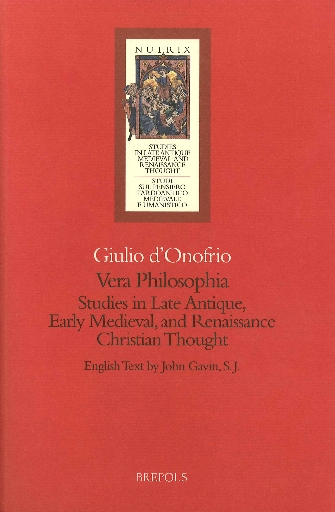
Vera philosophia
show More to view fulltext, buy and share links for:Vera philosophia show Less to hide fulltext, buy and share links for: Vera philosophiaThis volume includes a collection of reworked articles which the author, during the last twenty years, dedicated to the origins and conditions constitutive of Christian philosophical-theological thought. From the earliest centuries of the Christian era, human reason was submitted to a particular formal conditioning, in so far as it was necessarily obliged to confront the contents of a divine revelation recognized as necessarily ‘true’. The medieval Latin scholar was induced by the social and cultural peculiarities of his time to confront a model of thought which imposes a decisive subordination of natural knowledge - demonstrated to be imperfect and inconclusive - to the certainties assured by the faith. The production of this model of philosophia, significantly different from the dominant paradigms in the classical period, rooted itself in the critical redimensioning of reason which Cicerointroduced into the West. Departing from the observation of the failure of the philosophical aspirations of antiquity, the Christian intellectuals effected an operative ‘overturning’ of the conditions of veridical knowledge.
The new wisdom was not entirely the result of religion interfering in the field of rational science, but it was shaped by a conscious ‘conversion’ of the philosophers and reached fulfillment under two principles: faith, which requires earthly knowledge in order to defend itself from misunderstandings and heresies; and reason, which allows itself to draw upon supernatural revelation for the possession of regulatory principles which guide it in the study of natural things.
This book investigates the development of this approach during the course of the centuries which in the West precede the rediscovery of Aristotelian epistemology: from Augustine to Boethius, from John Scottus Eriugena to Anselm of Aosta. It concludes by describing the return of this methodological approach, at the end of the Medieval Scholastic period, in the results of the anti-Aristotelian critique carried out by the men of the Renaissance through the recovery of a model of thought which had dominated in the Patristic and Early Medieval periods.
-
-
-
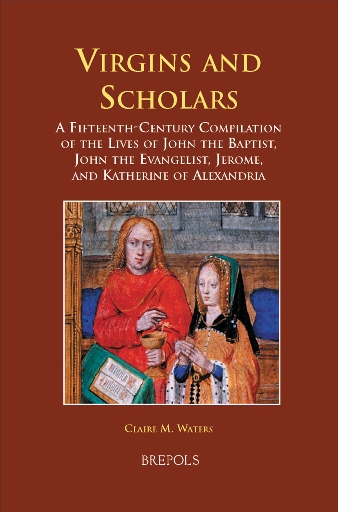
Virgins and Scholars
show More to view fulltext, buy and share links for:Virgins and Scholars show Less to hide fulltext, buy and share links for: Virgins and ScholarsThis collection of prose vitae of four virgins and scholars - Saints John the Baptist, John the Evangelist, Jerome, and Katherine of Alexandria - was almost certainly copied, and the texts very likely composed, at Syon Abbey or Sheen Charterhouse in the mid-fifteenth century. The lives cover a wide range of hagiographic modes, from hagiographic romance to affective, devotional appreciation to doctrinal treatise in narrative form. From the life of Jerome, composed by a monk for his aristocratic spiritual daughter, to the life of Katherine, reputedly translated for Henry V, to those of John the Baptist and John the Evangelist, which set their subjects in a recognizably Birgittine context, they show the interaction of men and women, lay and monastic, in the production of devotional literature. The diversity of their approaches and sources, moreover, shows the links between English dynastic politics and continental religious literature and spiritual traditions. As examples of translation practices, of monastic politics, and of religious instruction, these lives provide a window onto the devotional culture and literary worlds of fifteenth-century Europe.
-
-
-
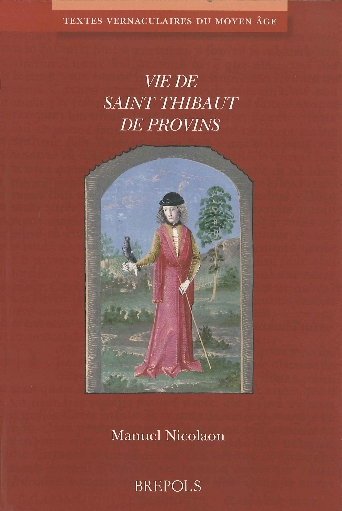
Vie de saint Thibaut de Provins
show More to view fulltext, buy and share links for:Vie de saint Thibaut de Provins show Less to hide fulltext, buy and share links for: Vie de saint Thibaut de ProvinsComment l’histoire si édifiante d’un jeune chevalier champenois du 11ème siècle qui, pour le seul amour de Dieu, délaisse pouvoir, famille et richesses et devient successivement ermite itinérant, pèlerin, prêtre et saint a-t-elle pu être écartée des fameuses compilations de vies de saints en français de la fin du Moyen Age et ainsi finalement tomber dans l’oubli ?
Bien sûr, la Vie de saint Thibaut de Provins n’est pas de ces textes qui mettent en évidence une figure emblématique ou des règles fondatrices de la religion chrétienne ; mais elle est loin cependant d’être une simple légende locale, et son intérêt réside sans aucun doute autant dans le caractère exemplaire de la vie qui est montrée que dans la valeur plus littéraire du récit qui, par le jeu de l’intertextualité, semble progressivement superposer la vie (ou plutôt la mort) de saint Thibaut à celle du Christ.
Accompagnée d’une introduction, d’une traduction, d’un appareil critique, de notes, d’un index, d’un glossaire et, en annexe, des différentes versions connues de la Vie de saint Thibaut, la présente édition souhaite ainsi permettre l’accès tant aux spécialistes de l’édition critique qu’aux amateurs de récits hagiographiques ou plus généralement d’histoire religieuse d’un texte français du 13ème siècle jusqu’alors inédit, dont la brièveté rend l’originalité et l’intérêt littéraire d’autant plus saillants.
-
-
-
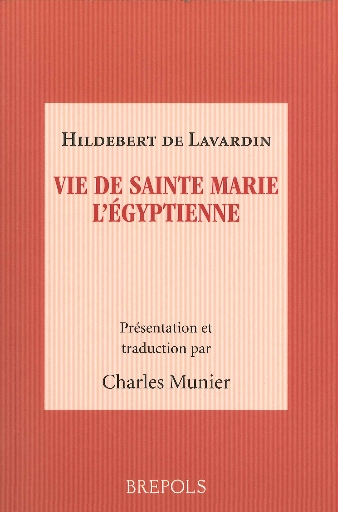
Vie de sainte Marie l'Egyptienne
show More to view fulltext, buy and share links for:Vie de sainte Marie l'Egyptienne show Less to hide fulltext, buy and share links for: Vie de sainte Marie l'EgyptienneHildebert de Lavardin, évêque du Mans (1096-1125), puis archevêque de Tours (1125-1133), l’auteur de la Vita beate Marie Egyptiace, dont nous donnons ici la première traduction française, fut l’une des figures littéraires les plus importantes du Moyen Age: pendant plusieurs générations ses vers furent lus avec plaisir dans toute l’Europe occidentale; ses lettres servirent de modèles dans les écoles cathédrales et monastiques, pour leur élégance et leur noble distinction, et ses traités de philosophie morale et de droit canonique devinrent des manuels universellement appréciés.
La légende de Marie l’Égyptienne, compte parmi les figures du Moyen Age les plus connues et les plus vénérées de celles qui illustrent l’influence salutaire de Notre-Dame sur les plus grands pécheurs; elle a contribué pour une part nullement négligeable au développement du culte marial qui prend son essor définitif en Occident partir de l’époque carolingienne. Marie l’Égyptienne n’est pas seulement l’héroïne d’une parabole « évangélique », mais le personnage-clé d’un drame de la plus brûlante actualité : non seulement elle incarne en sa personne l’aspiration du monde féminin à rejoindre le mouvement des nouveaux ermites de l’époque d’Hildebert, mais elle intervient, en sa qualité d’ermite, pour donner des conseils au monde monastique. Le texte prend place dans la grande discussion de l'époque d'Hildebert sur la hiérarchie des vocations monastiques et leurs mérites respectifs, et sur les origines érémitiques du monachisme chrétien.
-
-
-
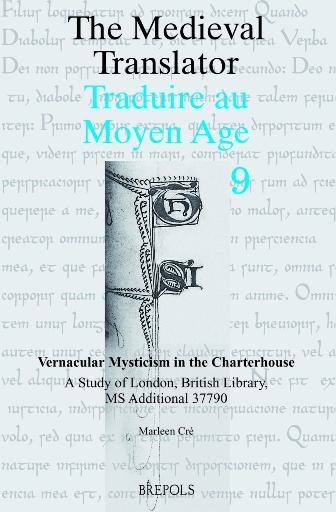
Vernacular Mysticism in the Charterhouse
show More to view fulltext, buy and share links for:Vernacular Mysticism in the Charterhouse show Less to hide fulltext, buy and share links for: Vernacular Mysticism in the CharterhouseThe first monograph to appear in The Medieval Translator series, Vernacular Mysticism in the Charterhouse presents a study of London, British Library, MS Additional 37790 (Amherst), a purpose-built anthology of major mystical texts by Richard Rolle, Julian of Norwich, Jan van Ruusbroec and Marguerite Porète, interspersed with shorter texts and compilations. Though the manuscript is famous mainly because it contains the only extant copy of Julian of Norwich's short text, it is an intriguing witness to the fifteenth-century spread of the vernacular into traditionally Latinate environments, in this case the Carthusian Order in England. In this process of transmission, translation plays a central part. Most of the texts in the anthology are translations from Latin or French into Middle English. In addition, the anthologist's selection and ordering of texts within the volume, intended to further the readers' spiritual lives, translates them anew for his intended audience. This study provides finely detailed analyses of the texts in the textual and material context of the Amherst anthology as well as in their religious and historical contexts. It also offers a first-time edition of Quedam introductiua extracta, a Latin compilation contained in the manuscript, and a discussion and listing of verbal marginal annotations reflecting early readers' reactions to the texts. By reading the texts in (one of) their medieval manuscript context(s), this book gives students and scholars of (translated) medieval religious texts a fresh view of the classics of mystical writing contained in the remarkable literary document that is the Amherst anthology.
-
-
-
Vincent de Beauvais et le Grand Miroir du monde
show More to view fulltext, buy and share links for:Vincent de Beauvais et le Grand Miroir du monde show Less to hide fulltext, buy and share links for: Vincent de Beauvais et le Grand Miroir du mondeLe Grand Miroir du monde, Speculum maius, est la «Grande Encyclopedie» du Moyen Age. Ce livre présente les étapes de son élaboration comme outil du studium, par Frère Vincent de Beauvais, lecteur dominicain au service de son Ordre, et par ailleurs familier du roi Louis IX. Il caractérise la documentation mise en œuvre et son évolution. Conçu d'abord en deux parties, clans un esprit proche de la pensée victorine, ( vers 1244), l'ouvrage fut ensuite remis en avancées de la nouvelle science, tributaire d'Aristote et d'al-Farabi (vers 1260). L'influence naturaliste d'Albert le Grand faisant suite á celle, exégétique, de Hugues de Saint-Cher, le Speculum maius devient ainsi une œuvre en trois parties, Speculum naturale, consacre á l'histoire naturelle selon l'ordre des six jours de la création; Speculum doctrinale, inachevé, exposant toutes les branches du savoir (trivium propédeutique, sciences pratiques, sciences mécaniques, sciences théoriques); Speculum historiale, deroulant les facta et gesta de l'humanité (histoire proprement dite, histoire littéraire et hagiographie) jusqu'au Jugement dernier, selon la vision augustinienne de l'histoire.
Des documents traduits, dont !'important prologue, Libellus apologeticus, illustrent la méthode de composition et le contenu de l'œuvre, la mettent en relation avec d'autres ecrits paralleles du XIIIe siècle et témoignent de son succès au cours des siécles.
-
-
-
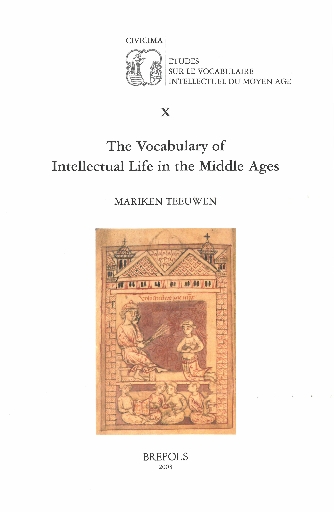
The Vocabulary of Intellectual Life in the Middle Ages
show More to view fulltext, buy and share links for:The Vocabulary of Intellectual Life in the Middle Ages show Less to hide fulltext, buy and share links for: The Vocabulary of Intellectual Life in the Middle AgesThe Latin vocabulary of intellectual life in the Middle Ages has been the focus of the CIVICIMA-series: nine volumes of conference-proceedings, monographs and collective works. The series has proved convincingly that analyses of the verbal expressions of medieval intellectual life and their precise meanings is a worthwhile and rewarding task, which sharpens and deepens our understanding of education and learning in the medieval world.
With this tenth volume the series has been brought to a conclusion. It serves as a handbook, a practical tool for finding information and material about a considerable number of key terms, which have been classified in four categories of “technical vocabulary” - terms that developed specialized meanings in the context of medieval education and learning. The first category consists of the vocabulary of schools and universities (for instance, schola, magister, universitas, etc.); the second the vocabulary of the book and book production (for instance, armarium, pecia, scriptorium, etc.); the third treats the vocabulary of teaching-methods, instruments and products of intellectual life (for instance, concordantia, disputatio, glossa, etc.); the fourth the names of the disciplines, their teachers and students (for instance, artes liberales, canonista, decretista, theologia, etc.).
Terms from these four categories are treated, either individually or in groups coherent with respect to content, in short and uniform articles. Their medieval meanings are described, together with their origins, their classical meanings, their semantic development, and the historical or regional differences in meaning.
-