


Antiquité Tardive - Late Antiquity - Spätantike - Tarda Antichità
Revue Internationale d'Histoire et d'Archéologie (IVe-VIIIe siècle)
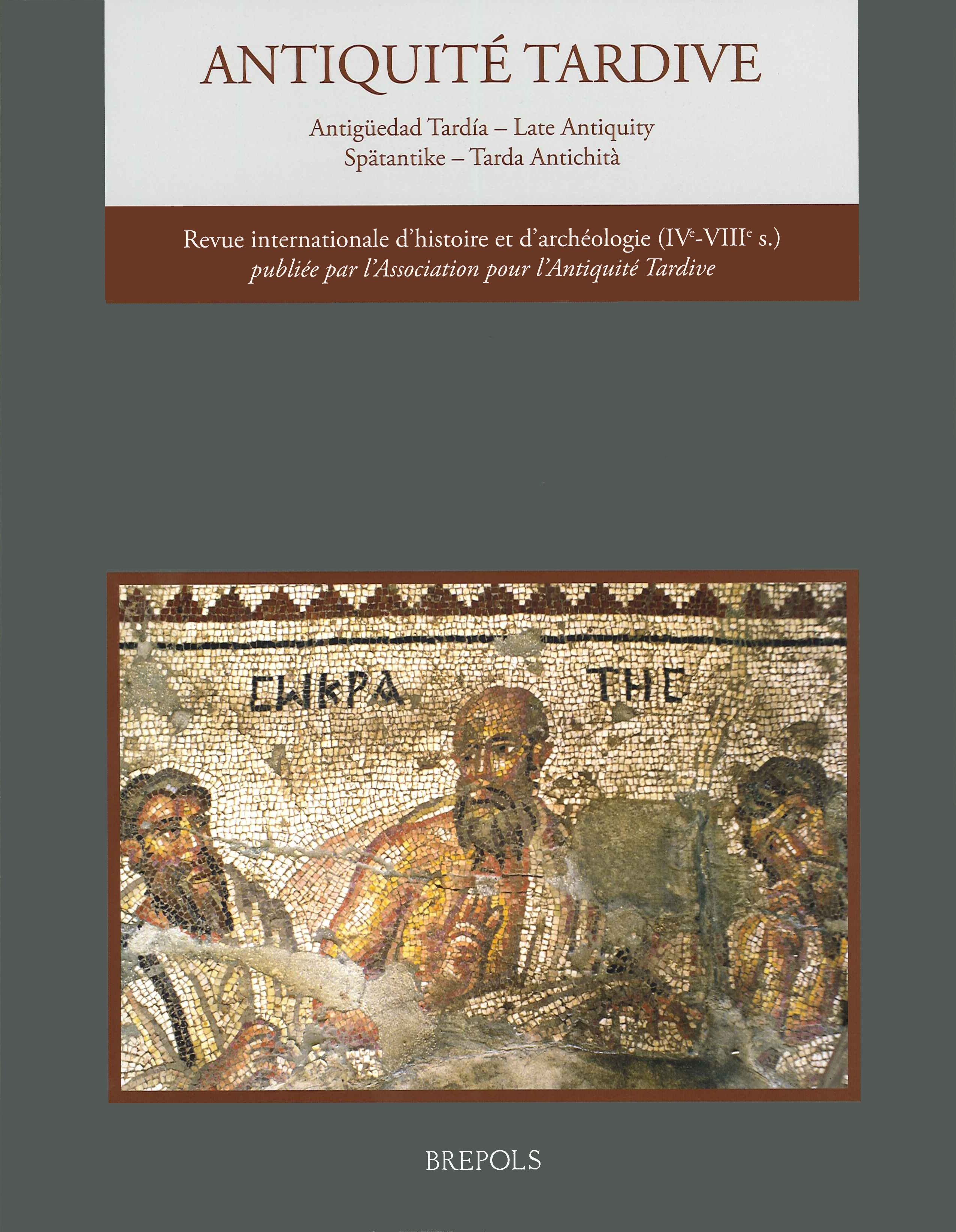
Volume 16, Issue 1, 2008
-
-
Front Matter (“Title page”, “Principales abbreviations”, “Table of contents”, “Editorial”, “Editorial board”)
show More to view fulltext, buy and share links for:Front Matter (“Title page”, “Principales abbreviations”, “Table of contents”, “Editorial”, “Editorial board”) show Less to hide fulltext, buy and share links for: Front Matter (“Title page”, “Principales abbreviations”, “Table of contents”, “Editorial”, “Editorial board”)
-
-
-
La Hispania de Teodosio: 379-395 AD
show More to view fulltext, buy and share links for:La Hispania de Teodosio: 379-395 AD show Less to hide fulltext, buy and share links for: La Hispania de Teodosio: 379-395 ADBy: J. ArceAbstractThe article is a study of the historical and archaeological aspects of the Dioecesis Hispaniarum during the reign of Theodosius I, and the eventual relations between the Emperor and his native country. The so called “circle of pious Spaniards” and their influence in religious or political decisions of Theodosius, seems very tenuous and some ideas maintained by some scholars about Theodosius as a “Spaniard” are clearly anachronistic. A case of study is the villa of Carranque (prov. Toledo), identify by some historians and archaeologists as the residence of Maternus Cynegius and his tomb. The villa has been used as a proof of the links between the Emperor and his pious Spanish entourage. However, there is no serious evidence, nor in the archaeological record nor from historical grounds, for maintaining the identification of the owner of the villa with the PPO of Theodosius. One of the most interesting documents of the period is the inscription of Siresa (prov. Huesca) that is evidence of the administrative reforms of Magnus Maximus in the Peninsula during his usurpation. The spread of priscillianism among the urban aristocracies and bishops and clergy is one the main features of Hispania during this period, contrasting with the currently claimed orthodoxy of theodosian Spain.
-
-
-
Végèce et les transformations de l’art de la guerre aux ive et ve siècles
show More to view fulltext, buy and share links for:Végèce et les transformations de l’art de la guerre aux ive et ve siècles show Less to hide fulltext, buy and share links for: Végèce et les transformations de l’art de la guerre aux ive et ve sièclesBy: S. JanniardAbstractA recent approach of Vegetius’s Epitoma rei militaris — to which the integrality of this study is devoted — tries “to restore to favour” its author, but, in the same time, brings discredit on the work as a source of knowledge for the late Roman art of war, and thus creates an useless tension between the historical and the prescriptive aspects of the text. The author rather thinks that the Epitoma is a well-ordered collection of practices, meant to be applicable. The opposition, placed at the heart of the matter, between the limited and perhaps purely empirical knowledge of the Emperor and his advisers on the one hand, the supposed universal aptitude of the compiler on the other hand, finds a way to be solved by the rewording of multiple and polygenetic experiments, using the literary criteria of the artes militares. It is thus its capacity to write a clear synthesis that Vegetius seeks to promote, maintaining however a clear distinction between the literary models, the only way for the expression of a recognized knowledge, and the applicable standards. Two methodological precautions should make it possible to restore to the Epitoma all its significance. First, a constant attention to the global organization of the text. For instance, it seems obvious that the point of view changes radically between book II and III, which is the compendium of an applicable military knowledge, written for a commander. Second, a precise comparison between the text of the Epitoma and the whole of the literary, documentary and archaeological sources on the late Roman army, which would reveal the relevance of the information contained in the work and show the descriptive value of many chapters, in particular II, 7 or III, 14-20. The question would not be any more to know if the Epitoma could have been used as a manual for Roman officers, but to patiently determine if the standards exposed in it have chances to reflect a contemporary military reality. The present study has precisely as an aim to show the relevance of such a method and its interest for the knowledge of the practices of the late Roman infantry in some tactical and operational fields: intelligence and the preparation for battle, its various phases and its mechanism, the measures to be taken after a victory or a defeat. It is not an exhaustive study of the Epitoma rei militaris, and fields where this work could be taken at fault of confusion (the antiqua ordinatio legionis…), or of lack of originality, were deliberately left out. However, the multiple echoes that the Epitoma awake in the contemporary narrative sources and in the later technical literature show all its relevance as a source for the late Roman military history. Far from being a nostalgic compilation or a whimsical proposal, the Epitoma represents rather, with an historiographic and practical scope, a true ordered compendium of the Roman military tradition, but also of the art of war at the end of the 4th c. AD.
-
-
-
Les soldats de la garde impériale à l’époque théodosienne: le témoignage des sources religieuses
show More to view fulltext, buy and share links for:Les soldats de la garde impériale à l’époque théodosienne: le témoignage des sources religieuses show Less to hide fulltext, buy and share links for: Les soldats de la garde impériale à l’époque théodosienne: le témoignage des sources religieusesBy: R. DelmaireAbstractAfter an historical survey of the transformations which affected the Palace Guards during the ivth century, this article confronts the official denominations of the Palatine scholae (scutarii, armaturae, gentiles) with those which were in use by the Fathers (doryphoroi, hypaspistai or aspidèphoroi, hoplitai). The ecclesiastical authors mainly gave importance to the sumptuous character of the guards accoutrements and their parading function which, after the reign of Theodosius Ist, tended to completely supersede their fighting abilities and role.
-
-
-
L’Empire des Théodoses et les regna Orientis (379-450): politique militaire et diplomatie impériale à l’égard des foederati orientaux
show More to view fulltext, buy and share links for:L’Empire des Théodoses et les regna Orientis (379-450): politique militaire et diplomatie impériale à l’égard des foederati orientaux show Less to hide fulltext, buy and share links for: L’Empire des Théodoses et les regna Orientis (379-450): politique militaire et diplomatie impériale à l’égard des foederati orientauxBy: G. SartorAbstractBetween the end of the reign of Valens (377-378) and the death of Theodosius II (450), the Roman Empire, in its Pars Orientis, developed a politicy of active diplomacy towards both the realms of the Causasian area (Armenia, Iberia, Colchis), and the groups of Sarakênoi from the limes Orientis. The establishment of foedera with “barbarian States”, which were, by definition (in most cases), outside of the Empire though still under the imperial influence, was conditionned by various factors: geopolitical considerations (such as rivalries with the Persian Empire, the presence of the Huns north of the Danube, relations with the Saracenoi Blemmyes and Noubades groups on the eastern borders, military interventions of the oriental Empire in the western part in 430-440), troubles inside the Empire since the Battle of Adrianople (granted settlement of the Goths as a consequence of the Gothic War of 379-382, the effects of this situation through the first decades of the 5th century, other barbarian groups being allowed intra fines imperii), and military imperatives (fighting against the gothic inner ennemy, and restoring imperial military power, on the short- and medium-term). Despite the limitations of the sources, it is nevertheless possible to speak of foederati by proposing a nuanced definition of the term which differentiates foederati extra fines imperii from foederati intra fines imperii on the political and diplomatic level on the one hand, and which makes a distinction on the military level (according to the nature of the fighting service provided to the Romans) on the other hand, between those barbarian foederati enlisted as regular units of the imperial army, and those barbarian foederati engaged by ethnic contingents with some tactical speciality. Close analysis, however, affirms the difficulty of identifying the foederati and their various types, and the necessity of adopting a level of interpreting the sources which is cautious, adaptable, pragmatic, and which is not blindly and rigidly systematic.
-
-
-
Deux notes sur Théodose II et les Perses
show More to view fulltext, buy and share links for:Deux notes sur Théodose II et les Perses show Less to hide fulltext, buy and share links for: Deux notes sur Théodose II et les PersesBy: G. GreatrexAbstractTwo points relating to Theodosius II and relations with Persia are discussed in this article. In the first section the author returns to the subject of the guardianship supposedly exercised by the Sasanian king Yazdgerd I over the young Theodosius through the despatch of a eunuch, Antiochus, to Constantinople. Despite recently expressed doubts as to the reliability of this tradition, he argues that it is credible and notes the publication of recent relevant evidence. In the second section he turns to the much debated question of the date of the foundation of Theodosioupolis (in Armenia), arguing in detail, contrary to recent discussions of the subject, that it was indeed founded in the immediate run-up to the Romano-Persian war of 421-422, rather than during the reign of Theodosius I.
-
-
-
Rome and the Barbarians in the 5th century
show More to view fulltext, buy and share links for:Rome and the Barbarians in the 5th century show Less to hide fulltext, buy and share links for: Rome and the Barbarians in the 5th centuryBy: W. PohlAbstractCette contribution répond aux récents débats menés sur le rôle des Barbares dans la chute de l’Empire romain. Trois positions fondamentales ont été proposées. Nombre de chercheurs, aux points de vue divers, s’orientent vers le paradigme de la «transformation du monde romain» développé en partie au cours du programme européen du même nom lancé dans les années 1990. En reconnaissant la nature dramatique des événements, ils tentent de trouver l’élément décisif dans le long processus d’intégration des Barbares dans l’armée romaine comme, plus tard, de forces autonomes dans les provinces romaines. Une deuxième position «hyper-romaniste», défendue surtout par Walter Goffart, nie le rôle des Barbares et, surtout, de leurs identités ethniques dans la chute de Rome. La troisième position en revanche, plutôt néo-germaniste (ou peut-être «barbariste»), revient à un paradigme catastrophiste. Les deux contributions les plus intéressantes dans ce champ sont celles de Peter Heather et de Bryan Ward-Perkins qui, dans une polémique ouverte à l’encontre de toute idée de transformation, soutiennent que la chute de Rome a été provoquée par les victoires barbares, conduisant à la «fin de la civilisation» ancienne. L’auteur de cet article défend le paradigme transformiste. Il n’est pas possible de nier le drame des événements politiques et militaires; leur conséquence ne suffit pas toutefois à expliquer un processus de plusieurs siècles au cours duquel le monde ancien fut entièrement transformé et ce de façon assez différente entre l’Occident latin, Byzance, l’Europe slave et le monde islamique.
-
-
-
L’idée de représentativité dans les conciles théodosiens
show More to view fulltext, buy and share links for:L’idée de représentativité dans les conciles théodosiens show Less to hide fulltext, buy and share links for: L’idée de représentativité dans les conciles théodosiensBy: S. DestephenAbstractThe Church councils do not specifically belong to the Theodosian era (late 4th to mid-5th century). Their deep historical and theological roots are attested to by the 2nd to 4th century Church tradition. In 325, the emperor Constantine’s decision to summon at Nicaea all the bishops under his rule created a new kind of ecclesiastical meeting. Through its affirmed ecumenical nature, the imperial council aimed to gather the universal Church and it was meant to be extended to all Roman provinces and, to some extent, Roman dominions. The success of the council of Nicaea was almost counteracted by the inability of Constantine’s sons to manage and control both debates and decisions in the next Church councils. For twenty years (c. 360-380) all the Roman emperors avoided convening such ecclesiastical institutions whose many members made doctrinal issues more unpredictable and religious disorders more probable. From Theodosius I to his imperial descendant Pulcheria, Theodosian sovereigns reinstated Church council traditions on special occasions by getting together bishops from all the Eastern Roman Empire and even abroad. In order to promote official religious policy, resolve ecclesiastical strife, and endorse the Fathers’ legitimacy, Theodosian emperors tried to conciliate the need for Church discipline with large scale meetings. The notion of representativeness gave to them a conceptual and practical tool to keep the ideal of ecumenicism intact and to exert strong influence upon doctrinal and ecclesiastical matters. The imperial will of controlling Church councils is mainly displayed in summon letters, attendance lists, and proceedings from the councils of Constantinople in 381, Ephesus in 431 and 449, and Chalcedon in 451. In the name of representativeness restrictions were imposed on bishops’ delegations sent by any province or diocese. Chairmanship and conciliatory missions were entrusted to some eminent and loyal Fathers, while supervision was given to high civilian officials who led debates in the expected way.
-
-
-
Per una lettura della legislazione di Teodosio II. Brevi note su alcune testimonianze normative in tema di religione
show More to view fulltext, buy and share links for:Per una lettura della legislazione di Teodosio II. Brevi note su alcune testimonianze normative in tema di religione show Less to hide fulltext, buy and share links for: Per una lettura della legislazione di Teodosio II. Brevi note su alcune testimonianze normative in tema di religioneBy: L. De GiovanniAbstractThis work aims at examining in a new light the reign of Theodosius II, for a long time neglected by the historiography. In particular, the legislation of the emperor, contained in his Codex Theodosianus, appears to be extremely worthy to be studied. In this code, the legislation specifically attributed to Theodosius seems to have, most of times, the function of confirming, precising or correcting the meaning and importance of measures of previous emperors, with the scope of impressing the sign of the Theodosian politics. This confers importance to that legislation which seems to reveal the new times, frequently presenting very original features. The study should be considered only the initial phase of an overall research on the legislation of Theodosius II.
-
-
-
Teodosio I y los heréticos: la applicación de las leyes en el Libellus precum (384)
show More to view fulltext, buy and share links for:Teodosio I y los heréticos: la applicación de las leyes en el Libellus precum (384) show Less to hide fulltext, buy and share links for: Teodosio I y los heréticos: la applicación de las leyes en el Libellus precum (384)AbstractThrough the libellus precum, addressed to Valentinian II, Theodosius and Arcadius by the Luciferian presbyters Faustinus and Marcellinus (384), Theodosius could see that the laws against the heretics were being used by prevaricating bishops from both parts of the Empire to dispel the Catholics from the churches and to persecute them. The purpose of these pages is to ascertain the form taken by the perverse and fraudulent enforcement of the anti-heresy laws of Theodosius I prior to this date. Moreover, the response of Theodosius clearly indicates the prevalence of empiricism in the issue of his laws on religious questions, beyond any programmatic reason, and his capacity to make decisions of contradictory character in accordance with ecclesiastical peace and political convenience.
-
-
-
Chersonesos in the Crimea: the first christian buildings (4th-5th centuries)
show More to view fulltext, buy and share links for:Chersonesos in the Crimea: the first christian buildings (4th-5th centuries) show Less to hide fulltext, buy and share links for: Chersonesos in the Crimea: the first christian buildings (4th-5th centuries)By: L. KhroushkovaAbstractChersonèse Taurique (Chersôn des sources byzantines, à partir du vie s.) était la plus grande ville de Crimée dans l’Antiquité. La propagation du christianisme dans cette ville remonte au début du ive siècle, entraînant la construction d’une série d’églises jusqu’à la seconde moitié du ive siècle. Leur chronologie reste incertaine: la phase initiale de l’activité édilitaire des chrétiens est particulièrement obscure. C’est l’approche topographique qui nous permet de distinguer les édifices de culte chrétiens les plus anciens, des martyria, implantés dans deux cimetières. Dans le cimetière principal, situé au sud-est, un petit martyrium de plan rectangulaire abritait une tombe vénérée, probablement d’un martyr mentionné dans La passion des sept évêques de Chersôn; il a été remplacé par un martyrium cruciforme sensiblement plus spacieux, transformé à son tour en église de culte eucharistique, dotée d’un baptistère. Dans le cimetière ouest, deux hypogées, l’un de plan rectangulaire, l’autre cruciforme, appartenaient à la première phase (seconde moitié du ive-début du ve s.) du développement ultérieur. Le premier martyrium pourrait être un lieu d’enterrement de Basileos, martyr mentionné dans la Passion, mais le manque de documents épigraphiques ne permet pas de le lui attribuer. Lorsque, vers l’époque justinienne, cette partie de cimetière a été intégrée dans l’espace urbain, les anciens martyria faisaient partie du complexe de la grande basilique, centre religieux principal de l’extrémité ouest de la ville. Les tombes peintes étaient décorées de symboles paléochrétiens courants (chrismes, oiseaux, guirlandes, etc.): datant de la seconde moitié du ive siècle et de la première moitié du ve, elles répondent bien aux premiers martyria, situés dans les mêmes zones cimétériales.
Les édifices funéraires ont influé sur quelques particularités de l’espace urbain. La composition du complexe occidental a été reproduite dans celui de la «basilique est», à l’extrémité orientale de la ville. L’un et l’autre ont créé l’axe est-ouest devenu rue principale au Moyen Âge. L’église cruciforme suburbaine avait deux répliques à l’intérieur des murs: l’une, de même plan et de mêmes dimensions, était bâtie sur les restes du théâtre de l’époque romaine, tandis que l’autre occupait l’agora au centre de la ville.
Les églises urbaines du ive siècle sont mal connues, bien que l’évêque de Chersonèse ait participé au concile de Constantinople en 381. De nombreux éléments de décor en marbres de Proconnèse constituent les indications chronologiques les plus claires. Les chapiteaux composites avec acanthe dite «finement dentelée» et quelques types de chapiteaux ioniques à imposte décoraient les églises de la fin du ve siècle. Les plus éloquentes sont la basilique dite «Ouvarovskaya» (basilique épiscopale) et la basilique bâtie sur l’emplacement de la synagogue.
-
-
-
Tendances esthétiques de la poésie latine tardive (325-470)
show More to view fulltext, buy and share links for:Tendances esthétiques de la poésie latine tardive (325-470) show Less to hide fulltext, buy and share links for: Tendances esthétiques de la poésie latine tardive (325-470)By: J.-L. CharletAbstractImpregnated with the triumphalism of the reigns of Constantine and Theodosius and persuaded, also after 410, of the eternity of Rome (Roma aeterna), of the triumph of light over darkness, the late Latin poetry is characterised by the search for a point of balance between its will to adopt the classical inheritance (rhetorical, literary and ideological neo-classicism) and the expression of its Alexandrian taste (mixture of poetic genres and tones; miniaturization and fragmented composition; predisposition towards a world of metamorphosis, change and illusion; taste for spectacle and the spectacular; sophistication and art of the enigma). In general, there is no fundamental difference in aesthetic attitude between pagan and Christian poets (contra R. Herzog); every poet, in his own way, strove for a balance between neo-classicism and neo-alexandrianism within the triumphal expression of contemporary ideology. But, for the true Christian, poetic activity became a spiritual act, a form of divine worship, and the poem itself an offering to God; he accepted the poetic tradition in order to convert it and devote it to his spiritual purpose.
-
-
-
La vida de Pertinax y el manuscrito Pal. lat. 899
show More to view fulltext, buy and share links for:La vida de Pertinax y el manuscrito Pal. lat. 899 show Less to hide fulltext, buy and share links for: La vida de Pertinax y el manuscrito Pal. lat. 899By: M. Mayer i OlivéAbstractA new critical reading of Historia Augusta’s Vita Pertinacis bears out the importance of the codex Palatinus Latinus 899 from the Vatican Apostolic Library for the establishment of the Historia Augusta text and its tradition. This article proposes some corrections to the text and state new considerations on this complex historical problem. Finally, we make some remarks on the additions to the text made by Petrarca’s hand.
-
-
-
Une lecture religieuse des invectives de Claudien est-elle possible?
show More to view fulltext, buy and share links for:Une lecture religieuse des invectives de Claudien est-elle possible? show Less to hide fulltext, buy and share links for: Une lecture religieuse des invectives de Claudien est-elle possible?By: St. RattiAbstractA recent work has proposed to literary reading of Claudian’s invectives, but this seems excessively restrictive. Indeed, In Rufinum and In Eutropium were drafted at a time when relations between pagans and Christians were polemical to such an extent Claudian could not have absolutely avoided current events, for he was himself a convinced heathen. In this connection Claudian’s poetry seems to show characteristics in common (although expressed with less acrimony) with the religious message which authors like Servius or Rutilius Namatianus were trying to circulate. A glance to the carm. min. 27 on the Phoenix shows that the poet had never given up disputing against Christians. Thus, a passage of In Rufinum (265-267) finds a new interpretation. One must of course raise the issue of several verses in Claudian’s work which seem to be biblical, but these were probably intended in an ironic or polemical way. An analysis of a passage of In Eutropium (2, 288-303) also requires a politico-religious reading of the omen connected with Cybele. Religious issues, which were reinforced by political disputes, appear to be the heart of In Eutropium. On this matter, however, the hypothesis according to which Claudian was an inspiration for the Historia Augusta should be reversed. In fact, it was the other way around, and Claudian actually shares with the author of the Historia Augusta a deep distrust of Constantinople, the Christian capital of the Empire. The study reveals many ideological affinities between Claudian and contemporary pagan authors, and argues for a religious reading of the poet’s invectives.
-
-
-
La première cathédrale de Zadar
show More to view fulltext, buy and share links for:La première cathédrale de Zadar show Less to hide fulltext, buy and share links for: La première cathédrale de ZadarBy: N. JakšićAbstractRelying on the historical description in Constantine Porphyrogenitus’ text (10th century) as well as on the incomplete archaeological researches, the author tries to describe the original building which preceded the construction of the romanesque cathedral of Zadar built through the 12th and the 13th century. On the basis of Porphyrogenitus’ description one can conclude that the building was a basilica with galleries above the lateral aisles, that its floor was decorated with rich mosaics and that some other parts of the building were painted, too. The author suggests a new interpretation of Porphyrogenitus’ syntagm xylographia archaia which would refer to the painted ceiling or the painted beams as proved in the 9th century architecture in Zadar (fig.3). Although very few, the remains of the mosaics in the lateral aisles show the basic ground plan of the carpets. There was a series of 11 identical motives in each of the aisles (fig.2) which directs us to the conclusion that there were 11 bays of the original building.
The cathedral was built in the vicinity of the Forum, leaning on the northern side of the back of the former tabernae. It integrated itself completely into the urban matrix of the Roman city so that its consignatorium occupies the space of three former tabernae while the baptistry occupies the space of the other two (fig.5). In the archaeological researches in today’s sacristy, i.e. in the former consignatorium, a 5th century mosaic floorboard with deer was discovered (fig.9), while below there is a monochrome mosaic floorboard. This earlier mosaic is the floorboard of a room that was made by joining the three former tabernae and it had a subsellium in the eastern part of the building. So this was Zadar’s first christian place of worship which was transformed into the consignatorium of the monumental cathedral after it was built during the 5th century. Its northern wall has been completely preserved (today this is the wall that divides the sacristy from the cathedral), as well as the stone gutter for rain water at the height of 6m which also belonged to it (fig.8). Thus it is possible to reconstruct the entire primitive church building of Roman Jader (Zadar) (fig.6). The history of the first christian community in Zadar is not known. The oldest cult building was built in the middle of the city, in the vicinity of the Forum. Thus one may conclude that the city government provided a space for the gathering of the christian community and that this may have happened not earlier that at the time of Theodosius I, when christianity became the official state religion.
-
-
-
La vaisselle d’argent à l’époque théodosienne: «renaissance classique» ou fin de l’art antique?
show More to view fulltext, buy and share links for:La vaisselle d’argent à l’époque théodosienne: «renaissance classique» ou fin de l’art antique? show Less to hide fulltext, buy and share links for: La vaisselle d’argent à l’époque théodosienne: «renaissance classique» ou fin de l’art antique?By: Fr. BaratteAbstractThe production of silver dishware is particularly well-known for the Theodosian period. Furthermore, a few such objects may be dated with considerable precision (which is rare), such as the missorium of Theodosius and the casket of Projecta. Moreover, recent challenges to the precise dating of these objects lack a solid basis. These two pieces may thus be used as points of departure for several observations on silver dishware from the late 4th and early 5th century. One may notice that many works based on new aesthetic principles which appear at the end of Antiquity, more oriented toward graphic effects and schematic compositions, rather than volume and depictions of space. The development of niello is a result of these sensitivities. In other objects, not only does one still find a traditional iconographic repertory, but also in their mode of manufacture can be seen, to a certain extent, elements of an art inherited from Hellenism. Yet there is no real “renaissance” in the production of silver dishware in this period, as is often asserted, since on the one hand we find these aesthetic sensibilities throughout the 4th century, and even after; and on the other hand, since the two tendencies are contemporary, not successive, and seem to have been appreciated by the same amateurs. Finally, among the reliefs which are in Classical tradition, the style is far from being homogeneous: Late Antiquity’s production of silver dishware is characterized above all by its diversity.
-
-
-
La pseudo «renaissance théodosienne» dans l’art de l’Antiquité tardive
show More to view fulltext, buy and share links for:La pseudo «renaissance théodosienne» dans l’art de l’Antiquité tardive show Less to hide fulltext, buy and share links for: La pseudo «renaissance théodosienne» dans l’art de l’Antiquité tardiveBy: J.-P. CailletAbstractWe here reconsider the idea of a “Theodosian Renaissance”, characterised by Ernst Kitzinger chiefly as the return to a kind of new classicism — including some alterations, of course — after a true crisis of Graeco-Roman art whose paroxysm would have occured during the Tetrarchic and Constantinian periods. But the evidence of several realizations of these decades, and a more objective look on other ones frequently invoked, determine a different interpretation. The classical spirit was not at all out of fashion around 300; and, regarding the general trend at least, it is rather a slow and progressive evolution, begun a long time ago, which led without any actual break to what was going to prevail about one century later.
-
-
-
Les Juifs et la cité. Pour une clarification du statut personnel des juifs de l’Antiquité tardive à la fin du royaume de Tolède (ive-viie siècles)
show More to view fulltext, buy and share links for:Les Juifs et la cité. Pour une clarification du statut personnel des juifs de l’Antiquité tardive à la fin du royaume de Tolède (ive-viie siècles) show Less to hide fulltext, buy and share links for: Les Juifs et la cité. Pour une clarification du statut personnel des juifs de l’Antiquité tardive à la fin du royaume de Tolède (ive-viie siècles)Authors: C. Martin and C. Nemo-PekelmanAbstractThe evolution of the personal status of Jews in the post-classical Roman and Visigothic law should be read within the scope of the general history of the juridical situation of persons at the same period. From the 4th to the 6th century, Jews were Roman citizens benefiting from the essential aspects of civil legal capacity; their status presenting no juridical originality contrary to what has often been stated. The fact by which a certain number of Jews, in certain places, at certain times, have received privileges, leads in no way to signify they were given a singular status, a notion resulting from a misunderstanding of the proper definition of privilege. It is only at the very end of the 7th century in the Visigothic world that Jews will lose their ingenui status by a measure that will abase them to slavery. This event, unprecedented in the history of Jews in the Western world, was brought forth in a context in which the status of freemen was becoming fragile throughout society.
-
-
-
Le préfet du prétoire Vitalianus et le tarif de la livre d’or
show More to view fulltext, buy and share links for:Le préfet du prétoire Vitalianus et le tarif de la livre d’or show Less to hide fulltext, buy and share links for: Le préfet du prétoire Vitalianus et le tarif de la livre d’orBy: A. HosteinAbstractTwo ancient graffiti engraved on a famous gold coin from the Beaurains hoard reveal the name of a new praetorian prefect of Constantine, called Vitalianus, and probably enable to calculate the official price of gold libra between 310 and 315 AD.
-
-
-
Fiscalité impériale et finances municipales au ive siècle
show More to view fulltext, buy and share links for:Fiscalité impériale et finances municipales au ive siècle show Less to hide fulltext, buy and share links for: Fiscalité impériale et finances municipales au ive siècleBy: G. BransbourgAbstractFor a long period of time, it has been maintained that the later part of the history of the Roman Empire was characterized by the progressive rise of imperial absolutism, at the expense of the liberties traditionally enjoyed by the Mediterranean cities. The bleak situation depicted by the Codes regarding taxation and the authoritarian behavior of the imperial bureaucrats reinforced by the depressing testimonies issued by Libanios or Lactantius led classic and modern historiography to use rare and dubious indices — all in all, two Julian’s decrees, one sentence by Ammianus and one by Libanios — to conclude that the central State had destroyed civic autonomy during the reigns of Constantine or Constance II by seizing municipal properties and incorporating them into its own domains. Although cities had lost part of their previous financial capacity by the end of the 4th century, some recent studies have challenged the confiscation scenario. This leads to a contradiction that requires a completely renewed approach of that historiographic hurdle.
What most likely happened is a very different set of events. The classical civic model had been relying for centuries on the financial responsibility of landed elites who could seize most of the ancient economies’ surpluses in return for bearing the costs and responsibilities of ruling them. This is why we will be able to prove that civic lands and taxation were across the classical world characterized by a very low yield of return. As Rome turned into an Empire of citizens, increasing internal economic pressure and more efficient external enemies gradually exposed the shortcomings of that system and led the energetic emperors who ruled from Aurelian to Diocletian to undertake a radical overhaul of its financial and political organization, following the 3rd century crisis.
As a direct result, the civic structure on which the Empire was still relying entered into a deep and extended crisis as a direct consequence of the Tetrarchy’s fiscal reform as landed provincials’ interests collided with the State financial needs. Surprisingly enough for those who still believe that the Late Empire is essentially the history of a long decline and fall, most of the ancient evidence of those times, including epigraphical testimonies, nonetheless points to a strong economical recovery until well into the 5th century, even in some areas of the West, and actually increasing the stakes of this struggle for wealth control. This conflict eventually reached its climax as Julian tried to restore the traditional civic model, and we will explore how our main scenario is allowing us to get closer to what this emperor’s aspirations might have been and the reasons for his failure. From Diocletian through Theodosius, we will thus demonstrate that the policy shifts we are able to highlight are illustrating the different phases of a continuous competition between cities and Empire for the control of the sources of wealth, which traditionally got mistaken for confiscations and the ruthless imposition of an Imperial power that no Roman emperor was ever able to achieve.
Maybe the outcome of that conflict was not what it seemed to traditional historiography: the rise of Imperial bureaucracy and then the apparent theocracy which seems to develop at the end of the 4th century are eventually parallel to an effective devolution of the State’s economic powers under the Theodosian dynasty which ultimately benefited categories of provincial holders of nominally imperial titles, spreading a level of wealth among the landed classes maybe never achieved before.
As the old civic autonomy finally died during the course of the 4th century, paradoxically destroyed by the last pagan emperors, powerful new local structures were able to replace it, relying on new financial circuits and supported by the cohesive strength of the new religion. The Christian city was then to become the true heir to the pagan city, linked by an impressive continuity to its Imperial past.
-
-
-
Last of the Catones. A profile of Symmachus the Younger
show More to view fulltext, buy and share links for:Last of the Catones. A profile of Symmachus the Younger show Less to hide fulltext, buy and share links for: Last of the Catones. A profile of Symmachus the YoungerBy: M. VitielloAbstractQuintus Aurelius Simmachus le jeune, membre de la famille des Anicii e beau-père de Boèce, est une des figures les plus illustres de son temps. En tant qu’homme de grande culture, mais aussi de par son rang de caput senatus, il eut un poids considérable au sein de la curie, représentant en outre une sorte de modèle pour l’élite italienne de cette génération. Le présent travail tente de reconstruire le profil culturel et politique du personnage, à travers l’analyse des témoignages de Cassiodore, d’Ennode et de Boèce. Le point de départ est celui de Cassiodore retransmis par l’Anecdoton Holderi, selon lequel Symmaque aurait été, de surcroît, imitator Catonis. Une telle définition, qui (au moins dans ce cas) va au delà de la rhétorique, renferme une série de valeurs clefs de la “Romanité” parmi lesquelles exempla, imitatio, mores, uirtutes, dont on trouve des confirmations précises dans les sources de la période en référence à Symmaque lui-même. À celles-ci s’ajoute la séculaire aspiration sénatoriale à la libertas, celle de l’époque républicaine que Caton d’Utique avait tenté de défendre jusqu’à la fin et qui ensuite, durant le Principat, avait entraîné la mort d’une série d’illustres membres du Sénat, souvent émules du Stoïcisme. C’est précisément dans le sillage de ces derniers que, des siècles plus tard, se placent les morts, successivement, de Boèce, dont le sacrifice est annoncé dans le De consolatione Philosophiae, et, tout de suite après, de Symmaque lui-même. La fin des derniers grands Anicii porta un coup mortel à ce Sénat vieux de mille ans, désormais irrémédiablement déchu et qui, quelques décades plus tard seulement, allait disparaître.
-
-
-
Iran e Mediterraneo nella Tarda Antichità (a proposito di un convegno recente)
show More to view fulltext, buy and share links for:Iran e Mediterraneo nella Tarda Antichità (a proposito di un convegno recente) show Less to hide fulltext, buy and share links for: Iran e Mediterraneo nella Tarda Antichità (a proposito di un convegno recente)By: T. GnoliAbstractWith the recent publication of the proceedings of an international conference held at Eutin (Germany) in 2000 (in collaboration with German, French and Italian students, and edited by Joseph Wiesehöfer et Philip Huyse), it is now possible to outline some of the characteristics of Late Antique Iran, under the Sassanians. While the chronological limits of this historical period in Iran correspond almost perfectly to those of Late Antique Greek and Roman world, several other similarities between these two perpetual enemies of Antiquity may also be highlighted. The perspective adopted in this excellent, highly interdisciplinary publication (though based essentially on approaches drawn from Iranian studies) constitutes a significant advance in the state of knowledge regarding relations between Ctesiphon and Rome/Constantinople.
-
-
-
Chronique d’historiographie tardive
show More to view fulltext, buy and share links for:Chronique d’historiographie tardive show Less to hide fulltext, buy and share links for: Chronique d’historiographie tardiveBy: Fr. PaschoudAbstractThis survey paper comments on three recent publications: an edition, German translation and monograph on Dexippus, a Greek historian of the 3rd century AD whose works survived only in fragments, a new volume of the full commentary of Ammianus by four dutch scholars on book 26, and a book on Ammianus as a elusive and allusive historian.
-
-
-
394: fin de la rédaction de l’Histoire Auguste?
show More to view fulltext, buy and share links for:394: fin de la rédaction de l’Histoire Auguste? show Less to hide fulltext, buy and share links for: 394: fin de la rédaction de l’Histoire Auguste?By: St. RattiAbstractThe author makes new points wich represent as many responses to possible objections to the thesis he exposed at the Historiae Augustae Colloquium Bambergense 2005, identifying the Historia Augusta with the Annales written by Nicomachus Flavianus senior.
1. Annales and imperial biographies: Actually, the difference between the two styles in Late Antiquity is groundless.
2. The seven books of the Historia Augusta and the Murbach catalogue: The text of the catalogue wich says that the Historia Augusta was written in seven books [Vita cesaru(m) u(e)l tira(n)noru(m) ab helio adriano us(que) ad Car(u)m carinu(m) libri VII] is reliable and does not need to be corrected.
3. The seven books: The structure of the Historia Augusta in seven books may have an ideologic and religious mean.
4. Chronological issues: a/ The composition’s date of the Historia Augusta: The Historia Augusta was composed between 392 and 394 in the form that we can read it. — b/ An allusion to the miraculous wind of the Frigidus’ battle? The theme of the storm (Gord. 16, 2) may be topical. It is not an allusion to the Frigidus but to a real storm that Zosimus knows. — c/ Probinus’ and Olybrius’ consulates: The Vita Probi probably contains a reference to the consuls of 395. As their nomination has been known in 394, that doesn’t provide any clue that the Historia Augusta is later than 394. — d/ Did the author of the Historia Augusta read Claudian? None of the presumed echoes of Claudian in the Historia Augusta is proved. — e/ The motif of the Kinderkaiser: Honorius became Augustus on january 23th, 393, whereas he was less than nine years old. Arcadius became Augustus on january 19th, 383, when he was six. This motif must have been developed by the Historia Augusta before 394. — f/ The religious atmosphere: The series of laws against pagans between 392 and 394 created a religious atmosphere wich perfectly fits with what we read in the Historia Augusta. — g/ Aurelianus, Stilicho and Eucherius in the Historia Augusta? References to the consuls of 400 in the Historia Augusta are not proved. Some allusions to Stilicho might be possible. But they don’t imply that the Historia Augusta was written later than 394. An allusion to Eucherius in the life of Maximinus Iunior is possible, but it doesn’t imply that the Historia Augusta was written later than 394. Reading the lives of the Maximini duo as a satirical tract against Stilicho is hard to admit. At any rate, it does not fit with the ascription of the Historia Augusta to Nicomachus Flavianus iunior.
-
-
-
A quarter century of Byzantine epigraphy: and where next?
show More to view fulltext, buy and share links for:A quarter century of Byzantine epigraphy: and where next? show Less to hide fulltext, buy and share links for: A quarter century of Byzantine epigraphy: and where next?By: F. MillarAbstractCet article rend compte de l’enregistrement des avancées de l’épigraphie byzantine que représentent les Chroniques d’épigraphie byzantine, 1987-2004 de Denis Feissel, publiées en 2006. Il analyse la nature de la contribution offerte par la redistribution des entrées byzantines du Bulletin épigraphique sous diverses catégories, essentiellement régionales, et se demande quels types d’utilisation pourraient et devraient maintenant être faites de la moisson d’inscriptions byzantines dans la recherche historique sur l’Antiquité tardive. La section finale s’intéresse principalement à l’Église dans le Moyen Orient ou, pour parler en termes romains de l’époque, dans le diocèse d’Orient.
-
-
-
Comptes rendus
show More to view fulltext, buy and share links for:Comptes rendus show Less to hide fulltext, buy and share links for: Comptes rendusAbstractHistoire et archéologie de l’Antiquité tardive.
C. Corbo,Paupertas. La legislazione tardoantica (IV-V sec. d.C.) (V. Toneatto et Cl. Lenoble); P.-G. Delage (éd.), Les Pères de l’Église et les ministères. Évolutions, idéal et réalités (P. Van Nuffelen); J. Fernández Ubiña, M. Marcos (eds.), Libertad e intolerancia religiosa en el Imperio romano (P. Van Nuffelen); C. Freu,Les figures du pauvre dans les sources italiennes de l’Antiquité tardive (V. Toneatto); M. Gaddis,There is no Crime for Those who have Christ. Religious Violence in the Christian Roman Empire (S. Destephen); M. Kahlos,Debate and Dialogue. Christian and Pagan Cultures c. 360-430 (S. Destephen); R. MacMullen,Voting About God in Early Church Councils (S. Destephen); P. norton,Episcopal Elections 250-600. Hierarchy and Popular Will in Late Antiquity (D. Moreau); S. Wood,The Proprietary Church in the Medieval West (D. Moreau).
Régions.
M. Buora, S. Seidel (dir.), Fibule antiche del Friuli (M. Vannesse); M. Buora, L. Villa (dir.), Goti nell’arco alpino orientale et M. Buora, L. Villa (dir.), Goti dall’Oriente alle Alpi (M. Vannesse); Le Martyre de Saint Aréthas et de ses compagnons (BHG 166), éd. et trad. M. Detoraki, J. Beaucamp (V. Christides); M. De Matteis, A. Trinchese (eds), Cimitile di Nola. Inizi dell’arte paleocristiana e tradizioni locali, et M. De Matteis, A. Trinchese (eds), Il complesso basilicale di Cimitile: patrimonio culturale dell’umanità? (M. Vannesse); S. Métivier,La Cappadoce (ive-vie siècle). Une histoire provinciale de l’Empire romain d’Orient (S. Destephen); A. Mosca, Ager Benacensis: carta archeologica di Riva del Garda e di Arco (IGM 35 I NE-I SE) (M. Vannesse); G. Pianu,La mansio di San Cromazio (M. Vannesse).
Philologie et sources.
S. Agusta-Boularot, J. Beaucamp, A.-M. Bernardi, E. Caire (eds), Recherches sur la Chronique de Jean Malalas II (S. Mariev); E. Amato (éd.), Approches de la Troisième Sophistique. Hommages à Jacques Schamp (A. Hostein); Ambrosiaster,Contre les païens (Question sur l’Ancien et le Nouveau Testament 114) et Sur le destin (Question sur l’Ancien et le Nouveau Testament 115) (L. Ciccolini); J.-P. Callu,Culture profane et critique des sources de l’Antiquité tardive. Trente et une études de 1974 à 2003 (St. Gioanni); M. Coumert,Origines des peuples. Les récits du Haut Moyen Âge occidental (550-850) (W. Goffart); Facundus d’Hermiane,Défense des trois chapitres (À Justinien). Tomes I-IV (P. Maraval); S. F. Johnson (éd.), Greek Literature in Late Antiquity. Dynamism, Didacticism, Classicism (P. Maraval); P. Molac,Douleur et transfiguration. Une lecture du cheminement spirituel de saint Grégoire de Nazianze (J. Prudhomme); F. Paschoud,Eunape, Olympiodore, Zosime. Scripta minora. Recueil d’articles, avec addenda, corrigenda, mise à jour et indices (St. Ratti).
Notes de lecture.
Les Apophtegmes des pères. Collection systématique, tome 3 (chapitres XVII-XXI) (St. Gioanni); A. Di Berardino (éd.), Patrology. The Eastern Fathers from the Council of Chalcedon (451) to John Damascus († 750) (S. Destephen); Commentaire sur la Paraphrase chrétienne du Manuel d’Épictète, intr., trad. et notes M. Spanneut (St. Gioanni); Évagre le Pontique,Chapitres des disciples d’Évagre, éd., intr., trad. et notes P. Géhin (S. Destephen); I. Gualandri, F. Conca, R. Passarella (eds), Nuovo e antico nella cultura greco-latina di IV-VI secolo (St. Ratti); Jérôme,Homélies sur Marc, intr., trad. et notes J.-L. Gourdain (St. Gioanni).
-
-
-
Back Matter (“Publications reçues en 2008”, “Recommendations to authors”, “Instructions aux auteurs”)
show More to view fulltext, buy and share links for:Back Matter (“Publications reçues en 2008”, “Recommendations to authors”, “Instructions aux auteurs”) show Less to hide fulltext, buy and share links for: Back Matter (“Publications reçues en 2008”, “Recommendations to authors”, “Instructions aux auteurs”)
-
Volumes & issues
-
Volume 32 (2024)
-
Volume 31 (2023)
-
Volume 30 (2022)
-
Volume 29 (2021)
-
Volume 28 (2020)
-
Volume 27 (2019)
-
Volume 26 (2018)
-
Volume 25 (2017)
-
Volume 24 (2016)
-
Volume 23 (2015)
-
Volume 22 (2014)
-
Volume 21 (2013)
-
Volume 20 (2012)
-
Volume 19 (2011)
-
Volume 18 (2010)
-
Volume 17 (2009)
-
Volume 16 (2008)
-
Volume 15 (2007)
-
Volume 14 (2006)
-
Volume 13 (2005)
-
Volume 12 (2004)
-
Volume 11 (2003)
-
Volume 10 (2002)
-
Volume 9 (2001)
-
Volume 8 (2000)
-
Volume 7 (1999)
-
Volume 6 (1998)
-
Volume 5 (1997)
-
Volume 4 (1996)
-
Volume 3 (1995)
-
Volume 2 (1994)
-
Volume 1 (1993)
Most Read This Month
