


Antiquité Tardive - Late Antiquity - Spätantike - Tarda Antichità
Revue Internationale d'Histoire et d'Archéologie (IVe-VIIIe siècle)
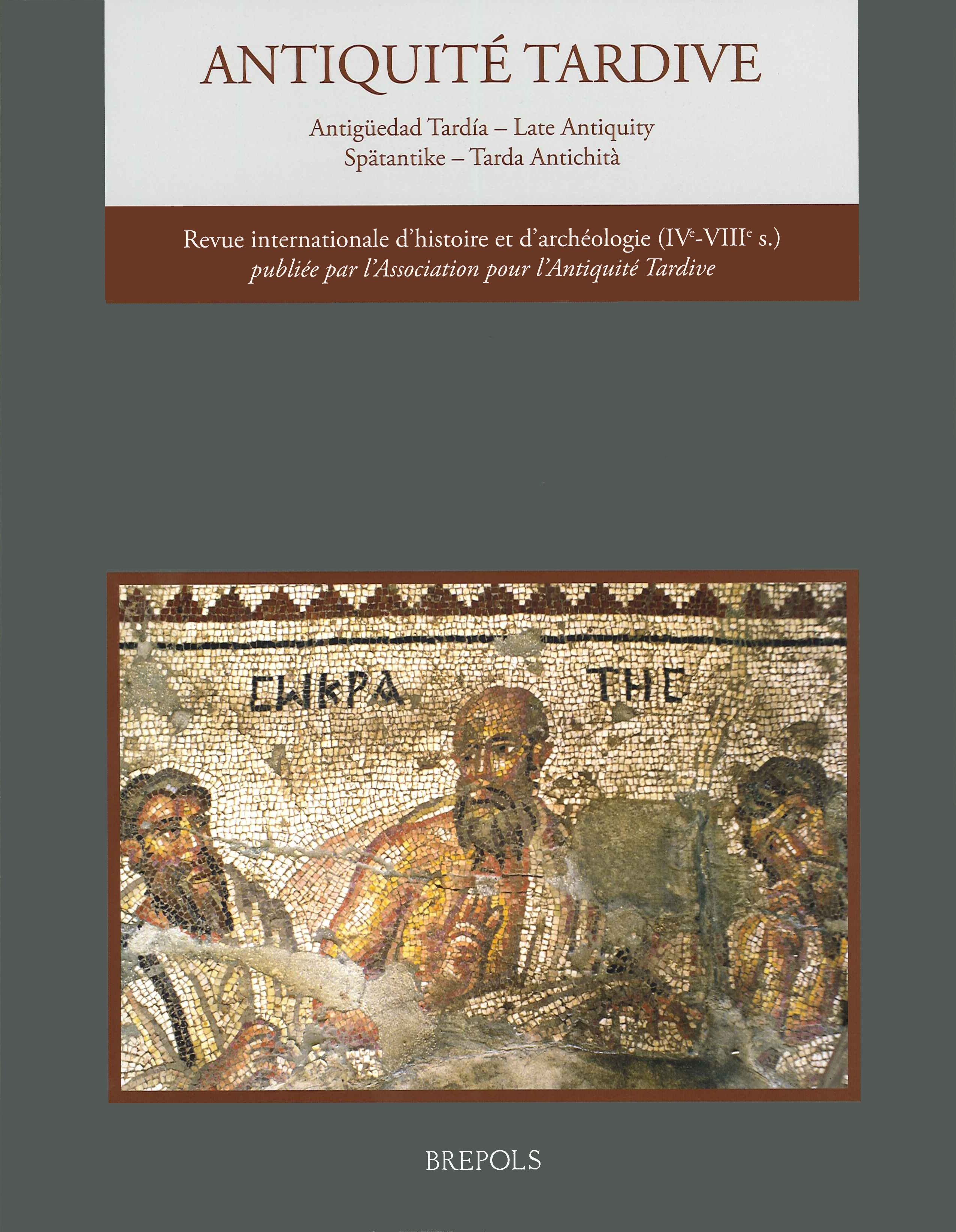
Volume 6, Issue 1, 1998
-
-
Front Matter (title page, principales abbréviations, Table des matières, éditorial, erratum, in memoriam)
show More to view fulltext, buy and share links for:Front Matter (title page, principales abbréviations, Table des matières, éditorial, erratum, in memoriam) show Less to hide fulltext, buy and share links for: Front Matter (title page, principales abbréviations, Table des matières, éditorial, erratum, in memoriam)
-
-
-
Le gouverneur romain a l'époque tardive : orientations de l'enquête
show More to view fulltext, buy and share links for:Le gouverneur romain a l'époque tardive : orientations de l'enquête show Less to hide fulltext, buy and share links for: Le gouverneur romain a l'époque tardive : orientations de l'enquêteAbstractThis presentation of the subject matter of the current volume attempts to set out - neither systematically nor exhaustively - recent and emerging trends in the study of Late Roman governors. As well as this bibliographic overview, two aspects are discussed more directly: the operation of provincial adjudication, and the dialectic of the triangular relationship between governor, public opinion and imperial authority. It is suggested that, in the failures of its local representatives - which went unnoticed more often than we might think - the central government was frequently confronted with its own failures, which were not resolved by piecemeal territorial reorganisation. On the other hand, although there are no reasons to query the negative image of governors and their exercise of power which is frequently presented by contemporaries — even by emperors — we should treat the texts criticising governors with no less rigorous caution than any other sources.
-
-
-
The Functions of the Governor in Late Antiquity: some observations
show More to view fulltext, buy and share links for:The Functions of the Governor in Late Antiquity: some observations show Less to hide fulltext, buy and share links for: The Functions of the Governor in Late Antiquity: some observationsAbstractDès que l'Empire est en paix, le rôle principal du gouverneur est de rendre la justice. Deplus en plus, le gouverneur était amené à la rendre sur place dans des conventus qui se sont multipliés, surtout après l'extension de la citoyenneté par la Constitutio Antoniniana. La fréquence de ces "tournées judiciaires" qui surchargeaient les gouverneurs est peut-être un des motifs de la réforme de Dioclétien. Les qualités souhaitées restent les mêmes que celles que recommandent les instructions de Ménandre le Rhéteur : sagesse, justice, tempérance, courage. Le problème de l'honnêteté est de plus en plus mis en avant avec l'accroissement de la corruption. On peut considérer que le rôle des gouverneurs comme intermédiates entre I'empereur et les sujets provinciaux tend à se modifier profondément au Bas-Empire. Les liens deviennent plus forts avec l'aristocratie locale, dont ils proviennent de plus en plus et où ils jouent le rôle d'évergètes traditionnels, malgré l'interdiction officielle du recrutement local: ce poste est devenu le sommet d'une carrière de notable. La complexité des tàches du gouverneur comme intermédiate entre les requêtes des sujets et les instructions de I'empereur et de la préfecture du prétoire est d'autant plus lourde que les gouverneurs ne restent en place quepeu de temps. L'autorité du préfet s'accroît. Le fait que l'autorité du gouverneur soit ainsi compromise peut expliquer le recours de plus en plus fréquent aux juridictions de la capitale. On a l'impression qu'il disparaît presque dans la pratique à partir du VIe siècle : les fastes sont deplus en plus lacunaires et on ne parle plus guère de cette fonction anachronique.
-
-
-
Ehrungen spätantiker Statthalter
show More to view fulltext, buy and share links for:Ehrungen spätantiker Statthalter show Less to hide fulltext, buy and share links for: Ehrungen spätantiker StatthalterBy: Marietta HorsterAbstractMore than 300 tituli honorarii for provincial governors have come down to us from late antiquity. The vast majority was erected in provincial municipalities toward the end of the honoree's term of office and, at least in the 4th through the first half of the 5th century, most of them were also paid for by the cities and towns. Generally honorific inscriptions were written on bases upon which larger than life-size marble statues (togati or chlamydati) were placed, resulting in a monument some 3-3.5m high. The small number of honors received from the provincial concilia demonstrates the exclusivity of such a distinction. By comparison, the small number of honors received from individual persons and groups clearly points to a social change in late antique society, characterized as it was by roles and hierarchies. Nevertheless, the content and form of all such tituli honorarii bestowed upon provincial governors reflect especially well the self-image of late antique senators, an ideal which governors, who were ranked as perfectissimi, aspired to achieve. Both the mention of ancestors who held public office and the listing of the public offices which the honoree occupied were often confined to honorific inscriptions at Rome and in cities in which the senators owned property. In the 5th century, acclamations, inscriptions on buildings, in mosaics and under painted portraits seem to have been considered increasingly as an alternative to statuary honours, a shift possibly linked with a constitution from 444 AD requiring honoree to finance themselves statues erected in their honor.
-
-
-
Ducs, praesides, poètes et rhéteurs au Bas-Empire
show More to view fulltext, buy and share links for:Ducs, praesides, poètes et rhéteurs au Bas-Empire show Less to hide fulltext, buy and share links for: Ducs, praesides, poètes et rhéteurs au Bas-EmpireBy: Jean GascouAbstractJean Gascou originally wrote this article in 1995, and kept it for this volume of studies on governors. In the meantime, a text published in Oxyrhynchus Papyri LXIII has confirmed his hypothesis that the dux Maurice, subject of an eulogy by one Cyrus of 'Antiopolis' (that is, Antaiopolis) mentioned by Photius in the Bibliotheca, should be identified with the dux Maurice attested not only in a graffito from the Syringes, but also in an inscription at Syene and a Latin papyrus at Leipzig, which date Cyrus and his poem to about 367-375 — a discovery which further supports Gascou's identification. This discovery led to some important conclusions, which provide another reason for publishing it without alteration. Photius apparently calls Maurice dux and also hegemon, a title which should only apply to a praeses. This encomium must have had a double object - the dux of Egypt and the praeses of Thebais. This is not as extraordinary as it might seem, and Gascou provides two parallels : the first is the eulogy written in 535-6 by Choricius of Gaza in honor of A ratios, dux of Palestine and Stephanos, praeses of Palaestina I ; the second is a poem, only known from its inscription by the grammarian John of Gaza (PLG III, p. 344 ; first half of the 6th century) in honor of two Zacharias, one a previously unknown dux of Palestine, and another whose rank of megaloprepestatos shows him to be a praeses, presumably of Palaestina I — not necessarily identifiable with the Zacharias known in this office in 516/7. Three encomiastic works with such similar inscriptiones allow us to imagine a particular literary genre, the eulogy of two subjects, which must have come into being in response to the double administration of certain provinces ; the lost poem of Cyrus of Antaiopolis provides the earliest evidence, and the speech of Choricius the only complete example.
-
-
-
Un nouvel épithalame de Dioscore d'Aphrodité adressé à un gouverneur civil de Thébaïde
show More to view fulltext, buy and share links for:Un nouvel épithalame de Dioscore d'Aphrodité adressé à un gouverneur civil de Thébaïde show Less to hide fulltext, buy and share links for: Un nouvel épithalame de Dioscore d'Aphrodité adressé à un gouverneur civil de ThébaïdeBy: Jean-Luc FournetAbstractI publish an unedited epithalamium in Greek verse, composed by Dioscorus of Aphrodite (Egypt, A.D. 6th cent.) in honour of an unnamed person. In spite of the inevitable fusion of both poetical form and encomiastic rhetoric, an analysis of technical terms allows us to identify the praised bridegroom with a praeses of Thebaid. A comparison with other poems by Dioscorus permits us, if not to name him with certainty, at least to reconstitute a typical family belonging to the administrative élites of the Late Roman provinces. An annex lists the 6th century praesides of Thebaid.
-
-
-
Provincial governors and their titulature in the sixth century
show More to view fulltext, buy and share links for:Provincial governors and their titulature in the sixth century show Less to hide fulltext, buy and share links for: Provincial governors and their titulature in the sixth centuryAbstractL 'auteur réexamine les intentions, le langage et la portée de la série de Novelles édictées par Justìnien dans les années 535-536 en vue de réorganiser l'administration provinciale, L 'apparente contradiction présentée par l'évocation de glorieux passés locaux et l'exaltation simultanée de la grandeur romaine, par l'exhumation de litres romains traditionnels (praetor, consularis, etc.) au moment même où le grec remplace le latin comme langue de la juridiction, peut s'expliquer par un programme de restauration de l'autorité centrale sur la vie provinciale s'accompagnant d'une tentative d'alliance avec les assemblées provinciales pourfaire pièce à la puissance insolente des aristocraties locales et asseoir l'autorité renforcée des gouverneurs : une cause perdue d'avance, cependant, comme on peut le constater dès la fin du VIe siècle.
-
-
-
Vicaires et proconsuls d'Asie du IVe au VIe siècle. Notes sur l'administration du diocèse asianique au Bas-Empire
show More to view fulltext, buy and share links for:Vicaires et proconsuls d'Asie du IVe au VIe siècle. Notes sur l'administration du diocèse asianique au Bas-Empire show Less to hide fulltext, buy and share links for: Vicaires et proconsuls d'Asie du IVe au VIe siècle. Notes sur l'administration du diocèse asianique au Bas-EmpireBy: D. FeisselAbstractFrom the establishment of the office of Vicarius under the Tetrarchy until its abolition in A.D. 535, the administration of the diocese of Asia was divided between proconsul and vicar. The purpose of this article is not to examine the entire history either of the vicariate of Asiana, or of the proconsulate of Asia, but to clarify the varying relationship between these two authorities. Four sections follow the development over time: i. Proconsular province and vicariate: the delimitation of two equivalent authorities. ii.An inventory of inscriptions for vicars of Asia, from the mid 4th to the early 5th century. iii: Proconsul and vicar: Stephanus and Isidore, iv. Comments on the status of the vicar of Asia, from the reign ofTheodosius II to its abolition under Justinian. Sections i and iv are based principally on legal and narrative sources, from the 4th and 6th centuries respectively. Sections ii and iii, however, are based on epigraphic sources, from Phrygia and Lydia for the vicars, and from Ephesus for the proconsuls. Sections iii and iv suggest a new interpretation of imperfectly understood aspects of the vicariate: firstly, two inscriptions from Ephesus show the office of proconsul and vicar combined, in an experimental arrangement of about 410; secondly, the abolition of the vicariate in 535 is shown not to be—as often assumed - the termination of an already moribund office, but a real administrative innovation.
-
-
-
Séparation ou cumul ? P ouvoir civil et autorité militaire dans les provinces égyptiennes de Gallien à la conquête arabe
show More to view fulltext, buy and share links for:Séparation ou cumul ? P ouvoir civil et autorité militaire dans les provinces égyptiennes de Gallien à la conquête arabe show Less to hide fulltext, buy and share links for: Séparation ou cumul ? P ouvoir civil et autorité militaire dans les provinces égyptiennes de Gallien à la conquête arabeAbstractIn the third century, a series of crises led to extraordinary military appointments (duces, correctores), which sidelined the authority of the civil governor. Diocletian's separation of the two forms of service — armata et inermis, civil and military - solidified under Constantine into a provincial administrative structure which disassociated civil and military authority. This separation lost its force after the middle of the fourth century, in favour of the military powers which encroached upon the powers of the civil governor. The history of the relationship between the two authorities is by no means as straightforward as it is commonly represented. Moreover, even when the separation of powers was in force, it did not entail a complete divide between the two authorities, which were led to co-operate in a variety of situations. The appointment of the Comes Aegypti under Theodosius created in the military sphere a rank equivalent to the 'vicariate' of the Augustalis, further extending the equivalence between military and civil structures. On many occasions, the tension between the two spheres was resolved by a combination of powers-for example, in the last quarter of the fifth century, the powers of the comes and the Augustal Prefect - but not on a permanent basis. Justinian took the opposite route, altering the balance in favour of the civil power while reinforcing the identity of the province (by a classicising return to the concept of the governor of the imperial period?). The effects of this double orientation - restoring authority to the civil power and reinforcing provincial autonomy — were disastrous for the defence of Byzantine Egypt, as was shown by the conquest of Egypt in 641, after that of Syria. The examples of Senecio (P. Abinn. 1), Flavius Eleutherius (SB VIII, 7840), the topoteretes Zoilos (P. Ross. Georg. V, 30) and the generals who commanded against the Arab attack (John of Nikiu) are examined in detail.
-
-
-
Praesides und Correctores der Augustamnica
show More to view fulltext, buy and share links for:Praesides und Correctores der Augustamnica show Less to hide fulltext, buy and share links for: Praesides und Correctores der AugustamnicaBy: Bernhard PalmeAbstractIn the course of the 4th century AD the arrangement of the provinces in Egypt underwent several changes. As early as the period between 297 and 341 three different models (division into two, three and four provinces) followed one another in quick succession. For recreating the circumstances in the 2nd half of the 4th century the province of Augustamnica, which was created in 341, is of central importance. This province initially included that part of the Delta which lays east of the Phatnite arm of the Nile, as well as the Heptanomia in middle Egypt. A praeses headed its provincial organization. In 374 it ceded the Heptanomia and portions of the Delta to the province Aegyptus (the western part of the Delta surrounding Alexandria). The new boundaries of the province of Aegyptus increased the standing of its prefect. A sign of the importance of this new prefecture is the fact that it was taken over by Eutolmius Tatianus, who had already held offices of higher rank. This province of Augustamnica, confined to the eastern portion of the Delta, is the basis of the description given of it by Ammianus Marcellinus, Res Gestac XXII, 16,1-6, a passage of which scholars until now have been unjustly suspicious. As a result of the confinement of the province of Augustamnica to the eastern part of the Delta, it disappeared from papyrological documentation, although it continued to exist into the 7th century. When Egypt became a diocese in 381 and was headed by a praefectus Augustalis, the province of Aegyptus was reduced to its old boundaries and presided over by a praeses, so that the new praefectus Augustalis did not inherit a potential rival. The province of Augustamnica regained portions of the Delta as well as the Heptanomia and thus again had its original boundaries. At this point the rank of its governor was upgraded from praeses to corrector. Around 397 the province of Augustamnica lost the Heptanomia for good. The Heptanomia in turn was organised as the province of Arcadia, of which the capital was Oxyrhynchos. From this time onwards the province of Augustamnica was confined to the portion of the Delta which lays east of the Phatnite arm of the Nile. The arrangement of the provinces in lower and middle Egypt thus assumed the form which was to remain standard into the 6th century.
-
-
-
Comtes et dues en Égypte autour de l'an 400 et la date de la Notitia Dignitatum Orientis
show More to view fulltext, buy and share links for:Comtes et dues en Égypte autour de l'an 400 et la date de la Notitia Dignitatum Orientis show Less to hide fulltext, buy and share links for: Comtes et dues en Égypte autour de l'an 400 et la date de la Notitia Dignitatum OrientisAbstractThe study consists of four prosopogmphical notes which deal with the career of high commanders and functionaries in Egypt. I. Fl. Eleuiherius is shown to have served first as dux of Thebaid and then as comes of Egypt (399-401). II. Synesius' friend the comes based in Alexandria is identified as comes Aegypti Fl. Herculianus (appointed in the summer of 395), III. Aedesius, the person guilty of not prosecuting Hypatia's murderers (415), is tentatively identified as the homonymous officer who appears as dux Thebaidis in a letter of Shenute and who could be later promoted comes Aegypti. TV. The mysterious Anatolius burned in Alexandria according to the Chronicle of Theophanes (398/9), is shown to have occupied the position of praefectus Augustalis, the last to bear the honorary rank of clarissimus. The latter note develops into a dissertation on the date of the promotion of comites Orientis, praefecti Augustales, vicarii, comites and duces to the rank of spectabiles and on the date of the Notitia Dignitatum Orientis, set inA.D. 401.
-
-
-
I governatori delle province Italiche
show More to view fulltext, buy and share links for:I governatori delle province Italiche show Less to hide fulltext, buy and share links for: I governatori delle province ItalicheAbstractThis paper follows the evolution in the institutional role and power of governors of the provincial districts in Italy from Diocletian to Justinian. There is no single governor's model which can be applied to the entire provincial territory, nor is there one which is valid in Italy for the entire period when a Roman provincial system can be considered as in force. Throughout the 4th century, and in the early years of the 5th century, in the central-south regions the great Roman-Italic landowning aristocracy was prominent in administration. The emperors knew how to take advantage of the mediating and even governing potential of their political-administrative methods and patronal traditions. Even though this élite was not excluded from office in Italia "Annonaria", the presence of imperial seats in Aquileia and, above all, in Milan, as well as the greater proximity to the military frontiers and the different social and economic background very likely required a more "bureaucratic" interpretation of the role of governor, and in some cases also the ability to deal with military emergencies. We may surmise that these needs certainly influenced the selection of the governors, even if the scarce nature of prosopographical information does not allow us to form definite conclusions. From the point of view of competence and authority, the Italic governors were no different from all the others: their main duties included the collection of taxes (but even in this context the provisioning of Rome had peculiar implications for the suburbicarian area and also for the cursus honorurn) and the administration of justice. In this respect, unjustified reservations have been expressed regarding the capital jurisdiction of the Italic governors, due, in part, to an inadequate examination of the evidence. Militarization and attempts at centralization progressed relentlessly in the 5th and the 6th centuries. In the 5th century once again we come up against the difficulties caused by inadequate documentation. It is assumed however that the great families belonging to the senatorial aristocracy tended to avoid positions of intermediate administrative responsibility (which is how a governorship must be considered, at least for many peninsular provinces), preferring to move on directly, and at an early age, to higher positions, be they palatine or connected with territorial government. This phenomenon seems to continue in the Ostrogothic age, and as far as the recruitment of governors is concerned, preference is given to the upper classes at the regional level and perhaps to civil functionaries linked to the Gothic court. In this period there are discontinuities in terms of functions, inasmuch the traditional responsibilities of the governors are reduced to a certain extent. From the point of view of the general structure of the districts, the dioecesis Italiciana regresses with respect to the situation in the 1st century and a half after provincialization. This is due both to the losses caused by invasions and to internal structural changes. Considering the Lombard invasion and the reduction in size of the Byzantine districts, and taking into account the gradual petering out of the traditional tax system and the increasingly extensive militarization of society and administrative figures, it no longer makes sense to speak about (civil) provincial governors based on the Roman model, even though sources continue to use the terms iudices and praesides sporadically up to the 7th century. The article ends with an appendix which contains information regarding recently found documents or new discussions of a prosopographical nature.
-
-
-
Deux procurateurs du Valais et l'organisation des districts alpins
show More to view fulltext, buy and share links for:Deux procurateurs du Valais et l'organisation des districts alpins show Less to hide fulltext, buy and share links for: Deux procurateurs du Valais et l'organisation des districts alpinsBy: François WibléAbstractThe author publishes two out of three altars recently discovered during the excavation of a mithraeum at Martigny, which was dedicated by two governors of Alpes Atrectianae or Alpes Graiae (French Tarentaise) and Vallis Poenina (modern canton Valais). This name first appears under Septimius Severus but could have been the province's official name as early as Claudius, even if three inscriptions dated between the end of the 1st and 2nd century name it only as Alpes Graiae or Atrectianae. The first of the officials, Julius Constitutus, is a procurator Augusti who can be identified with a praeses mentioned in an inscription from Sion in the same district The second, Publius Acilius Theodoras, is called vir perfectissimus et praeses, and does not occur earlier than the reign of Aurelian, The author suggests an increased importance of Valais in the 3rd century. He also includes a list of 23 governors and administrators of the province known over the whole Roman Empire.
-
-
-
Le gouverneur de Numidie en sa capitale : le lieu et les acteurs du procès de l'évêque de Cirta en 320
show More to view fulltext, buy and share links for:Le gouverneur de Numidie en sa capitale : le lieu et les acteurs du procès de l'évêque de Cirta en 320 show Less to hide fulltext, buy and share links for: Le gouverneur de Numidie en sa capitale : le lieu et les acteurs du procès de l'évêque de Cirta en 320By: Y. DuvalAbstractThis paper is based on a new study of the sole manuscript of the Gesta apud Zenophilura consularem. These Gesta are the Acts (preserved in an appendix of the treatise ofOptatus) of the trial of Silvanus of Cirta who was accused of traditio and of theft by one of his deacons in 320. Comparison between this document and two types of ancient sources concerning penal trials (official records preserved in Egyptian papyri and the proceedings of the trials of the martyrs contained in the Acta martyrum) sheds light on the analysis of the Gesta apud Z. There are two related problems in that document: the location of the trial, and the identification of the exceptor mentionned anonymously in the records. P. Monceaux in 1912 had significantly corrected the reference to Sexto Thamugadiensi (found at the beginning of the proceedings, in the brief list of participants) in order to read the name of Timgad (Thamugadi in ci(vitate), as well as the date, sixth of Ides), as he thinks that the location of the trial is always indicated at the beginning of official acts. In the light of other judicial records, it is possible to determine however that the location is not indicated when the trial takes place in the town where the presiding magistrate has his official residence. There is no reason to give Timgad as the location of the trial of the bishop of Cirta, specially when all the participants are also inhabitants of this town. This paper proves that the trial took place in Cirta (the capital of Numidia reunified in 314), with the provincial governor acting as president: in that case, the location must not be mentioned. The correction proposed by Monceaux must therefore be abandonned. As the first editors thought (although they did not clearly pose the question of the location of the trial), Sextus is the exceptor of the tribunal. His place of birth, Timgad, is specified because he is the only participant in the trial who was not from Cirta. It can be proved that Sextus was the notarius in charge of recording the proceedings (for drawing up the Acts), as well as the reader of the numerous official documents in the course of the trial.
-
-
-
Le "Palais de la Trouille" à Arles : palais impérial ou palais du préfet ?
show More to view fulltext, buy and share links for:Le "Palais de la Trouille" à Arles : palais impérial ou palais du préfet ? show Less to hide fulltext, buy and share links for: Le "Palais de la Trouille" à Arles : palais impérial ou palais du préfet ?By: Marc HeijmansAbstractDuring the Middle Ages the "Palais de la Trouille" in Aries belonged to the Counts of Provence, and a local tradition says it was the Palace of Constantine. Indeed, several monuments, which are dated by building technique to Late Antiquity, are still preserved in the centre of Aries and local historians interpreted them as a coherent complex. Its most visible part is a public bath of unknonwn date, which could be Constantinian. The most important and recent discovery concerns a huge, oblong building, whose walls, with high windows, are preserved as well as the facade with three entrances separated by columns. This building, which has no internal partitions, is next to the baths, but does not communicate with them. Its size (57 x 25 m) and proportions suggest a monumental hull for civil purposes, perhaps an audience hall. Its date might correspond with the installation of the pretorian prefect of Gaul and the occasional sejourns of several emperors during the 5th century, so that it could well be the public part of an official residence, like the well-known basilicas of Trier and Metz. It is not impossible that this basilica was used for the Christian cult and that it corresponds to the Basilica Constantia mentioned in the Vita s. Hilarii, whose location is unknown. Another part of this complex (perhaps its walls) consists of a Roman tower, which still stands south of the basilica, in the rue de la Liberté. The northern fagade of the forum-cryptoporticus received a new entrance during the reign of Constantine, as is shown by an inscription mentioning Fausta and the three Caesares. Of seemingly more recent date is the construction of a large exedra between the baths and the basilica, which could have been a swimming pool (natatio). Thanks to these recent discoveries, we know the monumental center of Arles in Late Antiquity much better than before, but its architectural unity remains uncertain for the moment, in spite of its perfect insertion in the street plan.
-
-
-
Les aspects sociaux et institutionnels des sciences et de la médecine dans l'Antiquité Tardive
show More to view fulltext, buy and share links for:Les aspects sociaux et institutionnels des sciences et de la médecine dans l'Antiquité Tardive show Less to hide fulltext, buy and share links for: Les aspects sociaux et institutionnels des sciences et de la médecine dans l'Antiquité TardiveBy: Ilsetraut HadotAbstractThis article studies the place of medicine and the sciences in education, research and society in Late Antiquity. Neither in the Hellenistic nor the Roman period did mathematics form part of a general education, it was reserved for those seeking a professional training - architects, engineers, surveyors - or to a few advanced students of philosophy: for them, as the ancient texts demonstrate, mathematics was conceived as a stage in philosophical education; by the study of actual numbers the student could discover the ontological function of intelligible numbers, and thus reach dialectic, the purest branch of philosophy. Arithmology, astrology, alchemy and Neoplatonic theurgy rested on the same philosophical basis. Mathematical teaching and research, moreover, were the work of philosophers in the Platonic tradition. Athens and Alexandria played an essential role in the transmission of learning, but other cities — especially in Syria and Mesopotamia - also made a contribution. Outside the philosophical schools there also was interest in geography, especially cartography, which seems to have been used regularly by rhetors and grammarians. As for medicine, it never detached itself from philosophy. The Latin tradition was constructed from compilations or translations of Greek works, with the result that ancient science was often transmitted in the Middle Ages in a dramatically reduced and altered form. In the eastern empire, after the formation of a corpus of medical writing - essentially from Hippocrates and Galen -, medical knowledge was either transmitted from Alexandria to Constantinople, or passed down via Middle Eastern languages - principally Arabic and Syriac. We do not know very much about the education of doctors, who came from a variety of backgrounds - slaves, men of high rank, and foreigners — and varied in status — as public doctors, free doctors and itinerant doctors.
-
-
-
"Come un bene ereditario". Costantino e la retorica dell'impero-patrimonio
show More to view fulltext, buy and share links for:"Come un bene ereditario". Costantino e la retorica dell'impero-patrimonio show Less to hide fulltext, buy and share links for: "Come un bene ereditario". Costantino e la retorica dell'impero-patrimonioBy: Ignazio TantilloAbstractThe author discusses the transformation of some crucial political concepts during the Constantinian era by analyzing the change in usage of one particular rhetorical image (the association of empire and private patrimony). In classical (pre-Constantinian) times that image had a strongly negative connotation and was employed in polemical contexts in order to express disagreement with "deviant" political behavior and attitudes. In the last part of Constantine's reign however, it underwent a radical modification and was used positively to symbolise the new ideology of a mystical, dynastic monarchy. The origin of this development must be sought on the one hand in the evolution of political thought which occurred in the late third century and the Tetrarchic period, and on the other hand in the extrapolation and partial absorption of some Biblical models.
-
-
-
Les routes d'Orose et les reliques d'Etienne
show More to view fulltext, buy and share links for:Les routes d'Orose et les reliques d'Etienne show Less to hide fulltext, buy and share links for: Les routes d'Orose et les reliques d'EtienneBy: Valérie GaugeAbstractThe role played by the Spanish priest Orosius in the dissemination of protomartyr Stephen's relics and in the implantation of his cult in the West, has long been proved. However, the trips he undertook through the Iberian Peninsula, Africa, Palestine and the Baleares give rise to several hypothesis about the chronology of his movements, his stopping places, his transportation means and his motives. The present study intends to compare the most recent theories on those questions, especially those voiced by G. Finck, E. D. Hunt, C. Torres Rodriguez, M. - P. Arnaud- Lindet, J. Amengual I Bade, S. Bradbury and F. Dolbeau, and relies mostly on literary sources such as Augustinus' correspondance, Orosius written worts, the Revelatio sancti Stephani of Lucian, Avit of Braga's letter, Severus of Minorca's testimony and the Relatio from Evodius of Uzalis. Severus' letter puts Orosius' responsability in the dissemination of Stephen's relics into question. Moreover, it allows to question the chronology of Orosius' return journey to the West, as well as Bishop Severus'use of protomartyr Stephen's relics to undertake the conversion of the Jews in Minorca.
-
-
-
L'influence antique dans l'art roman : le tympan de Saint-Ursin de Bourges
show More to view fulltext, buy and share links for:L'influence antique dans l'art roman : le tympan de Saint-Ursin de Bourges show Less to hide fulltext, buy and share links for: L'influence antique dans l'art roman : le tympan de Saint-Ursin de BourgesBy: Yann CodouAbstractContinuing studies previously published in this journal, the article underscores the influence of Late Antique sarcophagi, specifically those with hunting episodes, on Romanesque sculpture and analyzes the Medieval tympanum of the Church of Saint Ursinus (end llth, beginning 12th century) at Bourges, which is related to an antique sarcophagus used to bury Saint Ludre at Deols, located near Bourges. There is an even greater similarity to the hunt sarcophagus from Trinquetaille at Arles, and an example like that must have existed at Bourges, inspiring the artist. The fact that the scene copies a 4th-century sarcophagus removes all immediacy from this image of "contemporary life", but a correspondence of ideals and life style linked the two periods.
-
-
-
Golden jewelry from the imperial mausoleum at Šarkamen (Eastern Serbia)
show More to view fulltext, buy and share links for:Golden jewelry from the imperial mausoleum at Šarkamen (Eastern Serbia) show Less to hide fulltext, buy and share links for: Golden jewelry from the imperial mausoleum at Šarkamen (Eastern Serbia)Authors: Ivana Popović and Miodrag TomovićAbstractBien que les vestiges romains au lieu-dit Vrelo près de Šarkamen, à environ 220 km de Negotin, aient été décrits à la fin du XlXe siècle par le voyageur autrichien F. Kanitz, le site attira l'attention en 1975 quand on trouva des fragments d'une statue en porphyre, mais la recherche systématique ne commença qu'en 1994. Elle prouva qu'il ne s'agit pas d'un site militaire comme on le croyait, mais d'un "complexe mémorial", analogue architecturalement et idéologtquement à celui qui a été identifié non loin de là à Gamzigrad par une inscription comme l'ancienne Romuliana. La fortification principale, de plan rectangulaire irrégulier garni de dix tours, enclôt une surface de 0,87 ha. Les restes des remparts et des tours ainsi que les données de la stratlgraphie à l'intérieur prouvent que la construction fut interrompue brutalement. A environ 250 m de la porte principale, on a découvert un ensemble monumental qui se révèle être un mausolée carré (10,65 m de côté). Il est assez voisin pour ses dimensions et la technique d'exécution de celui attribué sur la hauteur de Magura près de Gamzigrad à la mère de Galère Romula (voir AnTard 2). Nous en déduisons que comme celui de Gamzigrad le complexe est formé d'unpalais et d'un ensemble mémorial, avec mausolée, tumulus de consécration, dont lafouille est en cours, une plate-forme pour la statue impériale et une enceinte circulaire non couverte. Pendant la fouille du mausolée en 1996, on a découvert dans la crypte une petite fosse creusée dans le terrain vierge contenant 29 pièces d'orfèvrerie et 9 plaquettes d'orportant des empreintes; Après restauration on emit distinguer deux boucles d'oreille, trois colliers avec un pendentif, trois bagues et deux anneaux de chevelure. La qualité des bijoux est médiocre et correspond à la production moyenne des ateliers locaux (Viminacium, Naissus, Ratiaria) dans la seconde moitié du IIIe siècle. Leplus intéressant des colliers est fait de neuf médallions de pâte de verre bleue et sept pièces ovales : l'ensemble est original par rapport à la production locale. Sur quatre plaquettes faites de feuilles d'or très fines était préservée — totalement ou partiellement — l'empreinte d'un solidus tétrarchique. Le nom n'est pas complet: il peut s'agir de Maximien, Galére ou Maximin. Les circonstances historiques, la localisation et la ressemblance avec Gamzigrad nous amènent à conclure que Maximin a été lefondateur du site et que le mausolée contenait les restes de sa mère après la cérémonie d'apothéose. L 'orfèvrerie apporte des indications nouvelles sur l'organisation des ateliers d'orfèvres au début du IVe siècle et sur la conception idéologique et religieuse de la Tétrarchie
-
-
-
Note sur les relations de trois historiens des IVe et Ve siècles : Sulpicius Alexander, Renatus Profutus Frigeridus et Olympiodore
show More to view fulltext, buy and share links for:Note sur les relations de trois historiens des IVe et Ve siècles : Sulpicius Alexander, Renatus Profutus Frigeridus et Olympiodore show Less to hide fulltext, buy and share links for: Note sur les relations de trois historiens des IVe et Ve siècles : Sulpicius Alexander, Renatus Profutus Frigeridus et OlympiodoreAbstractIn the first part of this note, the author compares his point of view on Alexander and Frigeridus with G. Zecchini's. Their opinions differ on the following questions: the identification, classification, and localization of the historians' fragments ; the copiousness of their works ; and the periods of time they deal with, and especially the question of whether Alexander continues Ammianus Marcellinus and Frigeridus Alexander - a hypothesis that Zecchini excludes whereas the author thinks it likely. The second part of the note deals with the similarities one can perceive between Zosimus 6,4,1-5,2 and a fragment of Frigeridus. The author tries to show that Olympiodorus, Zosimus' source, owes his information to Frigeridus, especially for this passage. There are however in Olympiodorus-Zosimus passages with a pagan bias, which cannot come from the Christian Renatus Frigeridus. One has therefore to admit that Olympiodorus combined, for the year 408 and thereafter, a factual source (Frigeridus ?) with a source giving him an ideological framework.
-
-
-
Échos scientifiques de l'année ambrosienne ; G. Cantino Wataghin, Note di archeologia ambrosiana
show More to view fulltext, buy and share links for:Échos scientifiques de l'année ambrosienne ; G. Cantino Wataghin, Note di archeologia ambrosiana show Less to hide fulltext, buy and share links for: Échos scientifiques de l'année ambrosienne ; G. Cantino Wataghin, Note di archeologia ambrosianaBy: Jacques FontaineAbstractIt seems an opportune moment to pass on to the readers of Antiquite Tardive notice of the principal scientific celebration of the 16th centenary of Ambrose, and to add to it reviews of three important and recent works on the bishop of Milan. Appearing in English, Italian and French (to follow the chronological order of their publication), they offer by reason of their three points of view a portrait of the bishop multidimensional. Taken together, they also help us mark the distance travelled since the classic syntheses of Palanque and Paredi, and also since the Milan congress of 1974. One hopes that this short account will attract young "Ambrosians " for the 21st century. Our Milanese friends told us optimistically that they were expecting to see us at the 17th centenary of the Edict of Milan, in 2013.
-
-
-
Recherches sur la transition de Rome à Byzance dans la région du Bas-Danube
show More to view fulltext, buy and share links for:Recherches sur la transition de Rome à Byzance dans la région du Bas-Danube show Less to hide fulltext, buy and share links for: Recherches sur la transition de Rome à Byzance dans la région du Bas-DanubeBy: Andrew PoulterAbstractExtensive excavations carried out within the late Roman cites in the Balkans provide a substantial quantity of archaeological evidence which, suggests, as do epigraphic finds that most cities in the region were already in decline by the early 4th century. There were exceptions but, where cities do show signs of growth or prosperity, they appear to be only those which became centres of imperial administration and this does not prove any revival in the prosperity or civic functions by the urban Elite. Even so, this argument relies precariously on the attribution of functions to particular building types and generalisations based on often limited excavation and a sequence which invariably rests upon an insecure chronology. It is argued that it is more effective to develop regional programmes, involving the study of urban centres, based upon palaeoeconomic data, and to chart changes in the economic basis of urbanism form the Roman to early Byzantine periods. The results of the British excavations at Nicopolis ad Istrum in Bulgaria are used to illustrate the method. Here there would seem to have been a profound change in the agricultural economy during the early Byzantine period when the physical character and the function of the city changed no less dramatically: it became a strongly fortified military and ecclesiastical centre with apparently no civilian population permanently resident within its defences. Although the physical layout of an early Byzantine city was established for Nicopolis and work suggests that geophysical survey could produce similar results at such sites as Philippi, this brings us no nearer to providing an explanation for physical or economic changes. One possible solution is to extend the scope of research to the countryside and to apply new techniques of intensive survey which have proved successful in a pilot study in northern Greece at Louloudies, near the city of ancient Pydna. Now under way, a new research programme in northern Bulgaria is investigating village settlement and particularly the economic character of typesites (cf Gradishte) across a 2,0000 square kilometre region. The aim here is, by excavation and applying the intensive survey techniques (in combination with geophysics) developed in Greece, to ascertain whether the economic changes identified for the city were equally true of the countryside. It should be possible to determine whether the fate of early Byzantine Nicopolis was a product of economic changes in its hinterland or whether the character of urbanism was determined by factors unrelated to its regional context: an approach to the past which, in the future, should result in more fundamental advances in our understanding of Late antiquity than our present state of knowledge permits.
-
-
-
Le dossier du groupe épiscopal de Naples. État actuel des recherches
show More to view fulltext, buy and share links for:Le dossier du groupe épiscopal de Naples. État actuel des recherches show Less to hide fulltext, buy and share links for: Le dossier du groupe épiscopal de Naples. État actuel des recherchesAbstractIn 1996 we had requested for the dossier on double churches an up-to-date statement on the cathedral of Naples by J. Desmulliez, who was then preparing a thesis on Christian Campania. She here provides an account of research questions based both on locally published reports, notably those by R. Di Stefano and N. Ciavolino following recent excavations which have modified accepted theories, and on syntheses by R. Farioli andL. Pani Ermini, as presented in her thesis. The episcopal group consists of a Constantinian basilica mentioned in the Roman Liber Pontificalis and in Neopolitan tradition, but the Gesta of the bishops of Naples assigns it to a bishop of the 2nd half of the 4th century. It is the nucleus of the present cathedral at the south-west of the insula, dedicated to Sancta Restituta after the transfer of this saint's relics to Naples via Ischia. The S. Giovanni in Fonte baptistery is also attributed to Constantine in the saint's life but the Gesta notes it as a construction of Bishop Severus at the end of the 4th century or beginning of the 5th, which Soter {attested in 465) modified and restored. It is one of the oldest surviving baptisteries with a vault over a tambour, and it is decorated with famous mosaics, which pose problems of iconography and chronology, for one discerns differences in the decorative plan and in style: was one part by Soter, or did two different teams work at the same time ? A second church is due to Bishop Stephanus {attested between 495 and 502), who gave it his name (Stephania). It was believed to lie perpendicular to the first church, but the excavations have demonstrated that it was para llel. Late sources state that it was dedicated to the Saviour, but there also existed a basilica apostolorum, which some believe to be only a first phase of the future Stephania. It is necessary to add another 'minor' baptistery, as at Milan, which has been located and which was associated with an apsidal room with a synthronos: consignatorium or accubitum attributed to Bishop Vincentius actually mentioned in a votive inscription? The episcopal group thus displays the form of two churches with a baptistery between. Relying upon the traditional schema, the recent authors see in this an illustration of the ideal complex defined by Paulinus of Nola for Sulpicius Severus at Primuliacum, and they distinguish a room for catechumens and a congregational church. In any case, we are not concerned here with a single program from the beginning, and the traditional interpretation has been widely discussed in the section devoted to this theme in AnTard 4.
-
-
-
Nouvelle interprétation du complexe épiscopal "pré-euphrasien" de Poreč
show More to view fulltext, buy and share links for:Nouvelle interprétation du complexe épiscopal "pré-euphrasien" de Poreč show Less to hide fulltext, buy and share links for: Nouvelle interprétation du complexe épiscopal "pré-euphrasien" de PorečAuthors: Ivan Matejčić and Pascale ChevalierAbstractThe well known complex of Porec-Parenzo has witnessed a new phase of investigations since the start of works inside the bishop's palace and between the palace and the church (1994-8). The historical sequence of the multiple churches predating the Group (cathedral, atrium, baptistery) developed by Bishop Euphrasius about 550 (and still surviving) remains unclear. A. Šonje had assumed, to the north of the "pre-Euphrasian" south church, a cult-room, furnished with a free-standing presbyteral bench, which he considered as a martyrium. It has proved possible to determine that the re-excavated remains belonged rather to a church consisting of a nave with two aisles, each with a rectangular chevet and free-standing synthronos (bench), the classic form in the Northern Adriatic region and very close to the "pre-Euphrasian" south church. The episcopal group thus already formed a classic double church in the 5th century. It seems quite probable that this north church survived into the 6th century at a brief distance from the "Euphrasian" church and communicated with it through an intermediate room.
-
-
-
Les Basilicae pictae de Split: les fouilles de 1997
show More to view fulltext, buy and share links for:Les Basilicae pictae de Split: les fouilles de 1997 show Less to hide fulltext, buy and share links for: Les Basilicae pictae de Split: les fouilles de 1997Authors: Franko Oreb and Tajma RismondoAbstractThe research at the site known in the academic literature under the name "Ad Basilicas Pictas" which are associated the churches of St. Andrew and St. John (and sometimes also St. Bartholomew), began in the 1950s. The discoveries of that period had already provided very important information about the continuity of occupation and the construction of cult buildings on the site between the first century AD and the early middle ages. The excavations undertaken in 1997 by the Office of Conservation of the Historic Monuments of Split, allow three phases to be distinguished: 1) the first corresponds to a large classical building of rounded form, whose stratigraphy is still poorly known and which will require further research ; 2) the second phase is that of the early Christian double church : so far revealed are the northern half of the south church, the baptistery with a cruciform tank, the mosaic pavement of the north church in the north section of the excavation (over a length of 12 m), as well as sarcophagi (one with a cross in relief and the other with a curving lid), two of which contained finds, allowing this phase to be dated to the 5th-6th centuries ; 3) the third period, medieval in date, has yielded several artefacts and others are visible in the north section, overlaying the mosaic of the north church. It is still necessary to excavate and to analyse the remainder of the site on which was built the early Christian double church, above newly discovered stonework of the Roman building of rounded form, with the aim of confirming its precise plan, and ensuring its conservation and public presentation.
-
-
-
Épitaphe d'un soldat africain d'Héraclius servant dans une unité indigène, découverte à Constantinople
show More to view fulltext, buy and share links for:Épitaphe d'un soldat africain d'Héraclius servant dans une unité indigène, découverte à Constantinople show Less to hide fulltext, buy and share links for: Épitaphe d'un soldat africain d'Héraclius servant dans une unité indigène, découverte à ConstantinopleAbstractOne of the cruciform stelae of Constantinople recently published by H. Kalkan et S. Şahin bears an unusual epitaph, which is reedited here. Our revision of the text demonstrates that it mentions not one person, as the first editors believed, but two: the defunct, a soldier named Theodore, native of Mauretania, and his commander Zar, praefectus gentis of Zarakianoi in Tripolitania. The presence of a Tripolitanian tribal unit in Constantinople is linked to the final stage of Heraclius' revolt (October 610). This late attestation of an African praefectus gentis (not recognized by the editors) prompts a revision in an Appendix of the well known dedication from Altava (CIL VIII, 9835 etc.) which also features a tribal praefectus.
-
-
-
Bulletin Critique,Publications reçues par la revue,Notes for Contributors
show More to view fulltext, buy and share links for:Bulletin Critique,Publications reçues par la revue,Notes for Contributors show Less to hide fulltext, buy and share links for: Bulletin Critique,Publications reçues par la revue,Notes for Contributors
-
Volumes & issues
-
Volume 32 (2024)
-
Volume 31 (2023)
-
Volume 30 (2022)
-
Volume 29 (2021)
-
Volume 28 (2020)
-
Volume 27 (2019)
-
Volume 26 (2018)
-
Volume 25 (2017)
-
Volume 24 (2016)
-
Volume 23 (2015)
-
Volume 22 (2014)
-
Volume 21 (2013)
-
Volume 20 (2012)
-
Volume 19 (2011)
-
Volume 18 (2010)
-
Volume 17 (2009)
-
Volume 16 (2008)
-
Volume 15 (2007)
-
Volume 14 (2006)
-
Volume 13 (2005)
-
Volume 12 (2004)
-
Volume 11 (2003)
-
Volume 10 (2002)
-
Volume 9 (2001)
-
Volume 8 (2000)
-
Volume 7 (1999)
-
Volume 6 (1998)
-
Volume 5 (1997)
-
Volume 4 (1996)
-
Volume 3 (1995)
-
Volume 2 (1994)
-
Volume 1 (1993)
Most Read This Month
