


The Journal of Medieval Latin
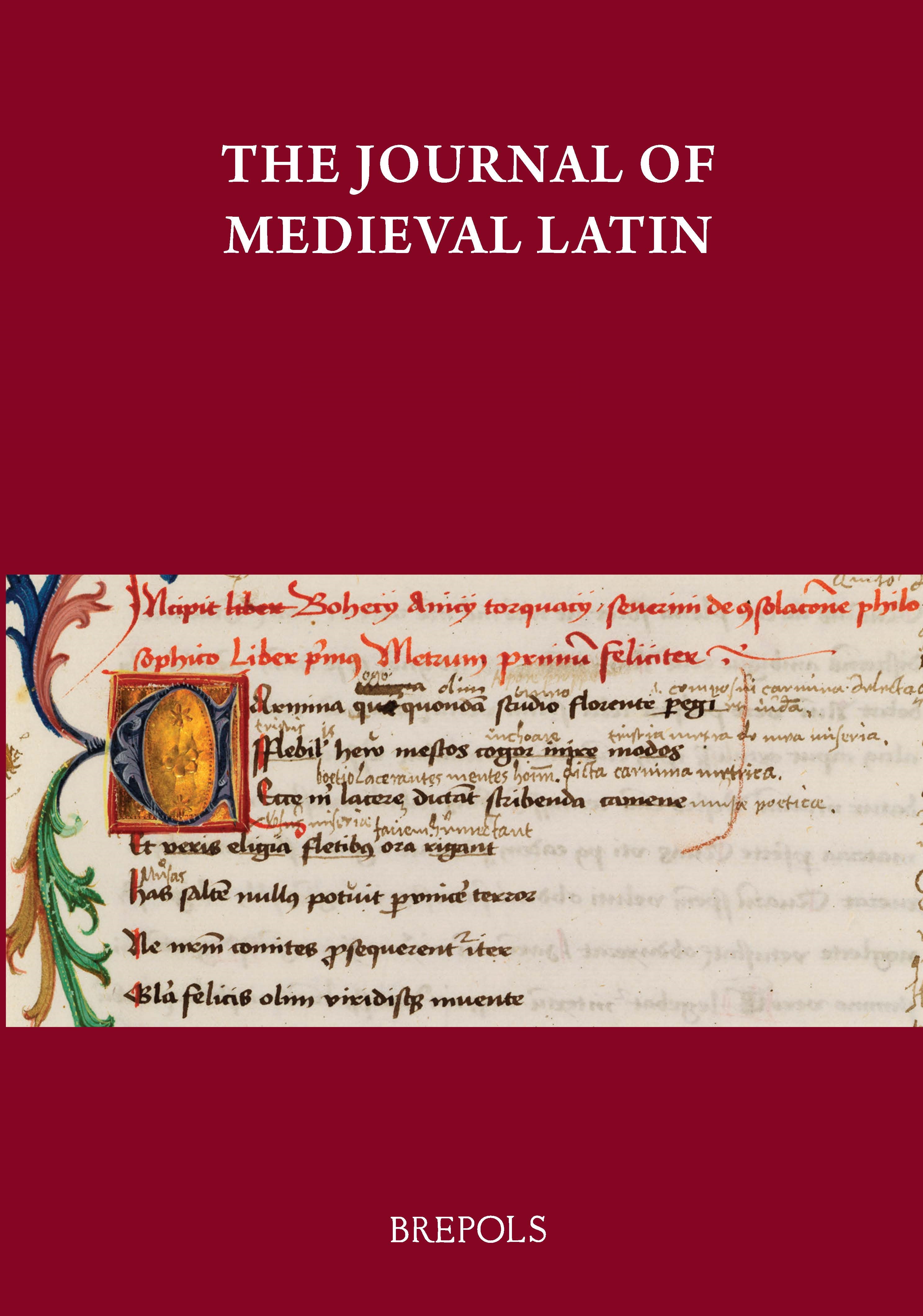
Volume 24, Issue 1, 2014
-
-
Front Matter ("Editorial Board", "Title Page", "Copyright Page", "Table of Contents")
show More to view fulltext, buy and share links for:Front Matter ("Editorial Board", "Title Page", "Copyright Page", "Table of Contents") show Less to hide fulltext, buy and share links for: Front Matter ("Editorial Board", "Title Page", "Copyright Page", "Table of Contents")
-
-
-
Quotation, Revision, and Narrative Structure in Giraldus Cambrensis’s Itinerarium Kambriae
show More to view fulltext, buy and share links for:Quotation, Revision, and Narrative Structure in Giraldus Cambrensis’s Itinerarium Kambriae show Less to hide fulltext, buy and share links for: Quotation, Revision, and Narrative Structure in Giraldus Cambrensis’s Itinerarium KambriaeBy: Georgia HenleyAbstractGiraldus Cambrensis is renowned for his historical and ethnographic works on Ireland and Wales. His sources for these texts are less clear, and the purpose of this article is to examine his usage of classical, biblical, and patristic texts as sources for quotations in the Itinerarium Kambriae, with reference to his other works when necessary. It argues that the quotations which appear in the text as altered from the original source are not the result of misquotation or faulty memory, as has been claimed previously, but of deliberate reworking to fit the context and the argument of the passage in which the quotation appears. This deft manipulation of quotations to support his argument reveals a level of rhetorical skill and awareness not previously acknowledged. The article also finds attribution for several quotations whose origins were previously unknown. As Giraldus was in the habit of adding quotations and self-quoted passages to his works over time, this discussion is followed by an examination of his revisions to the Itinerarium Kambriae and the implications of these revisions on the transmission of his work.
AbstractGiraldus Cambrensis est connu pour ses ecrits historiques et ethnographiques sur l’Irlande et le Pays de Galles. Ses sources pour ces textes sont moins claires, et le but de cet article est d’examiner son usage des textes classiques, bibliques et patristiques comme sources de citations dans l’Itinerarium Kambriae, en référant à ses autres oeuvres quand il en est nécessaire. L’article soutient que les citations qui figurent dans le texte ne sont pas modifiées de ses sources d’origine à cause d’une citation erronée ou d’une mémoire défaillante, comme l’on avait auparavant soutenu, mais d’un remaniement délibéré pour les adapter au contexte et à l’argument du passage dans lequel la citation figure. Cette manipulation habile des citations pour soutenir son argument révèle un niveau de compétence et de conscience rhétoriques ignoré jusqu’à présent. L’article trouve aussi les attributions de plusieurs citations dont les sources étaient auparavant inconnues. Puisque Giraldus a l’habitude d’ajouter des citations et des passages de ses propres œuvres à ses écrits au cours du temps, cette discussion est suivie par une étude de ses révisions de l’Itinerarium Kambriae et les conséquences de ces révisions sur la transmission de son œuvre. (Translation by Gregory Darwin)
-
-
-
Notes on John of Garland, Epithalamium Beatae Virginis Mariae
show More to view fulltext, buy and share links for:Notes on John of Garland, Epithalamium Beatae Virginis Mariae show Less to hide fulltext, buy and share links for: Notes on John of Garland, Epithalamium Beatae Virginis MariaeBy: Gregory HaysAbstractThis article discusses various passages in John of Garland’s Epithalamium Beatae Virginis Mariae, primarily cases where the text or Italian translation of Antonio Saiani (1995) can be improved. An appendix lists some sources and similia not identified by Saiani.
AbstractCet article traite de divers passages de l’Épithalamium Beatae Virginis Mariae de Jean de Garlande, principalement les cas ou le texte ou la traduction italienne d’ Antonio Saiani (1995) peuvent être améliorés. Une annexe énumère certaines sources et similia non pas identifiés par Saiani.
-
-
-
Learning for God: Education in the Carolingian Age
show More to view fulltext, buy and share links for:Learning for God: Education in the Carolingian Age show Less to hide fulltext, buy and share links for: Learning for God: Education in the Carolingian AgeBy: John J. ContreniAbstractSchools in the Carolingian age functioned within a context of political fragmentation, geographic isolation, institutional insecurity, limited communication, limited and unequal distribution of resources, and frequent political and social violence. Thus, the history of education in the Carolingian period was discontinuous. Nevertheless, reform movements made education and learning socially significant. At the heart of the reforms was a profound respect for the power of books and their texts to lead Europeans to truth. The collection, organization, and systematization of knowledge in book form is the principal achievement of Carolingian schools and their teachers. The continuity of Carolingian education, so difficult to observe in human and institutional terms, is implicit in the texts teachers and scholars created.
AbstractLes écoles carolingiennes connurent un contexte de fragmentation politique, d’isolement géographique, d’insécurité institutionelle, de communication limitée, de distribution limitée et inégale des ressources, enfin de fréquentes violences sociales et politiques. C’est pourquoi l’histoire de l’éducation durant la période carolingienne a été discontinue. Néanmoins, des mouvements de réforme ont donné à l’éducation et à la connaissance une place significative dans la société carolingienne. Au cœur des réformes il y avait un profond respect pour le pouvoir des livres et de leurs textes à mener les Européens à la vérité. La collecte, l’organisation et la systématisation du savoir sous forme livresque est la principale réussite des écoles carolingiennes et de leurs maîtres. La continuité de l’histoire de l’éducation carolingienne, si difficile à observer au niveau des hommes et des institutions, est implicite dans les textes écrits par les maîtres et les érudits.
-
-
-
La figure de Guillaume de Gellone d’après la Vita sancti Willelmi (v. 1125) : quelques remarques sur ses modèles hagiographiques
show More to view fulltext, buy and share links for:La figure de Guillaume de Gellone d’après la Vita sancti Willelmi (v. 1125) : quelques remarques sur ses modèles hagiographiques show Less to hide fulltext, buy and share links for: La figure de Guillaume de Gellone d’après la Vita sancti Willelmi (v. 1125) : quelques remarques sur ses modèles hagiographiquesBy: Jean MeyersAbstractIn the Vita Willelmi, William presents the figure of a warrior monk who offers an original synthesis of the two sides of caritas, the military service for Christ and the withdrawal from the world. This Vita fits into the context of the late-eleventh century conflict between the abbey of Gellone and its neighbour Aniane. The purpose of this paper is to focus upon the literary dimension of this text in order to situate the conflict between the two neighbouring institutions on the field of writing. We thus see that by using different hagiographic models, the author of the Vita engages in a “battle of writing” both to surpass the Vita Benedicti of Ardon and to place his text and his hero in a monastic tradition in which Martin and Hilarion are the preeminent examples.
AbstractDans la Vita Willelmi, Guillaume présente la figure d’un moine guerrier qui offre une synthèse originale des deux pendants de la caritas, l’engagement au service du Christ et le retrait du monde. Cette Vita s’insère dans le contexte du conflit qui opposa, à partir de la fin du XIe siècle, l’abbaye de Gellone à sa voisine Aniane. Le but de cet article est de tenir compte dans l’analyse du texte de sa dimension litteraire et de placer le conflit entre les deux établissements voisins sur le terrain de l’écriture. On verra ainsi qu’en reprenant différents modèles hagiographiques, l’auteur de la Vita se livre à une « bataille d’écriture » à la fois pour surpasser la Vita Benedicti d’Ardon et pour inscrire son texte et son heros dans une tradition du monachisme dont Martin et Hilarion forment les jalons essentiels.
-
-
-
Puer and Pueritia in Bede’s Historia Ecclesiastica Gentis Anglorum
show More to view fulltext, buy and share links for:Puer and Pueritia in Bede’s Historia Ecclesiastica Gentis Anglorum show Less to hide fulltext, buy and share links for: Puer and Pueritia in Bede’s Historia Ecclesiastica Gentis AnglorumBy: Andreas LemkeAbstractThis article argues that Bede purposefully applied the terms puer and pueritia in his Historia Ecclesiastica Gentis Anglorum, not to indicate a specific age, but rather to highlight the special status of children in his “grand narrative” of the Anglo-Saxon Church. By analyzing key scenes in Bede’s narration - e.g. the famous story of Pope Gregory and the Anglian youths - this article shows that children play an important role in the Christianization process. They are portrayed as innocent, pious, and believing from the start. These qualities apparently set them apart from their adult counterparts and are evidently implied by Bede’s usage of the term puer and pueritia. Bede’s terminology denotes that children are privileged with regard to divine truth, a privilege withheld from adolescents and grown-ups. In that capacity pueri serve as role models in contrast to adults and are symbolically (re)born as children of God through their baptism, accepting Him as their “spiritual father.” In this interpretation of the role of pueri Bede draws upon the tradition of the Gospels, his exegetical works thereof, and Isidore of Seville’s Etymologiae in order to educate his readers and inculcate Christian piety and morals to make them worthier children of God.
AbstractCet article révèle que Bede emploie intentionnellement les termes puer et pueritia dans sa Historia Ecclesiastica Gentis Anglorum, pas pour se référer à un age spécifique, mais plutôt pour accentuer la position particulière des enfants dans sa « grande histoire » de l’Église anglosaxonne. En analysant des scenes décisives dans le récit de Bede - par exemple la fameuse histoire de Pape Grégoire et des éphèbes - cet article montre que les enfants jouent un rôle principal dans le procès de la christianisation. Ils sont décrits comme innocents, pieux et croyants des le début. Ces qualités, évidemment impliquées par l’usage des termes puer et pueritia, représentent la différence entre eux et leurs contemporains adultes. La terminologie de Bede exprime que les enfants sont privilégiés en ce qui concerne la vérité divine, de laquelle les adolescents et les adultes sont privés. Ainsi, les pueri, contrairement aux adultes, servent comme modèles et sont symboliquement nés/régénérés comme enfants de Dieu par leur baptême, en l’acceptant comme leur « père spirituel . Dans cette interprétation du rôle des pueri, Bede suit la tradition des gospels, ses travails exégétiques là-dessus et l’Etymologiae d’Isidore de Séville pour cultiver ses lecteurs et pour enfoncer de la piété et de la morale chrétienne dans leurs têtes et les transformer en enfants de Dieu plus dignes.
-
-
-
The Manipulus florum, Johannes Nider’s Formicarius, and Late Medieval Misogyny in the Construction of Witches prior to the Malleus maleficarum
show More to view fulltext, buy and share links for:The Manipulus florum, Johannes Nider’s Formicarius, and Late Medieval Misogyny in the Construction of Witches prior to the Malleus maleficarum show Less to hide fulltext, buy and share links for: The Manipulus florum, Johannes Nider’s Formicarius, and Late Medieval Misogyny in the Construction of Witches prior to the Malleus maleficarumBy: Chris NighmanAbstractThis article demonstrates and analyses Johannes Nider’s reception of Thomas of Ireland’s Manipulus florum, a popular early fourteenth-century florilegium, in composing the fifth book of his Formicarius, a very influential text for the development of the gendered witch stereotype in the fifteenth century. It also examines the lemmata “Mulier” and “Coniugium” in the Manipulus, arguing that Thomas of Ireland’s construction of those topics was essentially misogamous, rather than misogynous, though its reception by Nider was informed by misogyny.
AbstractCet article montre et analyse la réception par Johannes Nider du Manipulus florum, un florilège populaire compilé au début du quatorzième siècle, en composant le cinquième livre de son Formicarius, un texte très influent pour le développement du stéréotype de la sorcière dans le quinzième siècle. Il examine également les lemmes « Mulier » et «Coniugium » dans le Manipulus, faisant valoir que la construction de Thomas de l’Irlande de ces sujets était essentiellement contre la matrimonie, plutôt que misogyne, même si sa réception par Nider a été informée par la misogynie.
-
-
-
The Epistolae Duorum Amantium, Abelard, and Heloise: An Annotated Concordance
show More to view fulltext, buy and share links for:The Epistolae Duorum Amantium, Abelard, and Heloise: An Annotated Concordance show Less to hide fulltext, buy and share links for: The Epistolae Duorum Amantium, Abelard, and Heloise: An Annotated ConcordanceAbstractThis concordance juxtaposes passages from the Epistolae duorum amantium with passages from the authentic writings of Abelard and Heloise which have clear resonance with the anonymously transmitted love letters. The accumulated evidence of authorship by Abelard and Heloise is considerable. At the same time the flaws in argumentation of the most prominent and vocal deniers of the ascription leave the current state of the question clear: authorship by Abelard and Heloise is probable; few arguments of substance opposing that claim remain. The texts juxtaposed here do not prove authorship by Abelard and Heloise conclusively, but they more than justify placing them in the foreground as the legitimate focus of study of the question, who wrote the Epistolae duorum amantium.
AbstractCette concordance juxtapose des passages textuels des Epistolae duorum amantium, avec des passages qui correspondent aux écrits authentiques d’Abélard et Héloïse. Les indices accumulés qui soutiennent l’attribution a Abélard et Héloïse sont considérables. En même temps on peut voir que les arguments contre l’attribution par des savants prominents contiennent de telles erreurs de méthode et de substance qu’ils ne peuvent pas convaincre. Les textes ici juxtaposés ne prouvent pas décisivement qu’Abélard et Heloïse soient les auteurs des ces lettres d’amour anonymement transmises, mais ils rendent indoutable la thèse que les deux amants célèbres du douzième siècle doivent avoir la première place en investigation de la question, qui a écrit les Epistolae duorum amantium.
-
-
-
Lexomic Analysis of Medieval Latin Texts
show More to view fulltext, buy and share links for:Lexomic Analysis of Medieval Latin Texts show Less to hide fulltext, buy and share links for: Lexomic Analysis of Medieval Latin TextsAuthors: Sarah Downey, Michael D. C. Drout, Veronica E. Kerekes and Douglas C. RaffleAbstractIn this paper we demonstrate how “lexomic” methods of computer-assisted statistical analysis can be adapted to the investigation of the structures, styles, sources, and authorship of Medieval Latin texts. The methods, which compare the vocabulary distributions of segments of texts, are first shown to produce results consistent with “control” texts whose characteristics have been determined by more traditional approaches. These controls include Waltharius, the Vita sancti Martini of Sulpicius Severus, Alan of Lille’s De planctu naturae, the Vita Merlini by Geoffrey of Monmouth, and the Gesta Friderici Imperatoris, and thus represent both poetry and prose from multiple genres, centuries, and geographical locations. After successfully testing the methods against the controls, we demonstrate how they may be applied to investigate texts whose characteristics are unknown or disputed. Our analysis of Dante’s Epistolae provides evidence that paragraphs 5-33 of the letter to Can Grande are not by Dante, a point disputed in Dante scholarship. We then examine Bede’s Historia Ecclesiastica and discover evidence that strongly suggests that Ceolfrid, Bede’s one-time abbot, was the author not only of the letter to King Nechtan that Bede quotes, but also of a computus-focused account of the Synod at Whitby that appears in Book 3, chapter 25, of the Ecclesiastical History. We thus demonstrate that lexomic methods, when used in conjunction with traditional forms of analysis, are useful for the investigation of Medieval Latin texts.
AbstractCet article a pour but de montrer comment les méthodes « lexomiques » d’analyse statistique assistée par ordinateur peuvent être adaptées a l’enquête sur les structures, les styles, les sources, et les auteurs de textes latins médievaux. Nous montrons d’abord que les méthodes, qui comparent les distributions de vocabulaire dans des segments de textes, fournissent des résultats cohérents par rapport aux textes de « contrôle » que sont le Waltharius, la Vita Martini de Sulpice-Sévère, le De planctu naturae d’Alain de Lille, la Vita Merlini de Geoffroy de Monmouth, et la Gesta Friderici Imperatoris, textes dont les caractéristiques ont été déterminées par des approches plus traditionnelles et qui représentent tant la poésie que la prose de genres divers, de différents siècles et lieux géographiques. Après avoir vérifié avec succès les methodes contre les textes de contrôle, nous montrons comment celles-ci peuvent être appliquées pour enquêter sur des textes aux caractéristiques inconnues ou disputées. Notre analyse des Epistolae de Dante semble bien démontrer que les paragraphes 5 à 33 de la lettre à Can Grande ne sont pas de Dante, un point conteste dans les recherches sur Dante. Puis notre examen de l’Historia Ecclesiastica de Bède fournit des éléments qui suggèrent de manière convaincante que Ceolfrid, qui fut l’abbé de Bède, serait en fait l’auteur non seulement de la lettre au roi Nechtan que Bède cite, mais encore celui d’un compte rendu sur le Synode de Whitby plus particulièrement centre sur le computus, texte apparaissant au Chapitre 25 du Livre 3 de l’Histoire Ecclésiastique. Nous montrons ainsi que les méthodes « lexomicques, employées conjointement avec les formes traditionnelles d’analyse, sont utiles à l’enquête sur les textes latins médiévaux.
-
-
-
Another Manuscript of Walter Map’s “Dissuasio Valerii”
show More to view fulltext, buy and share links for:Another Manuscript of Walter Map’s “Dissuasio Valerii” show Less to hide fulltext, buy and share links for: Another Manuscript of Walter Map’s “Dissuasio Valerii”By: Ralph HannaAbstractThis essay corrects one omission from Traugott Lawler’s and my earlier edition of Walter Map’s “Dissuasio Valerii,” extant in over 160 copies. At the time, we did not know of one copy that would have been germane to our inquiries, the acephalous fragment at Dublin, Trinity College, MS 515, fols. 5r-7v. Although lacking about twenty percent of the text, this manuscript proves important, first because it is a representative of the narrowly diffused authorial form of the text; and second because it offers overt evidence of what appears inferentially across the manuscript tradition, the conflation of readings from more than one textual source.
AbstractCet article corrige une lacune dans l’édition que j’ai produite avec Traugott Lawler du « Dissuasio Valerii » de Walter Map, qui subsiste en plus de 160 exemplaires. À l’époque, nous ignorions l’existence d’un exemplaire pertinent à nos recherches : le fragment acéphale de Dublin, Trinity College, MS 515, folios 5r-7v. Bien que ce manuscrit ne contienne qu’environ 80% du texte, il s’avère très important. Premièrement, le texte comprend les variantes de l’auteur et se présente donc sous une forme qui a connu une diffusion restreinte. Deuxièmement, il offre également une preuve tangible de ce qu’on ne peut qu’inférer à travers la tradition manuscrite, soit la combinaison de variantes textuelles provenant de plus d’une source.
-
-
-
Constance Brittain BOUCHARD, ed. Three Cartularies from Thirteenth-Century Auxerre
show More to view fulltext, buy and share links for:Constance Brittain BOUCHARD, ed. Three Cartularies from Thirteenth-Century Auxerre show Less to hide fulltext, buy and share links for: Constance Brittain BOUCHARD, ed. Three Cartularies from Thirteenth-Century AuxerreBy: Jonathan Herold
-
-
-
Catherine A. M. CLARKE. Writing Power in Anglo-Saxon England: Text, Hierarchies, Economies
show More to view fulltext, buy and share links for:Catherine A. M. CLARKE. Writing Power in Anglo-Saxon England: Text, Hierarchies, Economies show Less to hide fulltext, buy and share links for: Catherine A. M. CLARKE. Writing Power in Anglo-Saxon England: Text, Hierarchies, Economies
-
-
-
Chiara CRISCIANI and Gabriella ZUCCOLIN, eds. Michele Savonarola: Medicina e cultura di corte
show More to view fulltext, buy and share links for:Chiara CRISCIANI and Gabriella ZUCCOLIN, eds. Michele Savonarola: Medicina e cultura di corte show Less to hide fulltext, buy and share links for: Chiara CRISCIANI and Gabriella ZUCCOLIN, eds. Michele Savonarola: Medicina e cultura di corte
-
-
-
Mary GARRISON, Áprád P. ORBÁN, and Marco MOSTERT, eds. Spoken and Written Language: Relations between Latin and the Vernacular Languages in the Earlier Middle Ages
show More to view fulltext, buy and share links for:Mary GARRISON, Áprád P. ORBÁN, and Marco MOSTERT, eds. Spoken and Written Language: Relations between Latin and the Vernacular Languages in the Earlier Middle Ages show Less to hide fulltext, buy and share links for: Mary GARRISON, Áprád P. ORBÁN, and Marco MOSTERT, eds. Spoken and Written Language: Relations between Latin and the Vernacular Languages in the Earlier Middle AgesBy: Lucie Doležalová
-
-
-
James GRIER, ed. Ademari Cabannensis opera liturgica et poetica, Musica cum textibus
show More to view fulltext, buy and share links for:James GRIER, ed. Ademari Cabannensis opera liturgica et poetica, Musica cum textibus show Less to hide fulltext, buy and share links for: James GRIER, ed. Ademari Cabannensis opera liturgica et poetica, Musica cum textibus
-
-
-
Eric KNIBBS and E. Ann MATTER, eds. Alcuini Eboracensis, De fide sanctae Trinitatis et de incarnatione Christi [and] Quaestiones de sancta Trinitate
show More to view fulltext, buy and share links for:Eric KNIBBS and E. Ann MATTER, eds. Alcuini Eboracensis, De fide sanctae Trinitatis et de incarnatione Christi [and] Quaestiones de sancta Trinitate show Less to hide fulltext, buy and share links for: Eric KNIBBS and E. Ann MATTER, eds. Alcuini Eboracensis, De fide sanctae Trinitatis et de incarnatione Christi [and] Quaestiones de sancta Trinitate
-
-
-
Anne A. LATOWSKY. Emperor of the World: Charlemagne and the Construction of Imperial Authority, 800–1229
show More to view fulltext, buy and share links for:Anne A. LATOWSKY. Emperor of the World: Charlemagne and the Construction of Imperial Authority, 800–1229 show Less to hide fulltext, buy and share links for: Anne A. LATOWSKY. Emperor of the World: Charlemagne and the Construction of Imperial Authority, 800–1229
-
-
-
David LUSCOMBE, ed., Betty RADICE, trans., and David LUSCOMBE, translation rev. The Letter Collection of Peter Abelard and Heloise
show More to view fulltext, buy and share links for:David LUSCOMBE, ed., Betty RADICE, trans., and David LUSCOMBE, translation rev. The Letter Collection of Peter Abelard and Heloise show Less to hide fulltext, buy and share links for: David LUSCOMBE, ed., Betty RADICE, trans., and David LUSCOMBE, translation rev. The Letter Collection of Peter Abelard and HeloiseBy: Alexander Andrée
-
-
-
J. MARTÍNEZ GÁZQUEZ, Ó. DE LA CRUZ PALMA, and C. FERRERO HERNÁNDEZ eds. Estudios de Latín Medieval Hispánico
show More to view fulltext, buy and share links for:J. MARTÍNEZ GÁZQUEZ, Ó. DE LA CRUZ PALMA, and C. FERRERO HERNÁNDEZ eds. Estudios de Latín Medieval Hispánico show Less to hide fulltext, buy and share links for: J. MARTÍNEZ GÁZQUEZ, Ó. DE LA CRUZ PALMA, and C. FERRERO HERNÁNDEZ eds. Estudios de Latín Medieval Hispánico
-
-
-
Franco MORENZONI, ed. Guillelmi Alverni Sermones de tempore
show More to view fulltext, buy and share links for:Franco MORENZONI, ed. Guillelmi Alverni Sermones de tempore show Less to hide fulltext, buy and share links for: Franco MORENZONI, ed. Guillelmi Alverni Sermones de temporeBy: Carolyn Muessig
-
-
-
Peter RIEDLBERGER, ed. and trans. Philologischer, Historischer und Liturgischer Kommentar zum 8. Buch der Johannis des Goripp nebst kritischer Edition und Übersetzung
show More to view fulltext, buy and share links for:Peter RIEDLBERGER, ed. and trans. Philologischer, Historischer und Liturgischer Kommentar zum 8. Buch der Johannis des Goripp nebst kritischer Edition und Übersetzung show Less to hide fulltext, buy and share links for: Peter RIEDLBERGER, ed. and trans. Philologischer, Historischer und Liturgischer Kommentar zum 8. Buch der Johannis des Goripp nebst kritischer Edition und Übersetzung
-
-
-
Lorenz WEINRICH, trans. Sicard von Cremona: Mitralis, Der Gottesdienst der Kirche
show More to view fulltext, buy and share links for:Lorenz WEINRICH, trans. Sicard von Cremona: Mitralis, Der Gottesdienst der Kirche show Less to hide fulltext, buy and share links for: Lorenz WEINRICH, trans. Sicard von Cremona: Mitralis, Der Gottesdienst der KircheBy: Neil Adkin
-
-
-
Wanda ZEMLER-CIZEWSKI, trans. Peter Abelard: An Exposition on the Six-Day Work; Steven R. CARTWRIGHT, trans. Peter Abelard: Commentary on the Epistle to the Romans
show More to view fulltext, buy and share links for:Wanda ZEMLER-CIZEWSKI, trans. Peter Abelard: An Exposition on the Six-Day Work; Steven R. CARTWRIGHT, trans. Peter Abelard: Commentary on the Epistle to the Romans show Less to hide fulltext, buy and share links for: Wanda ZEMLER-CIZEWSKI, trans. Peter Abelard: An Exposition on the Six-Day Work; Steven R. CARTWRIGHT, trans. Peter Abelard: Commentary on the Epistle to the RomansBy: Willemien Otten
-
Volumes & issues
-
Volume 35 (2025)
-
Volume 34 (2024)
-
Volume 33 (2023)
-
Volume 32 (2022)
-
Volume 31 (2021)
-
Volume 30 (2020)
-
Volume 29 (2019)
-
Volume 28 (2018)
-
Volume 27 (2017)
-
Volume 26 (2016)
-
Volume 25 (2015)
-
Volume 24 (2014)
-
Volume 23 (2013)
-
Volume 22 (2012)
-
Volume 21 (2011)
-
Volume 20 (2010)
-
Volume 19 (2009)
-
Volume 18 (2008)
-
Volume 17 (2007)
-
Volume 16 (2006)
-
Volume 15 (2005)
-
Volume 14 (2004)
-
Volume 13 (2003)
-
Volume 12 (2002)
-
Volume 11 (2001)
-
Volume 10 (2000)
-
Volume 9 (1999)
-
Volume 8 (1998)
-
Volume 7 (1997)
-
Volume 6 (1996)
-
Volume 5 (1995)
-
Volume 4 (1994)
-
Volume 3 (1993)
-
Volume 2 (1992)
-
Volume 1 (1991)
Most Read This Month
