


EMISCS99

Collection Contents
51 - 57 of 57 results
-
-
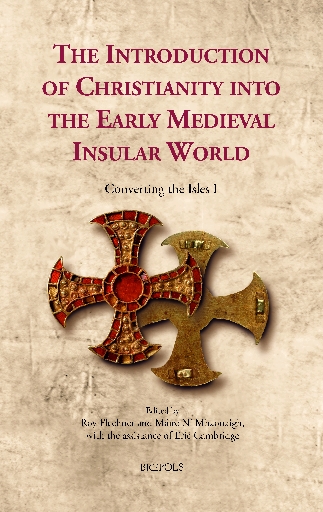
The Introduction of Christianity into the Early Medieval Insular World
show More to view fulltext, buy and share links for:The Introduction of Christianity into the Early Medieval Insular World show Less to hide fulltext, buy and share links for: The Introduction of Christianity into the Early Medieval Insular WorldConversion to Christianity is arguably the most revolutionary social and cultural change that Europe experienced throughout Late Antiquity and the early Middle Ages. Christianisation affected all strata of society and transformed not only religious beliefs and practices, but also the nature of government, the priorities of the economy, the character of kinship, and gender relations. It is against this backdrop that an international array of leading medievalists gathered under the auspices of the Converting the Isles Research Network (funded by the Leverhulme Trust) to investigate social, economic, and cultural aspects of conversion in the early medieval Insular world, covering different parts of Britain, Ireland, Scandinavia, and Iceland.
This is is the first of two volumes showcasing research generated through the ‘Converting the Isles’ Network. This volume focuses on specific aspects of the introduction of Christianity into the early medieval Insular world, including the nature and degree of missionary activity involved, socio-economic stimulants for conversion, as well as the depiction and presentation of a Christian saint. Its companion volume has the transformation of landscape as its main theme. By adopting a broad comparative and crossdisciplinary approach that transcends national boundaries, the material presented here and in volume II offers novel perspectives on conversion that challenge existing historiographical narratives and draw on up-to-date archaeological and written evidence in order to shed light on central issues pertaining to the conversion of the Isles.
-
-
-
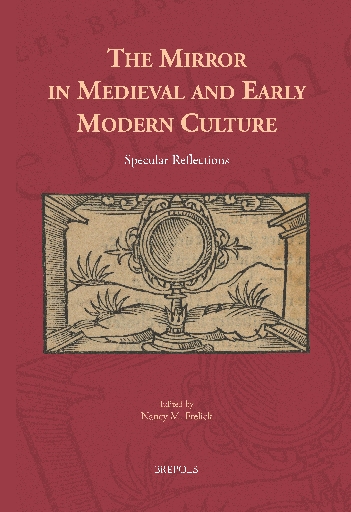
The Mirror in Medieval and Early Modern Culture
show More to view fulltext, buy and share links for:The Mirror in Medieval and Early Modern Culture show Less to hide fulltext, buy and share links for: The Mirror in Medieval and Early Modern CultureMirrors have always fascinated humankind. They collapse ordinary distinctions, making visible what is normally invisible, and promising access to hidden realities. Yet, these liminal objects also point to the limitations of human perception, knowledge, and wisdom. In this interdisciplinary volume, specialists in medieval and early modern science, cultural and political history, as well as art history, philosophy, and literature come together to explore the intersections between material and metaphysical mirrors in Europe and the Islamic world. During the time periods studied here, various technologies were transforming the looking glass as an optical device, scientific instrument, and aesthetic object, making it clearer and more readily available, though it remained a rare and precious commodity. While technical innovations spawned new discoveries and ways of seeing, belief systems were slower to change, as expressed in the natural sciences, mystical writings, literature, and visual culture. Mirror metaphors based on analogies established in the ancient world still retained significant power and authority, perhaps especially when related to Aristotelian science, the medieval speculum tradition, religious iconography, secular imagery, Renaissance Neoplatonism, or spectacular Baroque engineering, artistry, and self-fashioning. Mirror effects created through myths, metaphors, rhetorical strategies, or other devices could invite self-contemplation and evoke abstract or paradoxical concepts. Whether faithful or deforming, specular reflections often turn out to be ambivalent and contradictory: sometimes sources of illusion, sometimes reflections of divine truth, mirrors compel us to question the very nature of representation.
-
-
-
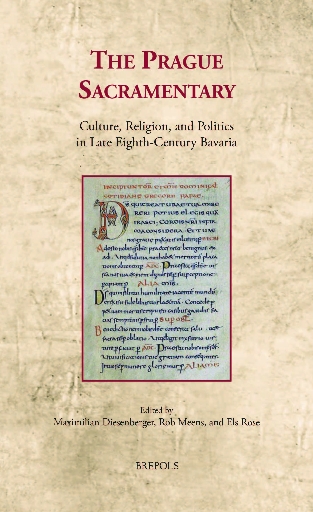
The Prague Sacramentary
show More to view fulltext, buy and share links for:The Prague Sacramentary show Less to hide fulltext, buy and share links for: The Prague SacramentaryThe Prague Sacramentary is a unique liturgical manuscript which can be very precisely located in a specific social and historical context. It was written in the turbulent period when Charlemagne crossed Bavaria to fight the Avars and when his son Pippin rebelled against him, seeking support among the Bavarian nobility. The manuscript can be linked to specific groups of Bavarian elites that had to come to terms with this explosive political situation. It also elucidates the ways in which Christian culture was expressed and experienced in Bavaria at the end of the eighth century. Although Bavaria may be regarded as a periphery from a Frankish perspective, it was certainly no cultural backwater. Because of its geographical position at the crossroads of Italian, Bavarian, and Frankish culture, Bavaria produced unique and intriguing texts and artefacts.
One such object is analysed here by a team of experts, shedding renewed light on the earthly and heavenly concerns of an early medieval community in a specific region. It includes a discussion of the topics of the formal invocation of saints, vernacular understandings of Latin texts, marriage, politics, and concerns for ritual purity as well as the well-being of the conflict-ridden Carolingian family.
-
-
-
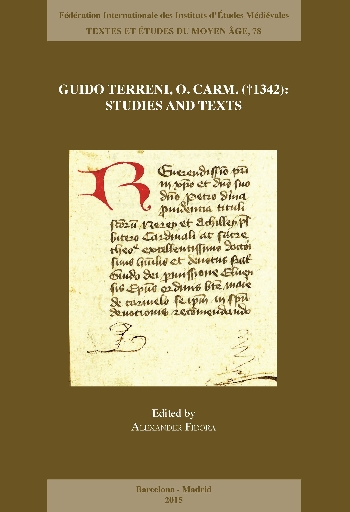
Guido Terreni, O. Carm. ( †1342)
show More to view fulltext, buy and share links for:Guido Terreni, O. Carm. ( †1342) show Less to hide fulltext, buy and share links for: Guido Terreni, O. Carm. ( †1342)The Catalan philosopher and theologian Guido Terreni (ca. 1270-1342) is one of the most outstanding fi gures in the history of the Carmelite order. The articles gathered in the first part of this volume explore the extremely rich, though still understudied, oeuvre of the Bishop of Majorca and Elne which comprises philosophicotheological, polemical, biblical and juridical texts. Since many of these works remain unedited, the second part of the volume contains selected text editions from Guido’s commentaries on Aristotle’s Physics and the Decretum Gratiani, as well as from his influential Quodlibetal Questions. Altogether, the sixteen contributions in this volume offer a comprehensive and up-to-date appraisal of Guido’s major contribution to the intellectual and political debates of his age and beyond.
-
-
-
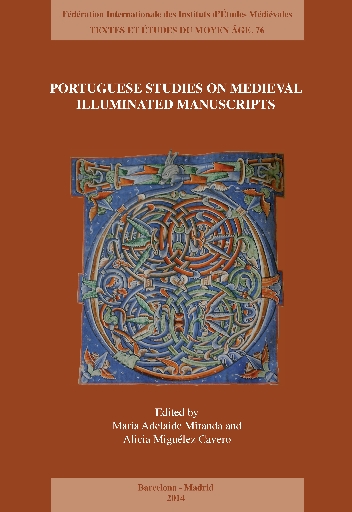
Portuguese Studies on Medieval Illuminated Manuscripts
show More to view fulltext, buy and share links for:Portuguese Studies on Medieval Illuminated Manuscripts show Less to hide fulltext, buy and share links for: Portuguese Studies on Medieval Illuminated ManuscriptsIn the most recent years a group of young researchers has given a new impetus to the study of Book Illumination in Portugal, promoting national and international research that focuses on understanding illuminated manuscripts in both their aesthetics and material dimensions, as well as the relationship between text and image. The developement of interdisciplinary research thanks, in part, to strategic partnerships between the Humanities and the domain of Exact Science has been established to address new issues raised by the need of more comprehensive and wide studies around the illuminated manuscript.
This volume gives thus light to the most important contributions of these new approaches, including new technical studies of pigments in manuscripts of the fund of the Monastery of Alcobaça and three copies of Hugh of Fouilloy’s Book of Birds, inquiries concerning a mismounted mappamundiin the Lorvão Beatus, a study of two southern French legal manuscripts, the image of the artist in astrological iconography, problems raised by two books of hours in the National Library of Portugal, and penwork decoration in fifteenth-century Hebrew manuscripts.
The authors of the volume belong to three Portuguese academic institutions. Maria Adelaide Miranda, Alicia Miguélez Cavero, Catarina Fernandes Barreira, Maria Alessandra Bilotta, Ana Lemos and Luís Ribeiro are integrated members of the Institute of Medieval Studies of the Nova University of Lisbon; Maria João Melo, Rita Castro, Conceição Casanova, Vania Solange Muralhas e Rita Araújo are members of the Department of Conservation and Restoration of the Nova University of Lisbon; Luís Urbano Afonso e Tiago Moita are members of the Institute of History of Art of the University of Lisbon.
-
-
-

Reading Sacred Scripture with Thomas Aquinas
show More to view fulltext, buy and share links for:Reading Sacred Scripture with Thomas Aquinas show Less to hide fulltext, buy and share links for: Reading Sacred Scripture with Thomas AquinasThomas Aquinas is still most widely known for his works in systematic theology (Summa theologiae) and as a commentator of Aristotle. Recent decades, however, have seen a revived interest in Aquinas as a biblical scholar. The essays gathered in this volume explore the richness of his biblical commentaries by analyzing the hermeneutical tools employed in his reading of Scripture and investigating the contemporary relevance of his biblical exegesis. Its goal is to familiarize the contemporary reader with an indispensable dimension of his scholarly activity: as a master in Sacred Scripture (magister in sacra pagina) Aquinas taught theology as a form of speculative reading of the revealed Word of God and hence the reading of the various books of the Bible constituted the axis of his scriptural didactics. Altogether, the nineteen contributions in the volume offers an up-to-date analysis of Aquinas’s contribution to medieval biblical exegesis and points to ways in which it can enrich contemporary debates on the relation between exegesis and systematic theology.
Contributors: Christopher Baglow, Timothy F. Bellamah, Lluís Clavell, Gilbert Dahan, Leo J. Elders, Jeremy Holmes, Daniel Keating, Matthew Levering, Enrique Martínez, Miroslaw Mróz, Mauricio Narváez, Marco Passarotti, Matthew J. Ramage, Elisabeth Reinhardt, Margherita Maria Rossi, Piotr Roszak, Olivier-Thomas Venard, Jörgen Vijgen, Robert J. Woźniak.
-
-
-
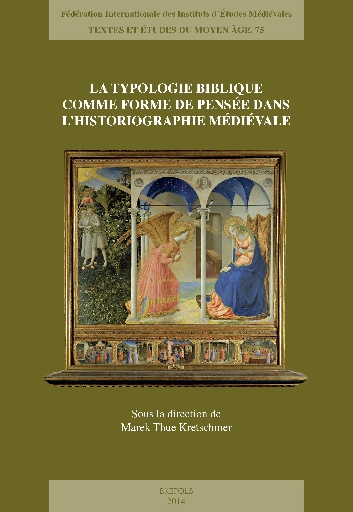
La Typologie biblique comme forme de pensée dans l'historiographie médiévale
show More to view fulltext, buy and share links for:La Typologie biblique comme forme de pensée dans l'historiographie médiévale show Less to hide fulltext, buy and share links for: La Typologie biblique comme forme de pensée dans l'historiographie médiévaleLe présent volume se propose, à travers des approches comparatives appliquées à un corpus de textes d’histoire appartenant à des périodes et des milieux différents, d’aboutir à une compréhension plus approfondie de l’infl uence de la typologie et des images bibliques sur l’historiographie du Moyen Âge: historiae, chronica, gesta, annales, vitae, epistolae, etc. Il s’agit, en effet, d’un aspect souvent négligé de l’historiographie médiévale, en raison, probablement, des controverses théoriques qui entourent le domaine. Cette publication devrait fournir de nouveaux outils de travail qui seront des apports précieux pour tous ceux qui s’intéressent à l’historiographie à l’époque médiévale.
-