Skip to content
1882
Volume 25, Issue 1
  • ISSN: 1250-7334
  • E-ISSN: 2295-9718

Abstract

Abstract

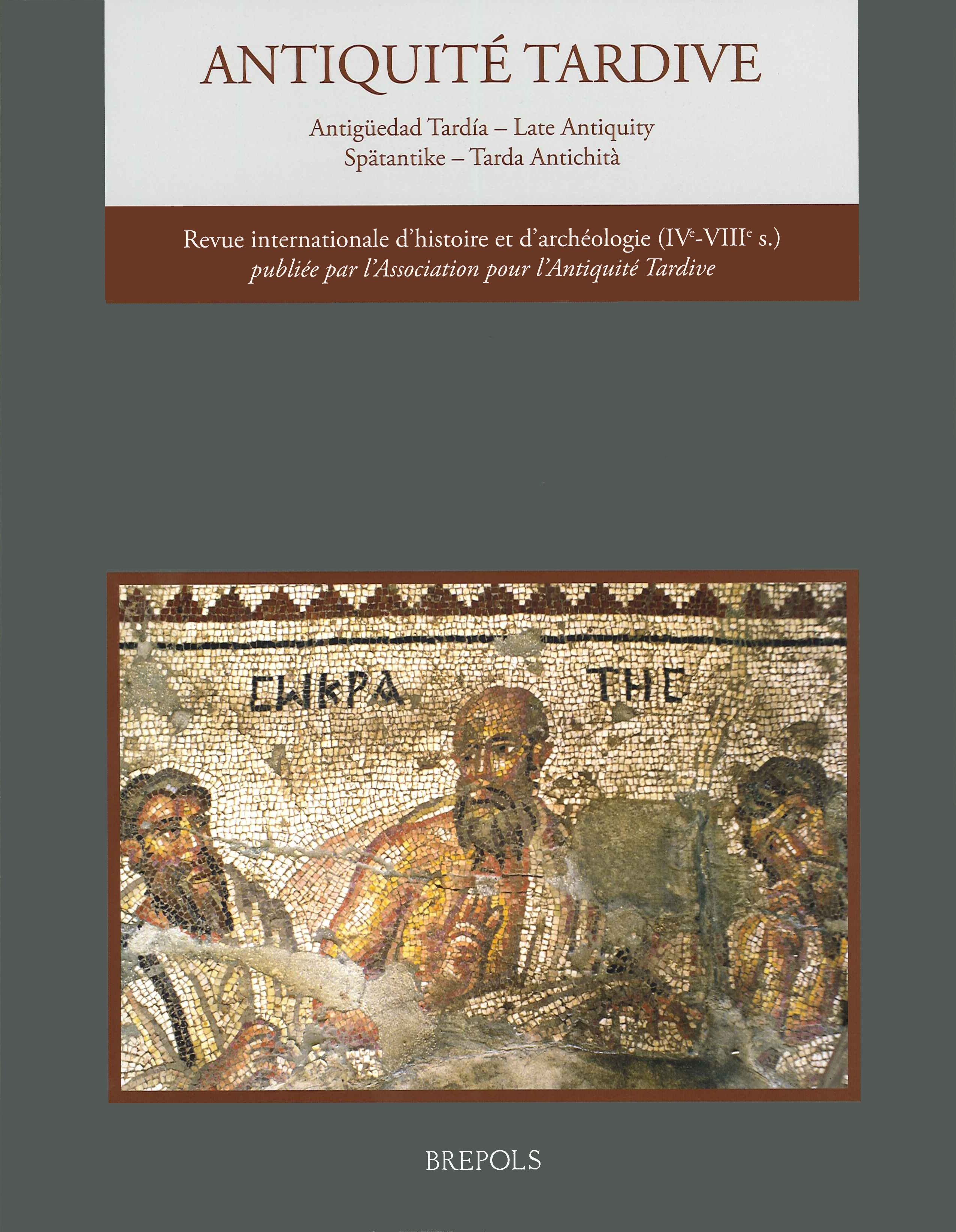
La chronologie (e, e, post-e siècle), l’origine culturelle (matrice romane ou byzantine) et l’interprétation de la mosaïque de la chapelle de l’amphithéâtre de Durres ont été longtemps débattues. L’article propose une analyse nouvelle de cette mosaïque en la replaçant dans son contexte architectural grâce à l’étude des techniques de mise en oeuvre et l’analyse physico-chimique des tesselles.

La chronologie des tesselles se place entre le e et le e siècle. Cette datation diffère toutefois de celle de la chapelle qui n’est pas bâtie avant le VIIe siècle et qui, pendant le e siècle, connaît une phase décorative qui précède la mosaïque. Est ainsi proposée l’hypothèse soit du remploi de tesselles provenant d’une autre mosaïque, soit du déplacement tardif d’une mosaïque paléochrétienne provenant d’un autre site de la ville.

Loading

Article metrics loading...

/content/journals/10.1484/J.AT.5.114867
2018-01-01
2025-12-05

Metrics

Loading full text...

Full text loading...

References

  1. Anamali S. 1993Oreficerie, gioielli bizantini in Albania: Komani,” in XL corso di cultura sull’arte ravennate e bizantina, Ravenna, pp. 435446.
    [Google Scholar]
  2. Andaloro M. 1986I mosaici parietali di Durazzo o dell’origine costantinopolitana del tema iconografico di Maria Regina,” in O. Feld, U. Peschlow (dir.), Studien zur spätantiken und byzantinischen Kunst, 3, Bonn, pp. 103115.
    [Google Scholar]
  3. Andreescu Treadgold I. 1977La mosaïque murale: histoire des restaurations, évolutions de ses techniques,” in Mosaïque n. 1, détérioration et conservation (Actes du 1er Symposium international sur la conservation des mosaïques, Rome, 2-5 novembre 1977), Paris, pp. 1935.
    [Google Scholar]
  4. Arletti R., Fiori C., Vandini M. 2010A study of glass tesserae from mosaics in the monasteries of Daphni and Hosios Loukas (Greece),” Archaeometry 52, pp. 796815.
    [Google Scholar]
  5. Bakirtzis Ch., Kourkoutidou-Nikolaidou E., Mavropoulou-Tsioumi Chr. 2014 Mosaics of Thessaloniki: 4th to 11th Century, Athens.
    [Google Scholar]
  6. Bavant B. 2004L’Illyricum,” in C. Morrisson (dir.), Le monde byzantin, I. L’Empire romain d’Orient (330-641), Paris, pp. 307351.
    [Google Scholar]
  7. Bertelli C. 1975Un antico restauro nei mosaici di Santa Maria Maggiore,” Paragone, pp. 4042.
    [Google Scholar]
  8. Boev B., Jelenkovic R. 2012Allchar deposit in Republic of Macedonia – Petrology and age determination,” in A. I. Al-Juboury (dir.), Petrology – New Perspectives and Applications 411, Rijeka, pp. 131168.
    [Google Scholar]
  9. Bonnerot O., Ceglia A., Michaelides D. 2016Technology and materials of early Christian Cypriot wall mosaics,” Journal of Archaeological Science. Report 7, pp. 649661.
    [Google Scholar]
  10. Boschetti C. 2009Alcune osservazioni sui mosaici e sulle pitture dell’anfiteatro di Durazzo,” in S. Santoro, A. Hoti (dir.), L’anfiteatro romano di Durazzo. Studi e scavi. 2004-2005 (Annuario della Scuola archeologica di Atene e delle Missioni Italiane in Oriente 83, serie III, 5, II), pp. 789799.
    [Google Scholar]
  11. Bowes K., Mitchell J. 2009The main chapel of the Durres amphitheatre,” MÉFRA 121/2, pp. 569595.
    [Google Scholar]
  12. Bowes K., Hoti A. 2003An amphiteater and its afterlives: survey and excavations in the Durres amphitheater,” JRA 16, pp. 380394.
    [Google Scholar]
  13. Brill R. H. 1988Scientific investigations of the Jalame glass and related finds,” in G. D. Weinberg (dir.), Excavations at Jalame: Site of a Glass Factory in Late Roman Palestine, University of Missouri, Columbia, pp. 257291.
    [Google Scholar]
  14. Bryer A. 1994Saint Asteios and the chapel in Dyrrachion,” Θυμίασμα στη μνήμη της Λασκαρίνας Μπούρα 1, pp. 4145.
    [Google Scholar]
  15. Castrillo M. J. 1975L’énigme de la mosaïque de Durrës,” Archéologia 79, pp. 8283.
    [Google Scholar]
  16. Cecchelli C. 1961A proposito dell’abside Lateranense,” Miscellanea Bibliothecae Hertzianae 16, pp. 1318.
    [Google Scholar]
  17. Ceglia A., Cosyns P., Nys K., Terryn H., Thienpont H., Meulebroeck W. 2015Late Antique glass distribution and consumption in Cyprus: a chemical study,” Journal of Archaeological Science 61, pp. 213222.
    [Google Scholar]
  18. Cheynet J.-Cl. 2006Les Balkans,” in J.-Cl. Cheynet (dir.), Le monde byzantin II. L’empire byzantin (641-1204), Paris, pp. 457471.
    [Google Scholar]
  19. Cholakova A., Rehren T., Freestone I. C. 2016Compositional identification of 6th c. AD glass from the Lower Danube,” Journal of Archaeological Science. Reports 7, pp. 625632.
    [Google Scholar]
  20. Conte S., Chinni T., Arletti R., Vandini M. 2014Butrint (Albania) between eastern and western Mediterranean glass production: EMPA and LA-ICP-MS of late antique and early Medieval finds,” Journal of Archaeological Science 49, pp. 620.
    [Google Scholar]
  21. Cormack R. 1985 The Church of Saint Demetrios: The Watercolours and Drawings of W.S. George, Thessaloniki.
    [Google Scholar]
  22. Cormack R. 1986 Writing in Gold. Byzantine Society and its Icons, London.
    [Google Scholar]
  23. Davis J. 2003The Durres regional archaeological project: archaeological survey in the territory of Epidamnos/Durres in Albania,” Hesperia 72, pp. 41119.
    [Google Scholar]
  24. Degryse P. 2014 Glass Making in the Graeco-Roman World, Leuven.
    [Google Scholar]
  25. Ducellier A. 1975 La façade maritime de l’Albanie au Moyen Âge, Durazzo et Valona du XIe au XVe siècle, Thessaloniki.
    [Google Scholar]
  26. Duchesne L. 1892L’Illyricum ecclésiastique,” Byzantinische Zeitschrift 1/3, Paris.
    [Google Scholar]
  27. Fiori C. 2013Mosaic Tesserae from the Basilica of San Severo and glass production in Classe, Ravenna, Italy,” in C. Entwistle, L. James (dir.), New Light on Old Glass: Recent Research on Byzantine Mosaics and Glass, London, pp. 3341.
    [Google Scholar]
  28. Fiori C., Vandini M., Mazzotti V. 2004 I colori del vetro antico. Il vetro musivo bizantino, Vicenza.
    [Google Scholar]
  29. Foster H. E., Jackson C. M. 2005‘A whiter shade of pale’? Chemical and experi-mental investigation of opaque white Roman glass gaming counters,” Glass Technology 46/5, pp. 327333.
    [Google Scholar]
  30. Foy D. 2009Les revêtements muraux en verre à la fin de l’Antiquité: quelques témoignages en Gaule méridionale,” Journal of Glass Study 50, pp. 5165.
    [Google Scholar]
  31. Foy D., Picon M., Vichy M., Thirion-Merle V. 2003Caractérisation des verres de la fin de l’Antiquité en Méditerranée occidentale: l’émergence de nouveaux courants commerciaux,” in D. Foy, M.-D. Nenna (dir.), Échanges et commerce du verre dans le monde antique (Actes du colloque de l’Association française pour l’archéologie du verre, Aix-en-Provence et Marseille, 7-9 juin 2001), Montagnac, pp. 4185.
    [Google Scholar]
  32. Freestone I. C. 2005The provenance of ancient glass through composi-tional analysis,” Materials Research Society Symposia Proceedings 852, pp. 114.
    [Google Scholar]
  33. Freestone I. C. 2015The recycling and re-use of Roman glass: analytical approaches,” Journal of glass studies 57, pp. 2949.
    [Google Scholar]
  34. Freestone I. C., Gorin-Rosen Y., Hughes M. J. 2000Primary glass from Israel and the production of glass in Late Antiquity and the early Islamic period,” in M.-D. Nenna (dir.), La route du verre. Ateliers primaires et secondaires du second millénaire av. J.C. au Moyen Âge, Lyon, pp. 6583.
    [Google Scholar]
  35. Freestone I. C., Bailey J., Jackson C. (dir.) 2015 Glass of the Roman world, Oxford.
    [Google Scholar]
  36. Gliozzo E. 2016The composition of colourless glass: a review,” Archaeological and Anthropological Sciences, pp. 129, online (doi: 10.1007-s12520-016-0388-y).
    [Google Scholar]
  37. Gliozzo E., Santagostino Barbone A., D’Acapito F., Turchiano M., Memmi Turbanti I., Volpe G. 2009The sectilia panels of Faragola (Ascoli Satriano, Southern Italy): a multi-analytical study of the green, marbled, blue and blackish glass slabs,” Archaeometry 50/3, pp. 389415.
    [Google Scholar]
  38. Godoy C. Fernandez 1999Basilica de l’amfiteatre de Tarragona,” in Del Roma al Romanic, Barcelona, pp. 177179.
    [Google Scholar]
  39. Gratuze B. 2000Annexe. Étude chimique des verres de l’atelier de Beyrouth,” Syria 77, pp. 291296.
    [Google Scholar]
  40. Gratuze B. 2007La composition des verres de Xanthos,” Anatolia Antiqua 15, pp. 247254.
    [Google Scholar]
  41. Gratuze B. 2016Glass characterization using laser ablation-inductively coupled plasma-mass spectrometry methods,” in L. Dussubieux, M. Golitko, B. Gratuze (dir.), Recent Advances in Laser Ablation ICP-MS for Archaeology, Berlin/Heidelberg, pp. 179196.
    [Google Scholar]
  42. Gratuze B., Soulier I., Barrandon J.-N., Roy D. 1992De l’origine du cobalt dans les verres,” Revue d’archéometrie 16/1, pp. 97108.
    [Google Scholar]
  43. Gutteridge A. 2003Cultural geographies and the ambition of Latin Europe: the city of Durres and its fortifications 400-1501,” Archeologia Medievale 30, pp. 1965.
    [Google Scholar]
  44. Harding C. 1989The production of Medieval mosaics: the Orvieto evidence,” DOP 43, pp. 73102.
    [Google Scholar]
  45. Henderson J. 2013 Ancient Glass. An Interdisciplinary Exploration, Cambridge.
    [Google Scholar]
  46. Ivanovici V. 2014‘Luce renobatus’. Speculations on the placement and importance of lights in Ravenna’s Neonian Baptistery,” in D. Mondini, V. Ivanovic (dir.), Manipolare la luce in epoca premoderna/Manipulating light in premodern times, Milano, pp. 1929.
    [Google Scholar]
  47. Ivanovici V. 2016 Manipulating Theophany. Light and Ritual in North-Adriatic Architecture (ca. 400-ca. 800), Berlin.
    [Google Scholar]
  48. Jackson C. M. 2005Making colourless glass in the Roman period,” Archaeometry 47, pp. 761780.
    [Google Scholar]
  49. James L. 2006Byzantine glass mosaic tesserae: some material considerations,” Byzantine and Modern Greek studies 30/1, pp. 2947.
    [Google Scholar]
  50. Lachin M. T., Serra C. L., Silvestri A., Molin G. M. 2009Vitreous mosaic from Tyana (Cappadocia),” in Late Antique/Early Byzantine glass in the Eastern Mediterranean, Izmir, pp. 171183.
    [Google Scholar]
  51. Lahanier C. 1987Études des tesselles de mosaïques et de verre à vitre syriens,” in M. T. Canivet, P. Canivet (dir.), Huarte, sanctuaire chrétien d’Apamène: IVe-VIe s. (Bibliothèque archéologique et historique, 122), Paris, pp. 331346.
    [Google Scholar]
  52. Lahlil S., Biron I., Galoisy L., Morin G. 2008Rediscovering ancient glass technologies through the examination of opacifier crystals,” Applied Physics A 92, pp. 109116.
    [Google Scholar]
  53. Lahlil S., Cotte M., Biron I., Szlachetko J., Menguy N., Susini J. 2010Synthesizing lead antimonate in ancient and modern opaque glass,” Journal Analytical Acta Spectrometry 26, pp. 10401050.
    [Google Scholar]
  54. Maltoni S., Silvestri A. 2016Innovation and tradition in the fourth century mosaic of the Casa delle Bestie Ferite in Aquileia, Italy: archaeometric characterisation of the glass tesserae,” Journal of Anthropological and Archaeological Science, online (doi:10.1007-s12520-016-0359-3).
    [Google Scholar]
  55. Marii F. 2013Glass tesserae from the Petra Church,” in C. Entwistle, L. James (dir.), New Light on Old Glass: Recent Research on Byzantine Mosaics and Glass, London, pp. 1118.
    [Google Scholar]
  56. Miraj L. 1988The new excavations in the amphitheatre of Durres,” Iliria 2, pp. 264265.
    [Google Scholar]
  57. Miraj L. 2013 Dyrrachium in the Early Christian and Byzantine Period, Tirane.
    [Google Scholar]
  58. Nallbani H. 1974Mozaiku i Kishes se Amfiteatrit ne Durres,” Monumentet 7-8, pp. 11118.
    [Google Scholar]
  59. Nallbani E. 2002 La “civilisation de Komani” de l’Antiquité tardive au Haut Moyen Âge, VIe-IXe s., PhD Dissertation, University Paris 1 Panthéon Sorbonne, Paris.
    [Google Scholar]
  60. Nenna M. D. 2007Production et commerce du verre à l’époque impériale: nouvelles découvertes et problématiques,” Facta 1, pp. 125147.
    [Google Scholar]
  61. Nenna M. D. 2014Egyptian glass abroad. HIMT glass and its markets,” in D. Keller, J. Price, C. Jackson (dir.), Neighbours and Successors of Rome: Traditions of Glass Production and Use in Europe and the Middle East in the Later 1st Millennium AD, Oxford, pp. 178193.
    [Google Scholar]
  62. Neri E. 2016 Tessellata vitrea in età tardoantica e altomedievale: produzione dei materiali e loro messa in opera. Considerazioni generali e studio dei casi milanesi, Turnhout.
    [Google Scholar]
  63. Neri E. in pressGlass material of Roman and Byzantine mosaics from Butrint: distribution, supply, production and technology by SEM/EDS analysis,” M. P. Raynaud (dir.), Corpus of Mosaics from Albania I: Butrint, Bordeaux, in press.
    [Google Scholar]
  64. Neri E., Verità M. 2012La produzione di tessere musive a Milano tra IV e V sec.? Un’indagine archeologico-archeometrica,” in A. Coscarella (dir.), Il vetro in Italia: testimonianze, produzioni, commerci in età basso medievale. Il vetro in Calabria: vecchie scoperte, nuove acquisizioni (Atti delle XV Giornate Nazionali di studio sul vetro, Università della Calabria, 9-11 giugno 2011), Cosenza, pp. 1532.
    [Google Scholar]
  65. Neri E., Verità M. 2013Glass and metal analyses of gold leaf tesserae from 1st to 9th century mosaics. A contribution to technological and chronological knowledge,” Journal of Archaeological Science 40, pp. 4596-4606.
    [Google Scholar]
  66. Neri E., Conventi A., Verità M. 2013Glass mosaic tesserae from the 5th-6th century baptistery of San Giovanni alle Fonti, Milan, Italy. Analytical investigations,” in C. Entwistle, L. James (dir.), New Light on Old Glass: Recent Research on Byzantine Mosaics and Glass, London, pp. 110.
    [Google Scholar]
  67. Neri E., Jackson M., O’Hea M., Gregory T., Blet-Lemarquand M., Schibille N. 2016Analyses of glass tesserae from Kilise Tepe: new insights and a reassessment of an early Byzantine production technology,” Journal of Archaeological Science. Reports 11, pp. 600612.
    [Google Scholar]
  68. Neri E., Morvan C., Colomban Ph., Guerra M. F., Prigent V. 2017a “Late Roman and Byzantine mosaic opaque ‘Glass-ceramics’ Tesserae (5th-9th century),” Ceramics International 42/16, pp. 1885918869.
    [Google Scholar]
  69. Neri E., Gratuze B., Schibille N. 2017b “Dating the mosaics of the Durres amphitheatre through interdisciplinary analysis,” Journal of cultural heritage, online (doi.org/10.1016/j.culher.2017.05.003).
    [Google Scholar]
  70. Neri E., Biron I., Verità M. in pressA lost mosaic (6th-9th c.) from Hierapolis (Turkey): PIXE/PIGE and SEM/EDS analysis of glass tesserae,” Archaeological and anthropological science.
    [Google Scholar]
  71. Nilgen U. 1981Maria Regina. Eine politischer Kultubildtypus?,” Romishes Jarburch fur Kunstgeshichte 19, pp. 133.
    [Google Scholar]
  72. Nordhagen J. 1990Gli effetti prodotti dall’uso dell’oro, dell’argento e di altri materiali nell’arte musiva dell’alto Medioevo,” in J. Nordhagen (dir.), Studies in Byzantine and Early Medieval Painting, London, pp. 131143.
    [Google Scholar]
  73. Pace V. 2001Between East and West,” in M. Vassilak (dir.), Mother of God: Representations of the Virgin in Byzantine art, Milano, p. 425, n. 3.
    [Google Scholar]
  74. Pace V. 2003Mosaici e pittura in Albania (VI-XIV secolo). Stato degli studi e prospettive di ricerca,” in M. Buora (dir.), Progetto Durres: l’indagine sui beni culturali albanesi dell’antichità e del Medioevo – tradizioni di studio a confronto (Atti del primo incontro scientifico, Parma-Udine, 19-20 aprile 2002), Trieste, pp. 93128.
    [Google Scholar]
  75. Pentcheva B. 2006 Icons and Power: The Mother of God in Byzantium, University Park of Pennsylvania State.
    [Google Scholar]
  76. Phelps M., Freestone I. C., Gorin-Rosen Y., Gratuze B. 2016Natron glass production and supply in the late Antique and early Medieval Near East: the effect of the Byzantine-Islamic transition,” Journal of Archaeological Science 75, pp. 5771.
    [Google Scholar]
  77. Piazza S. 2010Mosaïques en façade des églises de Rome (XIIe- XIIIe siècles): renaissance d’un modèle paléochré-tien,” Hortus Artium Medievalium 16, pp. 137150.
    [Google Scholar]
  78. Rosenow D., Rehren Th. 2014Herding cats – Roman to Late Antique glass groups from Bubastis, northern Egypt,” Journal of Archaeological Science 49, pp. 170184, online (doi: https://doi.org/10.1016/j.jas.2014.04.025).
    [Google Scholar]
  79. Runis-Jandot J. 1983La mosaïque murale dans la chapelle de l’amphi-théâtre de Dyrrachium,” Iliria 1, pp. 229232.
    [Google Scholar]
  80. Santoro S. 2003Lo stato degli studi sull’urbanistica di Epidamnos-Dyrrachion,” in M. Buora (dir.), Progetto Durres: l’indagine sui beni culturali albanesi dell’antichità e del Medioevo – Tradizioni di studio a confronto (Atti del primo incontro scientifico, Parma-Udine, 19-20 aprile 2002), Trieste, pp. 93128.
    [Google Scholar]
  81. Santoro S., Hoti A., Sassi B. (dir.) 2005 L’anfiteatro romano di Durazzo. Studi e scavi. 2004-2005 (Annuario della Scuola archeologica di Atene e delle Missioni Italiane in Oriente 83, serie III, 5, II), Athens, pp. 717806.
    [Google Scholar]
  82. Schibille N. 2011Supply routes and the consumption of glass in first millennium CE Butrint (Albania),” Journal of Archaeological Science 38, pp. 29392948.
    [Google Scholar]
  83. Schibille N., McKenzie J. 2011Glass tesserae from Hagios Polyeuktos, Constantinople: their early Byzantine affiliations,” in D. Keller, J. Price, C. Jackson (dir.), Neighbours and Successors of Rome: Traditions of Glass Production and Use in Europe and the Middle East in the Later 1st Millennium AD., Oxford, pp. 114127.
    [Google Scholar]
  84. Schibille N., Degryse P., Corremans M., Specht Ch. 2012Chemical characterisation of glass mosaic tesserae from sixth-century Sagalassos (south-west Turkey): chronology and production techniques,” Journal of Archaeological Science 39, pp. 14801492.
    [Google Scholar]
  85. Schibille N., Meek A., Tobias B., Entwistle C., Avisseau-Broustet M., Da Mota H., Gratuze B. 2016a “Comprehensive chemical characterisation of Byzantine glass weights,” PlosONE 11/12, online, e0168289 (doi: 10.1371/journal.pone.0168289).
    [Google Scholar]
  86. Schibille N., Sterrett-Krause A., Freestone I. C. 2016b “Glass groups, glass supply and recycling in Late Roman Carthage,” Archaeological and Anthropological Sciences, pp. 119, online (doi: 10.1007/s12520-016-0316-1).
    [Google Scholar]
  87. Silvestri A., Tonietto S., Molin G. 2011The Paleo-Christian glass mosaic of St. Prosdocimus (Padova, Italy): archaeometric characterisation of ‘gold’ tesserae,” Journal of Archaeological Science 38, pp. 34023414.
    [Google Scholar]
  88. Silvestri A., Tonietto S., Molin G. M., Guerriero P. 2012The Paleo-Christian glass mosaic of St. Prosdocimus (Padova, Italy): archaeometric characterisation of tesserae with antimony- or phosphorus-based opacifiers,” Journal of Archaeological science 39, pp. 21772190.
    [Google Scholar]
  89. Silvestri A., Tonietto S., Molin G. M., Guerriero P. 2014The Paleo-Christian glass mosaic of St. Prosdocimus (Padova, Italy): archaeometric characterisation of tesserae with copper- or tin-based opacifiers,” Journal of Archaeological Science 42, pp. 5167.
    [Google Scholar]
  90. Silvestri A., Nestola F., Peruzzo L. 2016Multi-methodological characterisation of calcium phosphate in late-Antique glass mosaic tesserae,” Microchemical Journal 124, pp. 811818.
    [Google Scholar]
  91. Tal O., Jackson-Tal E., Freestone I. C. 2004New evidence of the production of raw glass at late Byzantine Apollonia-Arsuf, Israel,” Journal of Glass Studies 46, pp. 5166.
    [Google Scholar]
  92. Tedeschi C. 2013Mosaics and materials,” in L. James, C. Entwistle (dir.), New Light on Old Glass: Recent Research on Byzantine Mosaics and Glass, London, pp. 6029.
    [Google Scholar]
  93. Terry A., Maguire H. 2007 Dynamic splendour. The wall mosaics in the cathedral of Eufrasius in Porec, Poreč.
    [Google Scholar]
  94. Thierry N. 1975À propos de la mosaïque murale de Durrës,” Archéologia 83, pp. 6062.
    [Google Scholar]
  95. Tiberia V. 1996 I mosaici del XII secolo e di Pietro Cavallini in Santa Maria in Trastevere: restauri e nuove ipotesi, Todi.
    [Google Scholar]
  96. Toçi V. 1971Amfiteatri i Dyrrahit,” Monumentet 2, pp. 3741.
    [Google Scholar]
  97. Toçi V. 1975Amfiteatri i Durresit,” Monumentet 6, pp. 4246.
    [Google Scholar]
  98. Vandini M., Arletti R., Cirelli E. 2014Five centuries of mosaic glass at Saint Severus (Classe, Ravenna),” Ocnus 22, pp. 91108.
    [Google Scholar]
  99. Vataj E., Hobdari E., Röhrs S., Vandenabele P., Civici N. 2017Analytical Characterization of glass tesserae from mosaics of Early Christian basilicas in Albania,” Applied Physics A 123/76, online (doi: 10.1007/s00339-016-0661-z).
    [Google Scholar]
  100. Verità M. 2000Tecniche di fabbricazione dei materiali musivi vitrei: indagini chimiche e mineralogiche,” in E. Borsook (dir.), Medieval Mosaics, Light, Color, Materials (Giornata di studi, Firenze, 1 May 1998), Cinisello B., pp. 4764.
    [Google Scholar]
  101. Verità M. 2011Tessere vitree del battistero Neoniano: tecniche e provenienza,” in C. Muscolino, A. Ranaldi (dir.), Il battistero Neoniano. Uno sguardo attraverso il restauro, Ravenna, pp. 7387.
    [Google Scholar]
  102. Verità M. in pressI materiali vitrei dei mosaici parietali a Roma tra IV e XIII secolo: tecnologia e degrado,” in M. Andaloro (dir.), I mosaici di Roma nei cantieri di restauro dell’ICR, Istituto Superiore per la Conservazione e il Restauro, Roma.
    [Google Scholar]
  103. Verità M., Santopadre P. 1993Le analisi delle tessere musive vitree: esempi d’applicazione nelle indagini preliminari al restauro del mosaico absidale della Cappella dei Santi Primo e Feliciano,” in G. Basile, A. Pandolfi, B. Mazzone, C. Prosperi Porta, M. S. D’Urbano, P. Bianchetti, B. Profilo, P. Santopadre, M. Verità, E. Anselmi, C. D’Angelo, C. Mora, “Il restauro del mosaico di S. Stefano Rotondo a Roma,” Arte Medievale 1, pp. 197228.
    [Google Scholar]
  104. Verità M., Profilo B., Vallotto M. 2002I mosaici della basilica dei santi Cosma e Damiano a Roma: studio analitico delle tessere vitree,” Rivista della Stazione Sperimentale del Vetro 5, pp. 1323.
    [Google Scholar]
  105. Verità M., Vallotto M. 2003Analisi delle tessere musive,” in V. Tiberia (dir.), Il mosaico di Santa Pudenziana a Roma. Il restauro, Todi, pp. 178199.
    [Google Scholar]
  106. Verità M., Rapisarda S. 2008Studio analitico di materiali musivi vitrei del XII-XIII secolo dalla Basilica di Monreale a Palermo,” Rivista della stazione sperimentale del vetro 2, pp. 1529.
    [Google Scholar]
  107. Verità M., Arena M. S., Carruba A. M., Santopadre P. 2009Materiali vitrei nell’opus sectile di Porta Marina (Ostia Antica),” Bollettino dell’Istituto Centrale del Restauro n.s. 16-17, pp. 7894.
    [Google Scholar]
  108. Verità M., Maggetti M., Saguì L., Santopadre P. 2013Colors of Roman glass: an investigation of the yellow sectilia in the Gorga Collection,” Journal of Glass Studies 55, pp. 2134.
    [Google Scholar]
  109. Verità M., Zecchin S. 2012Scientific investigations of byzantine glass tesserae from the mosaics on the south chapel of Torcello’s Basilica, Venice,” in D. Ignatiadou, A. Antonaras (dir.), Annales du 18e Congrès de l’Association internationale pour l’histoire du verre (Thessaloniki, septembre 2009), Thessaloniki, pp. 315320.
    [Google Scholar]
  110. Wypyski M. T. 2005Technical analysis of glass mosaic tesserae from Amorium,” DOP 59, pp. 183192.
    [Google Scholar]
  111. Wypyski M. T., Becker L. 2005Glassmaking technology at Antioch,” in L. Becker, Ch. Kondoleon (dir.), Glassmaking Technology at Antioch, in The Arts of Antioch, Worcester, pp. 115175.
    [Google Scholar]
  112. Zecchin S. 1990 Vetro e vetrai di Murano. Studi sulla storia del vetro, Venezia.
    [Google Scholar]
/content/journals/10.1484/J.AT.5.114867
Loading
  • Article Type: Research Article
This is a required field.
Please enter a valid email address.
Approval was a Success
Invalid data
An error occurred.
Approval was partially successful, following selected items could not be processed due to error:
Please enter a valid_number test
aHR0cHM6Ly93d3cuYnJlcG9sc29ubGluZS5uZXQv