


Antiquité Tardive - Late Antiquity - Spätantike - Tarda Antichità
Revue Internationale d'Histoire et d'Archéologie (IVe-VIIIe siècle)
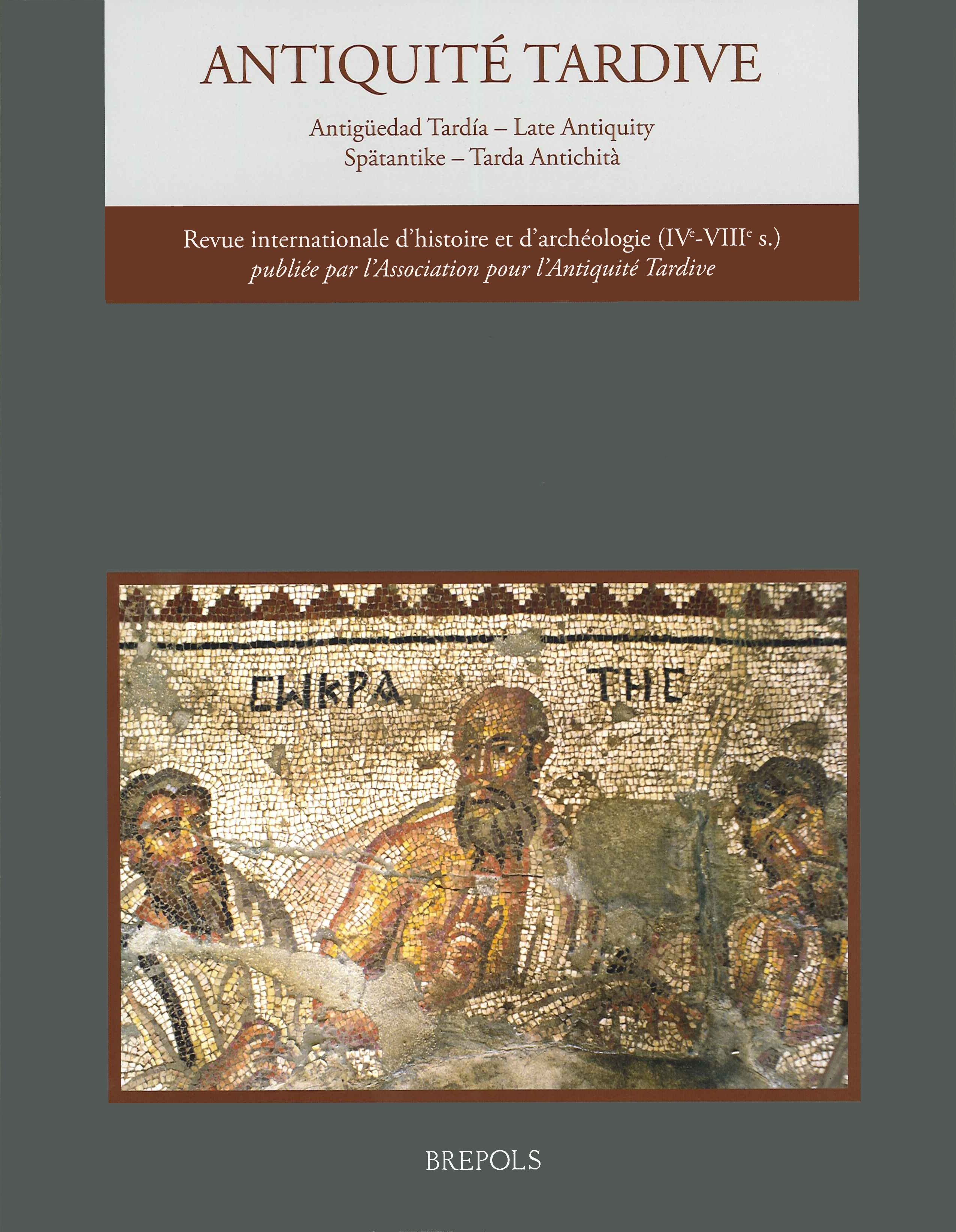
Volume 14, Issue 1, 2007
-
-
Front Matter (editorial information, title page, principales abbréviations, Table des matières, éditorial, erratum, in memoriam, bibliographie essentielle et abbréviations)
show More to view fulltext, buy and share links for:Front Matter (editorial information, title page, principales abbréviations, Table des matières, éditorial, erratum, in memoriam, bibliographie essentielle et abbréviations) show Less to hide fulltext, buy and share links for: Front Matter (editorial information, title page, principales abbréviations, Table des matières, éditorial, erratum, in memoriam, bibliographie essentielle et abbréviations)
-
-
-
Pratique et idéologie chrétiennes de l’économique (IVe-VIe siècles)
show More to view fulltext, buy and share links for:Pratique et idéologie chrétiennes de l’économique (IVe-VIe siècles) show Less to hide fulltext, buy and share links for: Pratique et idéologie chrétiennes de l’économique (IVe-VIe siècles)AbstractThe originality of the Christian language on economics does not lie in its being mainly ideological rather than technical, since that was equally the case for the language of the classical educated élite. Its originality rather lies in its superimposing a transcendent, eschatological discourse on top of economics, a discourse which had practical implications by calling to behave in given ways in everyday economic life. Christianity sets up the sphere of economics in the very heart of the individual practices of salvation and redemptive strategies. For that same reason, economics become the main metaphorical resource of the Christian language. Consequently, the Christian discourse on economics is part of the general process of “democratization of culture” as well as it upsets the social imagination and self-understanding of the classical world, and establishes a new typology of connections between political power and institutional religion.
-
-
-
Christianisme antique et économie: raison et modalités d’une rencontre historique
show More to view fulltext, buy and share links for:Christianisme antique et économie: raison et modalités d’une rencontre historique show Less to hide fulltext, buy and share links for: Christianisme antique et économie: raison et modalités d’une rencontre historiqueAbstractThis article intends to answer the following two questions: 1/ why did the Gospels and the Christian bishops of the first six centuries interest themselves in the moral aspects of economic life? 2/ did they say in this field anything relevant, or did they on the contrary “ignore the reality of society” (so K. Polanyi), and limit themselves to a “moral reform of individual behaviour”, neglecting “the How and Why of economic mechanisms” (so J. A. Schumpeter)? Question 1 is answered by defining Christianity as an “ethical religion” (a concept borrowed from Max Weber), that is to say a religion in which moral duties in the relationship between human beings appear as important as the very cult addressed to God. Concerning then question 2, by contrast with the Opus imperfectum in Matthaeum, which simplifies reality, several texts by Augustine of Hippo, Gregory the Great, and above all Ambrose of Milan, show a deep concern for society as a whole, and to a certain extent even an analysis of some socio-economic mechanisms. But this “golden age” of Patristic social thought did not last, and the Opus imperfectum in Matthaeum’s narrow-minded vision was prominent in the Middle Ages till the scholastic turn.
-
-
-
From study-house to marketplace: rabbinic guidelines for the economy of Roman Palestine
show More to view fulltext, buy and share links for:From study-house to marketplace: rabbinic guidelines for the economy of Roman Palestine show Less to hide fulltext, buy and share links for: From study-house to marketplace: rabbinic guidelines for the economy of Roman PalestineBy: Catherine HezserAbstractL’article étudie les instructions développées par les rabbins des cinq premiers siècles de notre ère pour éviter les comportements frauduleux et pratiquer les activités économiques d’une façon éthique et conforme à la Loi. Après un bref rappel des caractéristiques de l’économie de la Palestine romaine, l’auteur analyse le discours rabbinique sur les différents aspects de la vie économique abordés dans la Mishna : la supervision des marchés, la régulation des prix, la rétractation des ventes et l’embellissement factice des marchandises vendues. Les rabbins ne traitent pas de questions économiques de grande ampleur, mais ils s’intéressent aux problèmes nés de la pratique journalière des opérations économiques. Comme ils sont eux-mêmes activement engagés dans les activités de production et de vente, ils ont une connaissance de première main des questions qu’ils abordent. D’un autre côté, certaines discussions plus théoriques sont formulées dans le cadre de l’étude : les réponses apportées sont alors plus éloignées de la réalité. Si on peut penser qu’ils donnent leur avis aux personnes qui le leur demandent, ils n’ont aucune autorité pour obliger les gens à obéir à leurs règles. Il serait intéressant de comparer le discours rabbinique sur l’économie avec celui qui est transmis par le Digeste de Justinien puisque, comme la loi romaine, la loi rabbinique est casuistique, inspirée par des situations concrètes plutôt que par des principes abstraits.
-
-
-
Le financement de la construction des églises pendant l’Antiquité tardive et l’évergétisme antique
show More to view fulltext, buy and share links for:Le financement de la construction des églises pendant l’Antiquité tardive et l’évergétisme antique show Less to hide fulltext, buy and share links for: Le financement de la construction des églises pendant l’Antiquité tardive et l’évergétisme antiqueBy: Rudolf HaenschAbstractIn this paper the author investigates the links between the construction of churches and evergetism in the patriarchates of Antioch and of Jerusalem from the fourth century to the sixth. The exceptionally rich documentation allows a new analysis of the changes in benefactors’ attitudes under the influence of Christianisation. After an introductory summary of the historiographical problems, the author considers the features of the epigraphical material examined here: its abundance, the frequency of dated inscriptions, the good state of preservation of the inscriptions until recent times, as well as the uneven distribution of the material in space and in time. The paper goes on to consider the social standing of benefactors: interventions by aristocrats are relatively rare including even local notables; some ecclesiastical texts define particular features of Christian benefactions, but they are rarely put into practice; collective, sometimes anonymous, enterprises are quite frequent, a feature which distinguishes the generosity of church builders from that of classical benefactors. In a final section the paper examines the self-presentation of donors, stressing the changes in comparison with classical practice. It concludes that the evidence reveals neither a complete break from nor total continuity with classical traditions but mutations, some of which are peculiar to the region here studied, particularly in the social class of donors and in the way they represented themselves.
-
-
-
Clerics, property and patronage: the case of the Roman titular churches
show More to view fulltext, buy and share links for:Clerics, property and patronage: the case of the Roman titular churches show Less to hide fulltext, buy and share links for: Clerics, property and patronage: the case of the Roman titular churchesBy: Julia HillnerAbstractOn sait qu’un certain nombre d’églises romaines de l’antiquité tardive étaient désignées par le terme titulus suivi d’un nom de personne au génitif. Une analyse de l’emploi légal du terme titulus chez les Romains montre qu’on peut raisonnablement présumer que ces noms étaient, au moins à l’origine, ceux des fondateurs d’églises titulaires. Cependant, alors que l’on considère traditionnellement que la plupart de ces fondateurs étaient des sénateurs romains, l’auteur suggère que les patrons d’églises titulaires venaient au moins autant du milieu clérical que du milieu sénatorial. Cette hypothèse s’appuie sur les sources onomastiques, qui montrent que beaucoup de noms des églises titulaires coïncident avec des noms récurrents dans le clergé romain, et sur les légends hagiographiques, qui présentent dans le rôle de patrons aussi bien des ecclésiastiques que des sénateurs ; enfin, l’hypothèse s’appuie sur l’engagement actif financier des ecclésiastiques dans l’érection et la décoration des églises titulaires. Si l’on considère que, comme la loi romaine tardive le suggère, beaucoup de membres du clergé romain étaient recrutés parmi des classes urbaines prospères, on peut commencer à comprendre les ressources financières qui ont rendu le patronage clérical possible.
-
-
-
Administrer la propriété de l’Église : l’évêque comme clerc et comme entrepreneur
show More to view fulltext, buy and share links for:Administrer la propriété de l’Église : l’évêque comme clerc et comme entrepreneur show Less to hide fulltext, buy and share links for: Administrer la propriété de l’Église : l’évêque comme clerc et comme entrepreneurBy: Hartmut G. ZicheAbstractThis paper discusses the economic role(s) of bishops under the later Roman Empire. Its aim, on the one hand, is to examine whether the dual function of bishops, at the same time clerics and managers of Church property, has an impact on their economic behaviour and leads to the emergence of an ecclesiastical economy which can be distinguished from the rest of the late Roman economy. On the other hand the paper also explores the impact economic activity and the integration into a wider imperial economy have on the clerics themselves, i.e. whether in the face of the Church becoming increasingly mainstream in the 4th century, its clerics can potentially develop – and maintain – a different and original socio-economic stance. The approach chosen to answer these questions is part empirical, part modelising. We are going to reexamine and if necessary reinterpret some already well-known material, but the main interest of the present discussion is to modelise the compatibility of various options of ecclesiastical economic behaviour with, on the one hand, the known development of the church organisation and, on the other hand, the make-up and development of the imperial economy and society in general. Three interlocking arguments are being developed: in the first instance we are going to show that with the various constraints – legal and pragmatic – imposed on the economic strategies of bishops, an ecclesiastical economy tending towards a slow accumulation of capital is the most likely outcome. Spectacular charity or personal enrichment on the basis of the revenue derived from a Church’s institutional property are not immensely plausible. In a second argument we are going to demonstrate that the recruitment of clerics from the economic elites both depends on and conditions economic behaviour by bishops broadly in line with the economic behaviour of other elite classes. The key element here being patronage exercised by bishops on the basis of the double fudge of, on the one hand, the theoretical distinction between the institutional and the personal property of a bishop and, on the other hand, the a priori impossible distinction between economic and charismatic prestige. In the third and final argument we are going to show that there is not only a strong empirical indication that bishops use the same economic strategies as other large landowners, but that for reasons of coherence and plausibility – and consumption patterns! – the “ecclesiastical” economy of late Roman bishops can neither be very original nor very differing in performance from the rest of the late Roman economy.
-
-
-
Les patrimoines de l’Église romaine jusqu’à la mort de Grégoire le Grand. Dépouillement et réflexions préliminaires à une étude sur le rôle temporel des évêques de Rome durant l’Antiquité la plus tardive
show More to view fulltext, buy and share links for:Les patrimoines de l’Église romaine jusqu’à la mort de Grégoire le Grand. Dépouillement et réflexions préliminaires à une étude sur le rôle temporel des évêques de Rome durant l’Antiquité la plus tardive show Less to hide fulltext, buy and share links for: Les patrimoines de l’Église romaine jusqu’à la mort de Grégoire le Grand. Dépouillement et réflexions préliminaires à une étude sur le rôle temporel des évêques de Rome durant l’Antiquité la plus tardiveBy: Dominic MoreauAbstractAs its subtitle implies, this paper is not a complete history of the patrimonies of the Roman church until the death of Gregory the Great. It is rather a detailed status quaestionis prelimany to a study in progress about the development of the temporal role of the Roman bishops in latest Antiquity (440-604). It is proposed to look at all the sources used in the patrimonial histories published to date, especially since the early 20th Century. The purpose is to raise as many issues as possible. The reader will then find more questions than answers. These problematics will be addressed in four points: 1- from the first attestations of the patrimonies of the Roman Church to the death of Felix III (II) (to 492); 2- from Gelasius I to Silverius (492-537); 3- from Vigilius to Benedict I (537-579); 4- Pelagius II and Gregory I the Great (579-604).
-
-
-
Clero, proprietà, cristianizzazione delle campagne nel Nord Africa tardoantico: status quaestionis
show More to view fulltext, buy and share links for:Clero, proprietà, cristianizzazione delle campagne nel Nord Africa tardoantico: status quaestionis show Less to hide fulltext, buy and share links for: Clero, proprietà, cristianizzazione delle campagne nel Nord Africa tardoantico: status quaestionisBy: Anna LeoneAbstractThis paper analyses the growing involvement of the North African churches in economic activities and the acquisition of estates and properties, in the 4th and early 5th centuries. In particular it explores the process through which the clergy developed secular role in Byzantine society. The analysis considers principally written sources alongside the limited archaeological evidence. The combined data available do not permit a detailed understanding of the evolution of the role of the clergy in society, but the paper provides some general directions for the focus of future research. Overall it offers a detailed synthesis of the current state of knowledge and points problems and potential within the complex history of North Africa immediately prior to the fall of the Western Roman Empire.
-
-
-
Le don chrétien et ses retombées sur l’économie dans l’Antiquité tardive
show More to view fulltext, buy and share links for:Le don chrétien et ses retombées sur l’économie dans l’Antiquité tardive show Less to hide fulltext, buy and share links for: Le don chrétien et ses retombées sur l’économie dans l’Antiquité tardiveBy: Claire SotinelAbstractThe Christian gift is a response to religious demand, but it is realized in the domain of material exchanges. In this respect it is at the heart of an enquiry concerning the relations between religion and the economy. This article takes into account the Christian gift in all its forms, whether alms, gifts made to the Church for the support of clergy or the poor, sums to be distributed by the churches themselves, or gifts made by Christians for the construction of new buildings. It seeks to understand why it is so difficult to value the economic repercussions of practices which are very widespread. After noting the importance and the limits of a quantitative approach, it considers the gift, first from the point of view of the giver, and, secondly, that of the beneficiary. The economic repercussions of Christian practices of giving are limited; in the first place, on account of the relatively small amounts involved, but also because a large proportion of Christian giving is a substitute for other ways of distributing riches, whose characteristics it shares. In only two domains does Christian giving show any signs of innovation: direct support of the poor, albeit on a scale such that it can have only indirect and limited social effects, and no economic effect at all; and in new practices of communal collection, particularly visible in church construction. The economic repercussions are not negligible, but they are delayed as long as the gift keeps its voluntary character, as it does throughout Late Antiquity.
-
-
-
L’Afrique dans l’Antiquité tardive et la période byzantine: l’évolution de l’architecture et de l’art dans leur environnement
show More to view fulltext, buy and share links for:L’Afrique dans l’Antiquité tardive et la période byzantine: l’évolution de l’architecture et de l’art dans leur environnement show Less to hide fulltext, buy and share links for: L’Afrique dans l’Antiquité tardive et la période byzantine: l’évolution de l’architecture et de l’art dans leur environnementBy: Noël DuvalAbstractThis paper was originally meant to be published as an entry “Africa” (Mauretania, Numidia, Proconsularis) in the Reallexikon zur byzantinischen Kunst, in order to complete a dossier including two other entries, one on “Byzacene” written by M. Restle and the other one on “Karthago” by the late J. Christern, but finally remained unpublished. We first intended to add a few entries on Byzantine Africa, one on “Tripolitania”, alongside articles on some of the most relevant archaeological sites in Late Antique Africa, to be inserted at the end of the volume. However “Africa” eventually became a thorough study of its own concerning not only Africa but also “Byzacene” and “Carthago”, in which we updated M. Restle and Christern’s contributions taking into account the major discoveries and studies which have been published since. This study goes far beyond the presence of the Empire of Constantinople on African soil between 533 and 698, in order to encompass the whole christianization period from the IVth century AD to the end of the VIIth century AD and the final conquest of Carthage by the Arabs. Its historical part deals with topographical, institutional, political, religious, social and economical facts only as far as they are relevant to the evolution of art and especially architecture, as suggested by the title, leaving these topics to the second part of the dictionary. All bibliographical references have been removed from this latest version except for those on Carthage. References will be easily found in any textbook about Africa, like the “Agregation” or “Capes” handbooks published last year in France for students taking the competitive French examination to become teachers in history, as well as in the numerous catalogues with their photographs and pictures showing Tunisian, Algerian and Moroccan archaeological sites and material throughout the world.
-
-
-
La Notitia provinciarum et civitatum Africae et l’histoire du royaume vandale
show More to view fulltext, buy and share links for:La Notitia provinciarum et civitatum Africae et l’histoire du royaume vandale show Less to hide fulltext, buy and share links for: La Notitia provinciarum et civitatum Africae et l’histoire du royaume vandaleBy: Yves ModéranAbstractThe Notitia provinciarum et civitatum Africae gives a list of 459 names of African bishops, some of them with marginal annotations (such as the acronym prbt in 90 instances), being followed by a strange summary table which distributes the prelates among two general groups, qui perierunt (88) and qui permanserunt (378). Even if it is not a register of attendance, this list was actually drawn up in concomitance of the open conference between catholics and arians that was convened by the Vandal king Huneric in february 484; its purpose may have been to serve as documentary evidence for the catholic church in order to prove its overwhelming numerical superiority inside the kingdom. Later on, before 487, it was modified so as to record the effects of the persecution which had been launched by Huneric after the conference. Among those modifications, the most important was the addition of the acronym prbt, which should be connected with the ending formula : qui perierunt. This latter phrase, however, is not related to physical deaths: as attested by many contemporary texts, especially by the acts of the council held in Rome in 487 and devoted to Africa, perire here refers to spiritual death. Therefore the Notitia gives also the list of those bishops who renounced their faith under arianist duress in 484, i.e. nearly 20% of the catholic episcopal body. Such a conclusion compels us to revise acccepted ideas about the extension of the Vandalic kingdom and highlights the internal divisions of the African Church, more particularly at provincial level, during the period of Vandalic rule.
-
-
-
Les jeux d’alliances des tétrarques en 307-309 et l’élévation de Constantin au rang d’Auguste
show More to view fulltext, buy and share links for:Les jeux d’alliances des tétrarques en 307-309 et l’élévation de Constantin au rang d’Auguste show Less to hide fulltext, buy and share links for: Les jeux d’alliances des tétrarques en 307-309 et l’élévation de Constantin au rang d’AugusteBy: Alexandra StefanAbstractAn interpretative study of a group of inscriptions, corroborated by numismatic and papyrological data, throws light on some aspects of the crisis of the imperial college that have been omitted by the litterary tradition and enables to propose a more precise view of the date, circumstances and immediate consequences of Constantine’s elevation to the rank of Augustus. Thus, two milliaries from Cilicia which we date in november 307 celebrate a college made up of the Augusti Maximian and Galerius and the Caesars Maximinus and Constantine. In the same way as the contemporary coins and papyri, they reveal several features of the politics displayed by Maximin between 307 and 309, among which especially his obvious opposition to Galerius following the later’s refusal to promote him Augustus in place of Severus who died on 16 september 307, equally his unfailing support to Maximian’s come back to the ruling team as first Augustus and the political alliance formed in november 307 with Maximian and Constantine. The counterpart of the milliaries from Cilicia is to be found in the coins struck by Constantine in honour of the same imperial college, which we date in autumn 307, as well as the proclamation in Gaul of Maximian and Constantine as consuls, after Severus’ death. Since they style Constantine Caesar in november 307, the Cilician milliaries afford a new terminus post quem for his promotion to the rank of Augustus and wedding with Fausta, which we consequently place in december, not september, 307. Furthermore, the alliance of Maximinus they are ascertaining had a remarkable impact, both political and strategical, on these two events, in the context of the failure of Galerius’ campaign in Italy. The analysis of Constantine Augustus’ coinage discloses not only his quest for recognition of his rank, but also his attempt at restoring the cohesion of Empire by striking at the beginning of 308 in the name of a college fitting with the realities of the moment, including the four Augusti Maximian, Galerius, himself and the usurpator in Rome Maxentius, as well as the Caesar Maximinus. The rejection of this project gave way to the apex of the crisis, when Constantine struck only in his own and Maximian’s name. For his own, Galerius no longer recognized Constantine’s legitimacy from autumn 307, followed by Maximinus from the beginning of 308. This is confirmed by the imperial epistula to Heraclea Sintica promulgated only in the names of Galerius and Maximinus, thus to be dated in the first months of 308. From that reconstruction, the seriousness of the 307-308 crisis invites us to reconsider the effects of the meeting held at Carnuntum in november 308 and highlights Constantine’s political qualities, the one among all those emperors who was ever able to draw benefits from this struggle for power, while strenghtening his own.
-
-
-
What is the De fisco Barcinonensi about?
show More to view fulltext, buy and share links for:What is the De fisco Barcinonensi about? show Less to hide fulltext, buy and share links for: What is the De fisco Barcinonensi about?By: Damián FernándezAbstractLa lettre De fisco Barcinonensi est l’un des rares documents dont nous disposons au sujet de la fiscalité visigothique. Dans cet article, nous passons en revue la documentation permettant de définir la nature précise du document. Nous suggérons que la lettre traite de l’adaeratio (tarif de conversion entre impôts en nature et impôts en espèces), explication qui peut se fonder à la fois sur une stricte lecture du texte et sur le contexte politique dans lequel la lettre a été rédigée. En conséquence, le rôle des évêques dans le processus de levée des impôts se voit réduit à une fonction de porte-parole des communautés locales et de leurs élites.
-
-
-
L’Histoire Auguste, le consul Aurelianus et la réception de la Notitia Dignitatum en Occident
show More to view fulltext, buy and share links for:L’Histoire Auguste, le consul Aurelianus et la réception de la Notitia Dignitatum en Occident show Less to hide fulltext, buy and share links for: L’Histoire Auguste, le consul Aurelianus et la réception de la Notitia Dignitatum en OccidentBy: Bruno PottierAbstractThe chapters X-XV of emperor Aurelianus’ biography in the Historia Augusta (H. A.) contain numerous references to Aurelianus, a consul in 400 A. D. under the emperor Arcadius. The author of the H. A. seems to attribute Fravitta’s victory over the Goths of Gaïnas in front of the walls of Constantinople to Aurelianus, as Synesios of Cyrene similarly does in the De Providentia. When describing a fancy honorific ceremony held for the emperor Aurelianus in the baths at Byzantium, the author of the H. A. mentions a list of dignitaries from the Eastern Empire which mirrors the Notitia Dignitatum. This passage enforces C. Zuckermann’s hypothesis that the Eastern contribution of the Notitia Dignitatum was sent to the West in 400 or 401 A. D. as a result, in part, of a good relationship between Arcadius and Stilicho at this time.
-
-
-
Rutilius Namatianus, Aelius Aristide et les chrétiens
show More to view fulltext, buy and share links for:Rutilius Namatianus, Aelius Aristide et les chrétiens show Less to hide fulltext, buy and share links for: Rutilius Namatianus, Aelius Aristide et les chrétiensBy: Stéphane RattiAbstractWithout any doubt, Rutilius Namatianus, when writing his De reditu suo in 417, was personally acquainted with Aelius Aristides’ oration In praise of Rome. Nevertheless it still remains unobserved how fundamentally different can be, in terms of signification, the eulogy to Roman universalism from a Greek living in the second century and from a Roman living in the fifth. Here is an attempt to demonstrate that the political context in which this pseudo-travel narrative was written in fact shows signs of the climate of intellectual contest between pagans and chritians and, indeed, the De reditu stands at the very hearth of a lobbying network woven by the partisans of the old religion among whom are equally to be found the Symmachi, Servius and Macrobius. The demonstration proceeds according to three stages: the first one reminds us of all that the praise of goddess Roma in the poem owes to the Augustean ideology transmitted by Virgilius, in order to bring out, in the second stage, the differences of signification between this anthological piece and Aristides’ interpretatio graeca of Roman imperialism and then, eventually, to outline the extended intellectual circle on which De reditu’s author drew his inspiration devoted to his antichristian convictions, sometimes expessed in a polemical tone.
-
-
-
« Vt maiores pagani non sint! » Pouvoir, iconoclasme et action populaire à Carthage au début du Ve siècle (saint Augustin, Sermons 24, 279 et Morin 1)
show More to view fulltext, buy and share links for:« Vt maiores pagani non sint! » Pouvoir, iconoclasme et action populaire à Carthage au début du Ve siècle (saint Augustin, Sermons 24, 279 et Morin 1) show Less to hide fulltext, buy and share links for: « Vt maiores pagani non sint! » Pouvoir, iconoclasme et action populaire à Carthage au début du Ve siècle (saint Augustin, Sermons 24, 279 et Morin 1)Authors: Júlio César Magalhães De Oliveira and Júlio César MagalhãesAbstractThis article examines two sermons delivered by Saint Augustine at Carthage in June 401. Preached in a context of serious tensions between Christians and pagans as well as within the Catholic community, these sermons are precious documents about the forms of popular action and the involvement of the common people in the religious conflicts of the age. Augustine’s sermon 24 is a discourse designed to calm the fury of the Christian crowd in a dangerous situation for the African bishops assembled in a council at Carthage on 16 June 401. A statue of Hercules, recently restored, had its golden beard “shaved” by the action (or under the pressures) of a Christian mob. People then take possession of the church and the streets not only to protest against the pagans and their idols, but also to demand the active involvement of the clergy in their struggle against idolatry. As a consequence of these manifestations, a leading pagan, who had been explicitly criticized by the Christian mob, joined the Catholic Church. In the sermon 279 and in his post-sermonem Morin 1, preached on Sunday 23 June 401, Augustine takes the defence of the converted before the congregation that refused to accept what seemed to be a simulated and interested conversion. In this text, we analyse the political and religious implications of the manifestations evoked in these sermons and try to explain the motivations and behaviour of their participants.
-
Volumes & issues
-
Volume 32 (2024)
-
Volume 31 (2024)
-
Volume 30 (2022)
-
Volume 29 (2022)
-
Volume 28 (2021)
-
Volume 27 (2020)
-
Volume 26 (2019)
-
Volume 25 (2018)
-
Volume 24 (2017)
-
Volume 23 (2016)
-
Volume 22 (2015)
-
Volume 21 (2013)
-
Volume 20 (2013)
-
Volume 19 (2012)
-
Volume 18 (2011)
-
Volume 17 (2010)
-
Volume 16 (2009)
-
Volume 15 (2008)
-
Volume 14 (2007)
-
Volume 13 (2006)
-
Volume 12 (2005)
-
Volume 11 (2004)
-
Volume 10 (2003)
-
Volume 9 (2002)
-
Volume 8 (2001)
-
Volume 7 (2000)
-
Volume 6 (1999)
-
Volume 5 (1998)
-
Volume 4 (1997)
-
Volume 3 (1995)
-
Volume 2 (1994)
-
Volume 1 (1993)
Most Read This Month
