


Antiquité Tardive - Late Antiquity - Spätantike - Tarda Antichità
Revue Internationale d'Histoire et d'Archéologie (IVe-VIIIe siècle)
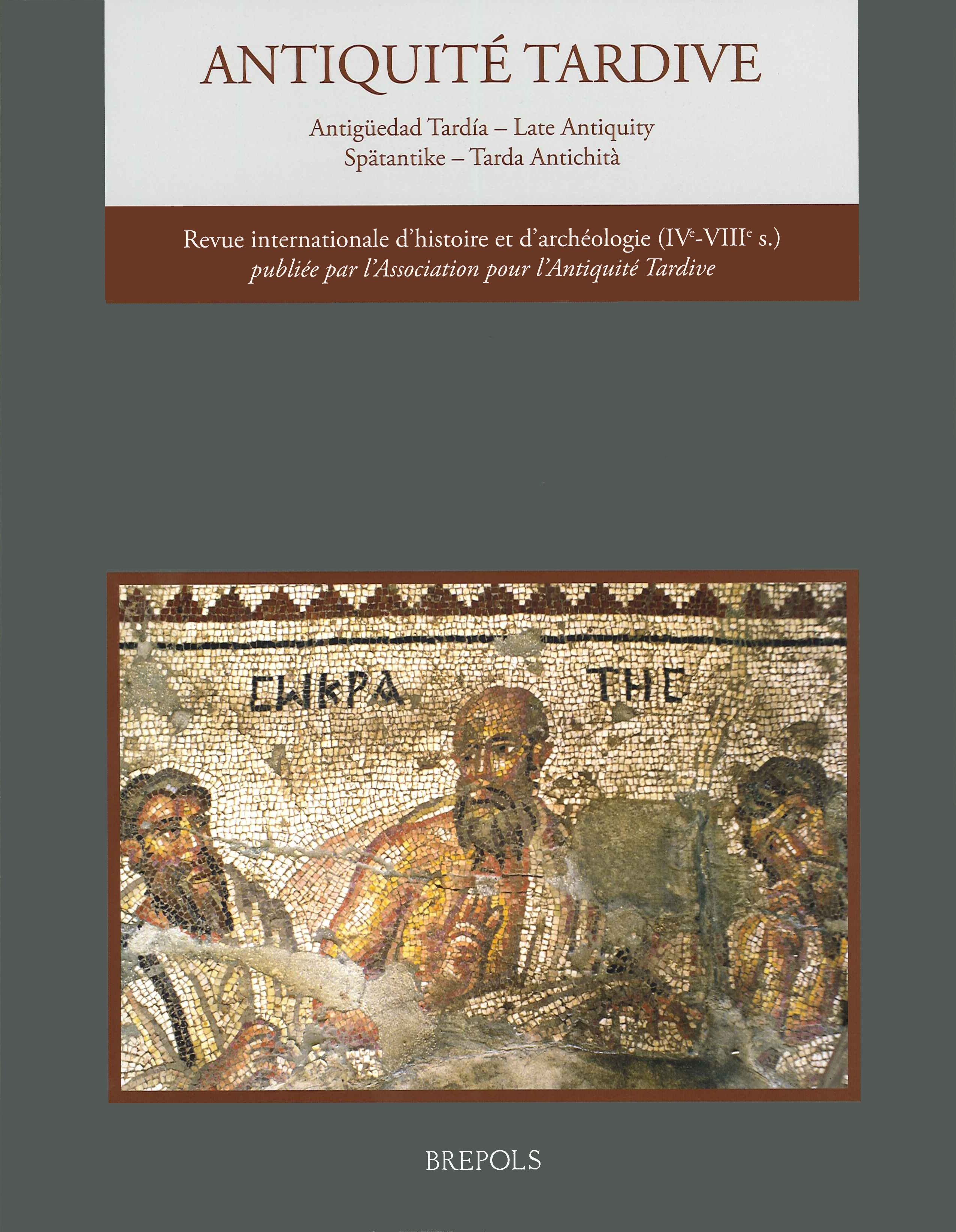
Volume 20, Issue 1, 2013
-
-
Front Matter ("Editorial board", "Title page", "Principales abréviations", Table of contents", "Éditorial")
show More to view fulltext, buy and share links for:Front Matter ("Editorial board", "Title page", "Principales abréviations", Table of contents", "Éditorial") show Less to hide fulltext, buy and share links for: Front Matter ("Editorial board", "Title page", "Principales abréviations", Table of contents", "Éditorial")
-
-
-
Introduction
show More to view fulltext, buy and share links for:Introduction show Less to hide fulltext, buy and share links for: IntroductionAuthors: Gisella Cantino Wataghin and Hervé InglebertAbstractThe study of the ancient countryside started in the 19thcentury, when the textes of the Roman land surveyors were published. Researches began on towns’ territories and their limitatio, expanding afterwards to the problems of agrarian structures and of the ways of soil exploitation. As far as Late Antiquity is concerned, the countryside shared the negative image attached to the period, all the more dark this image, that the one of the prievious centuries was idealized. Following some topoi of the written sources, but without any sound argument, the prevalent opinion was that the countryside was exposed to stagnation of the production, depopulation due to epidemics and climatic reverses, and abandonment of settlements. More recently, a more critical appraisal of written sources and the development of archaeological researches have opened new perspectives, taking into account the achievements of historical geography, paleo-climatology, paleo-anthropology. The result is a complex picture, made of lights and shadows, with many regional differences. The two dossiers (2012 and 2013 issues of the Revue) consider some important open questions, through both general / methodological papers and case studies on the Western and Eastern part of the Roman world.
-
-
-
Nommer les structures rurales entre fin de l’Antiquité et Haut Moyen Âge : le répertoire lexical gréco-latin et ses avatars modernes (1re partie)
show More to view fulltext, buy and share links for:Nommer les structures rurales entre fin de l’Antiquité et Haut Moyen Âge : le répertoire lexical gréco-latin et ses avatars modernes (1re partie) show Less to hide fulltext, buy and share links for: Nommer les structures rurales entre fin de l’Antiquité et Haut Moyen Âge : le répertoire lexical gréco-latin et ses avatars modernes (1re partie)AbstractTwelve centuries separate the age when villa signified a type of residential complex built on a land property, and castellum a village, from the age when villa changed its meaning for that of “village” or produced in French the word “ville”, and castellum its French derivative “château”. When should we situate those discontinuities? In the 6th century? the 9th? the 12th? Such were indeed the different moments that were hypothesized for the same break: deciding between them is not possible but from a one and only ‘questionnaire’ in which terminology plays a major part. This long evolution is of interest for both historians and archaeologists, whose dialogue is more often than not unsatisfactory, all the more since fewer are those cases in which written sources and archaeological documentation tally each other. Not to consider that semantic evolutions are not the same in the various regions and written sources, at any time, simultaneously make use of different styles (practical, literary, underlitterary or familiar, even slang) while the persisting use of Latin and Greek uniformly draws an illusory veil of continuity upon higly moving referents. Therefore our intention here is, for that long sequence (3rd-12thcentury), although focusing on the 4ththrough 9thcenturies, to acknowledge the semantic evolution in the terminological resources of ancient languages (Latin and Greek) as regards the rural realities - agrarian structures, landholding, settlement -, but equally estimate how some ancient lexemes are transplanted right into the discourse of today antiquaries and medievalists, either historians or archaeologists.
Fresh inquiries made clear the use of some terms which spread in that age, such as massa fundorum, praetorium, in relation with the transformations of the agrarian producing system while other ones (praedium and its Greek equivalent epoikion, sors, iuga) added a new meaning in connexion with the major fiscal reform by Diocletian which conceded autopragia to the largest estates. Some semantic evolutions seem to have been anticipated by the historians (chôrion or villa with the meaning of village, castellum with that of fortified village), when others were postponed like that of villa in the meaning of estate; some senses were ignored, like castrum in the singular as a synonym for castellum / village. Polysemic phenomena were badly kept unobserved. We should elsewhere take into account the difficulty experienced by the moderns in forgetting those connotations that we consciously or unconsciously apply today to many Latin and Greek terms related to ancient realities (to be continued).
-
-
-
Paesaggi in equilibrio: uomo e acqua nella Pianura Padana Centrale tra IV e IX secolo
show More to view fulltext, buy and share links for:Paesaggi in equilibrio: uomo e acqua nella Pianura Padana Centrale tra IV e IX secolo show Less to hide fulltext, buy and share links for: Paesaggi in equilibrio: uomo e acqua nella Pianura Padana Centrale tra IV e IX secoloBy: Fabio SaggioroAbstractIn the Middle Ages, the Po Valley was a large wetland, shaped by large marshes and forests, alternating with waterways and strips of dry land. In this paper we consider: 1/ transformation of rural settlements in relation to wetlands; 2/ environmental aspects and their transformations in Early Middle Ages; 3/ the way of living in wetlands area; 4/ the organization of lived space and the definition of places; 5/ theoretical and methodological implications of the different approaches and the perspectives of historical and archaeological research.
We examine the hydrological changes which occurred between the 6thand 7thcenturies, as well as the material culture of settlements which arise in the Early Middle Ages (6th-9thcentury) in contact with wetlands. We would like to show what kind of common processes affect lowland areas: the landscapes are much changed from Roman period (1st-2dcentury), and a decrease of the population has to be observed as well as a transformation in location strategies for settlements (Nogara, Comacchio, Ferrara).
The study also presents a preliminary examination of the environment, as revealed by recent studies on the considered area, like Cava Pedocca, Nogara, etc. Wetlands come indeed into the redefinition of the population between Late Roman Period and Early Middle Ages, as settlements up to the 9thcentury are closely in contact with these zones.
Management and exploitation of the lowlands, as it is, make us think wetland and woodland areas less marginal as expected. On the contrary, it leads us to think about an economic and cultural system where wetlands, forests and waterways are essential to settlements. Finally, all these seem to also show the theoretical implications on the organization of archaeological research and interpretation models resulting.
-
-
-
The paradoxes of Late Antiquity: a thermodynamic solution
show More to view fulltext, buy and share links for:The paradoxes of Late Antiquity: a thermodynamic solution show Less to hide fulltext, buy and share links for: The paradoxes of Late Antiquity: a thermodynamic solutionBy: John BintliffAbstractLa période du Bas-Empire du IIIeau VIIesiècle connaît beaucoup de contradictions paradoxales dans ce que l’on peut reconstruire de l’archéologie, de l’art et de l’histoire. Cet article résume ces aspects et suggère une façon d’expliquer ces paradoxes, à travers des modèles mathématiques et thermodynamiques.
-
-
-
Apports de l’anthropologie en matière de démographie et de dynamique d’occupation des sols dans l’Occident des IVe-VIIIe siècles
show More to view fulltext, buy and share links for:Apports de l’anthropologie en matière de démographie et de dynamique d’occupation des sols dans l’Occident des IVe-VIIIe siècles show Less to hide fulltext, buy and share links for: Apports de l’anthropologie en matière de démographie et de dynamique d’occupation des sols dans l’Occident des IVe-VIIIe sièclesBy: Luc BuchetAbstractThe question of identity of populations, like the study of migratory movements, form the subject of debates for a long time between scientific communities. Based on their respective data sources, historians, archaeologists and anthropologists have tried, separately, to distinguish between the migration of peoples and the diffusion of cultures, without anyone hangs on truly the conviction. Although studies of ancient DNA show great promise, the analysis of the dynamics of settlements currently rests priorily on archaeological and anthropological data to which one can now, thanks to the development of new tools, include a paleodemographic approach. However, this analysis must be done in a joint approach among these disciplines. One will see that, in spite of the imperfections of the samples, it is possible to find arguments attesting to the existence of population movements and that, under certain conditions, a dynamic approach of the evolution of a population is possible at the scale of the quarter century.
-
-
-
Évolution démographique et modes d’occupation du sol en Syrie du Nord : les cas du Ǧebel Waṣṭāni, du Ğebel Zāwiye et des Marges arides (IIe-VIIe s.)
show More to view fulltext, buy and share links for:Évolution démographique et modes d’occupation du sol en Syrie du Nord : les cas du Ǧebel Waṣṭāni, du Ğebel Zāwiye et des Marges arides (IIe-VIIe s.) show Less to hide fulltext, buy and share links for: Évolution démographique et modes d’occupation du sol en Syrie du Nord : les cas du Ǧebel Waṣṭāni, du Ğebel Zāwiye et des Marges arides (IIe-VIIe s.)Authors: Catherine Duvette, Bertrand Riba, Marion Rivoal, Gérard Charpentier and Bernard GeyerAbstractThe three papers presented here sum up some of the results achieved by three archeological missions in Northern Syria. Focusing mainly on settlement and occupation dynamics, these contributions are dealing with methodological approaches dictated by geographical and archaeological features in each area: Ǧebel Waṣṭāni, Ğebel Zāwiye and northern Syria’s steppes. They successfully draw out common occupation patterns in these regions during Late Antiquity.
B. Riba, Démographie et dynamique de l’occupation du Ǧebel Waṣṭāni dans le Massif calcaire de la Syrie du Nord (IIe-VIe siècles)
The interest in the archaeological heritage of the Ǧebel Waṣṭāni, in the Limestone Massif of northern Syria, is fairly recent despite the privileged position of the ridge between Antioch and Apamea. Following the surveys carried out by Franciscans in the 1980s, several research surveys were conducted from 2002 as part of the “Syrian Mission of Banassara and Ǧebel Waṣṭāni”. They were undertaken over the whole mountain range, and in particular at the sites Banassara and Kefert Ἁqab. Currently, these surveys allow us to understand the conditions of settlement of Gebel Wastani, the characteristics of the implementation of rural housing, and the modes of development of village communities in the Roman and Byzantine periods. They are also an opportunity to consider the place of the ridge in the general evolution of the Limestone Massif.
C. Duvette, Le Ğebel Zāwiye (Massif calcaire de la Syrie du Nord) : l’architecture domestique reflet d’une évolution démographique
More than 200 rural settlements reflect the attractiveness of the Ğebel Zāwiye, the southernmost and largest of the limestone hills of northern Syria, between the 2nd and the 6th century AD. The growing population of this region during this period mainly resulted in the development of villages surrounded by agricultural parcels. We have an image still virtually intact of these rural settlements in some areas, and a description of their development is possible in terms of individual and related growth processes. The evolution of domestic architecture is one of the focuses of these studies.
M. Rivoal, Les fluctuations du peuplement antique dans la steppe de Syrie du Nord en question (IIe-VIIe siècle)
From the beginning of the Roman period, the steppe’s fringe of Northern Syria experienced a strong sedentary expansion eastwards which reached its peak towards the end of Byzantine period. During the last two decades, the “Arid Margins Survey” has drawn a vivid picture of this gradual conquest. However, many questions remain beyond the reach of surface surveys, such as occupancy duration or differences between Roman, Byzantine or Umayyad occupation on a same site. The very phenomenon of this expansion is still to be understood. It may have involved massive immigration of sedentary people from neighboring countries as much as nomad herder’s settling down.
-
-
-
Death in the countryside: some thoughts on the effects of famine and epidemics
show More to view fulltext, buy and share links for:Death in the countryside: some thoughts on the effects of famine and epidemics show Less to hide fulltext, buy and share links for: Death in the countryside: some thoughts on the effects of famine and epidemicsAbstractCet article vise à présenter un panorama critique de la recherche actuelle sur l’impact des crises de subsistance et des épidémies sur les populations des campagnes tardo-antiques. Mon intention est d’offrir un état de la question, ainsi que des suggestions pour des recherches futures. Dans cette étude centrée sur l’est de la Méditerranée, l’apport des sources écrites est confrontée aux données des études paléopathologiques récentes qui nous éclairent sur l’état de santé et de nutrition des populations rurales entre le IVeet le VIIIesiècle. La présence de maladies comme la peste, la malaria ou la lèpre est aussi bien évaluée que les états qui prouvent une malnutrition chronique et ses effets sur les populations.
-
-
-
Questioni di storia agraria tardoromana: schiavi, coloni, villae
show More to view fulltext, buy and share links for:Questioni di storia agraria tardoromana: schiavi, coloni, villae show Less to hide fulltext, buy and share links for: Questioni di storia agraria tardoromana: schiavi, coloni, villaeBy: Domenico VeraAbstractThree general issues, which have been recently widely discussed, are relevant to the historical reconstruction of different provincial setups in Late Antiquity.
One issue is whether rural slavery was quantitatively limited everywhere in the Empire and should be included in the free colonate, as scholars mainly argued in past decades, or whether it remained the type of labour more suitable to agricultural systems oriented towards a market economy, thus particularly flourishing in the East during the 4th-5thcentury AD development.
Recent economic and legal historical research has identified colonate not as an organic part of agricultural systems where property did not concentrate on direct production but as a different institution: not a type of land rent but a “contract of employment” where coloni cultivated manorial lands (here again East and Egypt predominate) and were paid by the use of plots of land. Therefore in a kind of “precapitalistic” context the colonic workforce was a salary.
Lastly was the luxurious Late Roman villa (praetorium) mainly the site for accumulation of surpluses produced autonomously in colonic farms or did it keep specific features of the classic model, i.e. resident slaves and direct agricultural production? Were well-known western villas similar to those still to be explored thoroughly in the East?
-
-
-
La structure agraire dans l’Empire tardif au miroir du Code Théodosien : quelques observations
show More to view fulltext, buy and share links for:La structure agraire dans l’Empire tardif au miroir du Code Théodosien : quelques observations show Less to hide fulltext, buy and share links for: La structure agraire dans l’Empire tardif au miroir du Code Théodosien : quelques observationsBy: Pierre JailletteAbstractThe Theodosian Code, which was first enforced in January 439, was meant as a tool to enable lawyers to put an end to ceaseless squabbles caused by a host of confused and obscure texts. After a brief reminder of the models relating to the later Roman Empire as put forward by scholars, this paper aims to deal with three aspects of the judiciary relations between men and land as shown by the constitutions, namely the usurpatio of land, the issue of agri deserti and the ways and means to which the Res privata resorted to make their estates profitable.
-
-
-
Oil and wine press technology in its economic context: screw presses, the rural economy and trade in Late Antiquity
show More to view fulltext, buy and share links for:Oil and wine press technology in its economic context: screw presses, the rural economy and trade in Late Antiquity show Less to hide fulltext, buy and share links for: Oil and wine press technology in its economic context: screw presses, the rural economy and trade in Late AntiquityBy: Tamara LewitAbstractLa principale innovation concernant la technologie du pressoir à vin et à huile depuis presque 2000 ans intervient entre le Iersiècle avant J. C. et le Iersiècle après J. C., avec l’utilisation de la vis, mais la diffusion la plus large de cette technologie ne s’est faite qu’à l’époque tardive au Levant, en Égypte, à Chypre et en Turquie. Comment la diffusion d’une telle innovation se répercute-t-elle dans le cadre plus général de l’économie rurale ? Des exemples de pressoirs des Ieret IIesiècles après J. C. en Italie, Gaule et Espagne, ainsi que ceux du Proche-Orient tardif témoignent des conditions favorables qu’a pu offrir l’exportation intensive des productions à l’adoption de nouveaux mécanismes de pressoirs. Pour autant, l’absence notable de pressoirs à vis en Tunisie, Tripolitaine et Methana montre que de hauts niveaux de production ne suffisaient pas à stimuler de tels changements techniques. La présence de propriétaires locaux ou de métayers vivant à proximité de leurs terres semble avoir eu plus d’impact sur l’innovation de techniques productives. Les formes d’habitat de la Méditerranée orientale apparaissent en ce sens significatives. Contrairement aux petites fermes dispersées de l’Occident, elles pouvaient manifestement fournir une importante main d’oeuvre saisonnière nécessaire à des opérations de pressoirs à vis laborieux. Plusieurs petits pressoirs à vis correspondaient sans doute à une bonne solution technologique pour de tels producteurs, en leur permettant de traiter plus efficacement les différents lots de raisins ou d’olives.
-
-
-
L’économie rurale et les productions en Gaule durant l’Antiquité tardive : moyens et techniques de production
show More to view fulltext, buy and share links for:L’économie rurale et les productions en Gaule durant l’Antiquité tardive : moyens et techniques de production show Less to hide fulltext, buy and share links for: L’économie rurale et les productions en Gaule durant l’Antiquité tardive : moyens et techniques de productionAuthors: Paul Van Ossel and Claude RaynaudAbstractResearch on late Antique rural Gaul has sufficiently progressed these last decades, in order to draw a global outline of rural economy, its tools and techniques. After an introduction to the evolution of late rural Gaul, this article examines the main agrarian productions, and analyses the changes that took place from the end of the 3rdcentury onwards. Livestock breeding, cereal, vegetable and fruits, as well as wine and oil production are successively analysed, based on examples chosen for their exemplary character. Apart from these agrarian productions, equal attention is given to non-agrarian resources, that seem to take an important place in state-owned economy. Lastly, cereal processing enables the questioning of innovating techniques.
-
-
-
La production rurale dans la phase finale du royaume de la Grande Arménie : le témoignage de Moïse de Khorène
show More to view fulltext, buy and share links for:La production rurale dans la phase finale du royaume de la Grande Arménie : le témoignage de Moïse de Khorène show Less to hide fulltext, buy and share links for: La production rurale dans la phase finale du royaume de la Grande Arménie : le témoignage de Moïse de KhorèneBy: Giusto TrainaAbstractIn the XVth chapter of his monograph Armenia in the Period of Justinian, Nikolaj Adontz traced a short but important outline of the problems of land tenure in the kingdom of Greater Armenia. Adontz eventually praised the documentary value of the History of Armenia (Patmut‘iwn Hayoc‘) by Movsēs Xorenats‘i, a historian who nowadays is considered with suspicion. In his historiographical work, he claims that the Arsacid dynasty founded the basis of the society of the kingdom of Greater Armenia, including the organization of landed property. Accordingly, Xorenats‘i is, to a certain extent, more sensitive to the Realien than the other contemporary Armenian historiographers, who prefer to concentrate on social relations rather than considering the material and administrative aspects of rural economy.
-
-
-
The transformation of Roman slavery: an economic myth?
show More to view fulltext, buy and share links for:The transformation of Roman slavery: an economic myth? show Less to hide fulltext, buy and share links for: The transformation of Roman slavery: an economic myth?By: Kyle HarperAbstractCet article traite de la question de l’esclavage romain en tant que problème dans la tradition du matérialisme historique. Face à l’ampleur exceptionnelle du système esclavagiste romain, les historiens de l’économie ont élaboré des théories tendant à expliquer sa croissance et son développement. Marx et Weber surtout, dans leurs efforts initiaux pour historiciser le développement économique, ont opéré une forte distinction entre les processus pré-capitalistes et capitalistes. Ils ont trouvé, dans la thèse de la conquête, une explication toute prête pour rendre raison de l’expansion de l’esclavagisme romain - cette thèse revenant à considérer que le système esclavagiste romain était la conséquence directe de l’impérialisme romain. Cette vision a eu un sérieux impact sur la perception de la dynamique historique du système et a notamment eu une profonde influence sur la manière dont la « fin » ou « transformation » de l’esclavage a été abordée. Le présent article suggère que les débats contemporains - par exemple les récentes discussions entre Wickham et Banaji - ont été influencés par ces premières tentatives pour distinguer l’esclavagisme romain du capitalisme moderne.
-
-
-
La réforme administrative de Dioclétien et les cités africaines
show More to view fulltext, buy and share links for:La réforme administrative de Dioclétien et les cités africaines show Less to hide fulltext, buy and share links for: La réforme administrative de Dioclétien et les cités africainesBy: Yutaka OshimizuAbstractDiocletian divided many provinces and created the system of dioceses made up of several provinces. Many scholars consider his reform as establishing greater centralization: henceforth each provincial governor could control more strictly the cities under his rule. A sentence of Lactantius’ De Mortibus Persecutorum (VII, 4) is frequently cited in order to justify that view, but the fact that he was a Christian writer who harshly criticized the persecutors should not be overlooked. The aim of this article is to reconsider the real effect of the administrative reform on the relationship between the provincial cities and the imperial authority in the case of the African provinces, where many inscriptions give us abundant information.
First, the situation of Proconsularis is discussed. The date of the division of that province is uncertain: there is a strong case for 303, but 294/295 is possible. Therefore we examine successively the situation under Diocletian before 294, then from 295 on, ending with an analysis of the situation under of the reign of Constantine. In the first part of Diocletian’s reign, the activities of proconsul T. Cl. Aurelius Aristobulus are very important, but the province was not yet divided during his term. His activities should not be regarded as evidence for centralization, but as a policy aimed at facilitating the provincial reform. The province of Africa Proconsularis seems to be divided immediately after his departure. In the second part of Diocletian’s reign, no inscription testifies the development of centralization. Many cities continued to restore and construct public works and dedicate inscriptions to the Tetrarchic emperors on their own initiative and at their own expense.
In the reign of Constantine, the influence of senatorial governors seems to get stronger than before. According to some scholars, that situation was created by Diocletian’s administrative reform. But due to the shortness of his term, a provincial governor did not matter to the cities. Rather, they wanted to reinforce long relationship with influential senators, as the ordo recovered influence and power under Constantine.
It seems that the governors of Numidia and Mauretania encroached more on the municipal life than those of Proconsularis and Byzacena. But such a situation was not created by the reform of Diocletian: in Numidia, the third Augustan legion was stationed there and governors could use the soldiers. Besides, the number of cities was limited. In Mauretania, cities were few, and the governors had to make war against the mountain dwellers.
In conclusion, the examination of epigraphic and legal documents does not testify the development of centralization after the administrative reform of Diocletian. The differences between provinces and the effects of political change should be paid more attention to better comprehend the relationship between provincial cities and the imperial authority.
-
-
-
Symmachus, Boethius and the Consecratio ivory diptych
show More to view fulltext, buy and share links for:Symmachus, Boethius and the Consecratio ivory diptych show Less to hide fulltext, buy and share links for: Symmachus, Boethius and the Consecratio ivory diptychBy: Bente KiilerichAbstractLe feuillet en ivoire dit de Consécration ou d’Apothéose, conservé au British Museum à Londres, pose beaucoup de problèmes délicats : quand et où a-t-il été produit ? Qui en est le protagoniste ? Qui en était le commanditaire ? Quel était le sujet du second feuillet du diptyque ? Certains ont voulu identifier le protagoniste à un empereur : Antonin le Pieux, ou Marc Aurèle, ou Julien dit l’Apostat, en plaçant l’ivoire vers 430/486. D’autres l’ont associé à un homme privé : le sénateur Symmaque, décédé en 402, ou Théodose père. J’estime que l’ivoire montre Quintus Aurelius Memmius Symmaque, consul en 485, et que le feuillet perdu était consacré à son beau-fils, le philosophe Boèce. En outre, je propose que le diptyque ait été commandé par les deux fils du Boèce - Fl. Symmaque et Fl. Boèce - en mémoire de la mort par exécution, en 525 environ, de leur père et grand-père.
-
-
-
The presence and treatment of Gratia in Augustine’s Sermones ad Populum on the liturgical feast of Pentecost: do anti-donatist and anti-pelagian polemics influence Augustine’s preaching?
show More to view fulltext, buy and share links for:The presence and treatment of Gratia in Augustine’s Sermones ad Populum on the liturgical feast of Pentecost: do anti-donatist and anti-pelagian polemics influence Augustine’s preaching? show Less to hide fulltext, buy and share links for: The presence and treatment of Gratia in Augustine’s Sermones ad Populum on the liturgical feast of Pentecost: do anti-donatist and anti-pelagian polemics influence Augustine’s preaching?By: Anthony DupontAbstractCette contribution analyse la présence et le traitement spécifique de la Grâce dans les Sermones ad populum que saint Augustin a donné à l’occasion de la fête liturgique de Pentecôte. Treize sermons sont liés à cette célébration : ss. 29, 29A, 29B, 266-272, 272A, 272B, 378 ; aucun n’avait jusqu’ici été étudié en détail et tous n’avaient pas été pris en compte. Par ailleurs, aucune attention n’a jamais été accordée, dans les sermons liturgiques en général, au thème de la grâce. Il est apparu intéressant de voir si, et comment, saint Augustin aborde le thème de la grâce dans le cas particulier des sermons liturgiques et jusqu’à quel point il le traite différemment dans ses autres écrits, notamment ceux à l’encontre des idées de Pélage.
-
-
-
L’Antiquité à tout prix ? Réflexions sur les Saturnales de Macrobe
show More to view fulltext, buy and share links for:L’Antiquité à tout prix ? Réflexions sur les Saturnales de Macrobe show Less to hide fulltext, buy and share links for: L’Antiquité à tout prix ? Réflexions sur les Saturnales de MacrobeAbstractA semantic analysis of two lemmas, antiquitas and uetustas, shows that Macrobius does not look towards Antiquity with blind fervour, but with a kind of qualified respect. In the eyes of the members of the banquet of his Saturnalia, Virgil achieves perfection. By making use of previous authors, he maintained their life and promoted them to a greater destiny: the Mantuan is not a despoiler but a defender of literary inheritance. Regarding Servius, the one presented by Macrobius is rather different from the real Servius: whereas the latter took from the poets of the Silver Age of Latin literature - Lucan, Statius and Juvenal - to explain the work of Virgil, the one pictured by Macrobius does not.
-
-
-
Los contextos de fundación de las iglesias tardoantiguas en Galicia (ss. V-VIII): substratos arqueológicos, distribución y significados
show More to view fulltext, buy and share links for:Los contextos de fundación de las iglesias tardoantiguas en Galicia (ss. V-VIII): substratos arqueológicos, distribución y significados show Less to hide fulltext, buy and share links for: Los contextos de fundación de las iglesias tardoantiguas en Galicia (ss. V-VIII): substratos arqueológicos, distribución y significadosAbstractThis paper aims to analyze and discuss the different spatial contexts in which churches were founded in Galicia (Northwest Spain) between the 5thand the 8thcentury. This is a topic with great potential, but scarcely studied so far by Spanish historians, since texts offer very little evidences about the specific contexts of foundation, and material data have almost only been approached from perspectives of traditional archaeology or history of art. The present work aims to explore these spatial contexts of Galician churches foundation from a catalogue of 50 possible Late Antique ecclesiastical buildings, based both on archaological works and stilistic-typological approaches. Although some of the data are still problematic, interesting ideas relating distribution and archaeological substrates can be observed in the general corpus. Following these premises, in the first part it is discussed the wider geographical frame of church foundation, mainly the distribution of evidences in relation to different Galician environments and Late Antique territorial articulation. So, it is observed an important relationship between evidences of churches and Roman-Late Roman dynamic axis and areas in Galicia. The second part analyzes the relation of the evidences with their archaeological substrates and discusses different evolutions from Roman to Medieval uses, which are not always lineal. This means dealing with the concepts of continuity-break and pragmatical-symbolical reuse, and it will be discussed here whether material techniques are reliable indicators of socioeconomical development. In the third part some proposals regarding different historical and geographical contexts for church foundation in Late Antique and Early Medieval Galicia are presented. Complexity and variety in cases are likely to be bigger than usually thought and approaches such as the study of building techniques can be, in the future, a powerful indicator to solve some problems. In general, in spite of many limits, Late Antique foundation of churches in Galicia, show similar characteristics to other Western European regions.
-
-
-
Revalorización de lo clásico en la España tardoantigua y altomedieval. Un análisis a través de la decoración arquitectónica
show More to view fulltext, buy and share links for:Revalorización de lo clásico en la España tardoantigua y altomedieval. Un análisis a través de la decoración arquitectónica show Less to hide fulltext, buy and share links for: Revalorización de lo clásico en la España tardoantigua y altomedieval. Un análisis a través de la decoración arquitectónicaAbstractLate Antique and Early Medieval world is marked by a complexity of social, cultural and economic phenomena, which evolve from the classical to the medieval patterns, with changing and developing elements, and periodically returning elements. Artistic productions, and architectural decoration in particular, were not strangers to this process, since they never abandoned classicism definitely that survives through two phenomena: old material recycling and stylistic imitation of classical models. Both phenomena, which respond to ideological, symbolic and economy of means factors, are often interrelated. They are the result of a reappraisal of the classic that has the ability to transport the spectator to a bygone era and the coexistence of spolia and imitations pursues usually the homogenization of the elements that decorate a building.
-
Volumes & issues
-
Volume 32 (2024)
-
Volume 31 (2024)
-
Volume 30 (2022)
-
Volume 29 (2022)
-
Volume 28 (2021)
-
Volume 27 (2020)
-
Volume 26 (2019)
-
Volume 25 (2018)
-
Volume 24 (2017)
-
Volume 23 (2016)
-
Volume 22 (2015)
-
Volume 21 (2013)
-
Volume 20 (2013)
-
Volume 19 (2012)
-
Volume 18 (2011)
-
Volume 17 (2010)
-
Volume 16 (2009)
-
Volume 15 (2008)
-
Volume 14 (2007)
-
Volume 13 (2006)
-
Volume 12 (2005)
-
Volume 11 (2004)
-
Volume 10 (2003)
-
Volume 9 (2002)
-
Volume 8 (2001)
-
Volume 7 (2000)
-
Volume 6 (1999)
-
Volume 5 (1998)
-
Volume 4 (1997)
-
Volume 3 (1995)
-
Volume 2 (1994)
-
Volume 1 (1993)
Most Read This Month
