


Judaïsme Ancien / Ancient Judaism
Revue internationale d’histoire et de philologie / International Journal of History and Philology
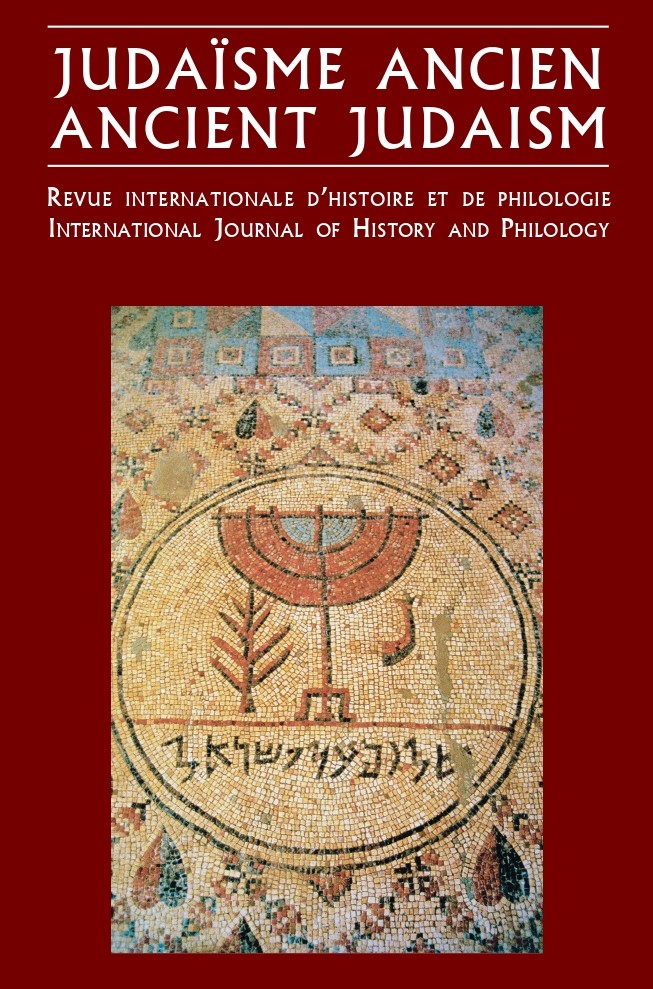
Volume 8, Issue 1, 2020
- DOSSIER COORDONNÉ PAR ERIC CRÉGHEUR « Textes et contextes : les trajectoires des manuscrits gnostiques coptes »
-
-
-
Gnosticism: an Artificial and Incoherent Category
show More to view fulltext, buy and share links for:Gnosticism: an Artificial and Incoherent Category show Less to hide fulltext, buy and share links for: Gnosticism: an Artificial and Incoherent CategoryAbstractDepuis la publication de Rethinking Gnosticism par Michael Williams en 1996, les spécialistes des origines chrétiennes remettent de plus en plus en question la validité historique du terme “gnosticisme.” Si certains plaident en faveur des “gnostiques” ou même de christianismes alternatifs tels que les mouvements gnostiques valentiniens ou séthiens, les chercheurs reconnaissent que la catégorie a néanmoins regroupé des idées et des textes anciens qui, en fait, ne vont pas ensemble.
AbstractSince Michael Williams’ 1996 publication, Rethinking Gnosticism, some scholars of Christian Origins have increasing questioned the historical validity of the term “Gnosticism.” While some would argue for “gnostics” or even for distinct alternative Christianities such as Valentinian or Sethian gnostic movements, researchers recognize that the category has included ancient texts and ideas which in fact do not belong together.
-
-
-
-
Quelques réflexions pour une approche philologique et historique des textes de Nag Hammadi
show More to view fulltext, buy and share links for:Quelques réflexions pour une approche philologique et historique des textes de Nag Hammadi show Less to hide fulltext, buy and share links for: Quelques réflexions pour une approche philologique et historique des textes de Nag HammadiAbstractDans cet article, nous proposons quelques réflexions critiques inspirées par les thèses des protagonistes d’une origine monastique des codices de Nag Hammadi et nous enregistrons un plaidoyer en faveur d’une approche globale, sur le plan philologique et historique, des codices et des textes qui y sont contenus.
AbstractIn this paper we propose some critical reflections inspired by the theses of the protagonists of a monastic origin for the Nag Hammadi Codices and we advocate a global approach, on the philological and historical level, of the codices and the texts contained therein.
-
-
-
Rethinking the Origins but also the Destination: Some Considerations on the History of Research on the Nag Hammadi Codices’ Context of Compilation, Destination and Conservation
show More to view fulltext, buy and share links for:Rethinking the Origins but also the Destination: Some Considerations on the History of Research on the Nag Hammadi Codices’ Context of Compilation, Destination and Conservation show Less to hide fulltext, buy and share links for: Rethinking the Origins but also the Destination: Some Considerations on the History of Research on the Nag Hammadi Codices’ Context of Compilation, Destination and ConservationAbstractLes dernières décennies ont été témoin d’un intérêt croissant de la part des chercheurs scientifique pour le contexte copte des textes de Nag Hammadi. Cependant, la plupart des études sur le sujet n’ont pas tenu compte de la distinction fondamentale entre la production (origine), la réception (destination) et la conservation des codices, considérant généralement comme “origine” l’ensemble des différents aspects de l’histoire de ces manuscrits. Après avoir résumé et discuté les principales pistes et études sur la vie copte des textes de Nag Hammadi, nous illustrons comment le manque de précision dans la distinction de ces trois aspects peut conduire à une image fausse et biaisée de la vie copte des traités de Nag Hammadi.
AbstractThe last few decades have witnessed a growing interest from scholars for the Coptic context of the Nag Hammadi texts. However, most of the studies on this subject have not taken into consideration the fundamental distinction between the production (origin), the reception (destination) and the conservation of the codices, generally labeling as “origin” all the different aspects related to the history of these manuscripts. Summarising and discussing themain threads and studies on the Coptic life of the Nag Hammadi Codices, I illustrate how the lack of precision in the distinction of these three may be misleading in the study of the Coptic life Nag Hammadi treatises.
-
-
-
La dernière page du codex Askew comme témoin du contexte copte du manuscrit ?
show More to view fulltext, buy and share links for:La dernière page du codex Askew comme témoin du contexte copte du manuscrit ? show Less to hide fulltext, buy and share links for: La dernière page du codex Askew comme témoin du contexte copte du manuscrit ?By: Eric CrégheurAbstractNegligee par la recherche moderne, la ≪ Pistis Sophia ≫ du codex Askew se divise en quatre parties, tantot accompagnees d’un titre tantot non, et se clot sur une decoration. Or, apres cette decoration, au recto d’un nouveau folio, le scribe a recopie 22 lignes d’un court texte qui n’a apparemment aucun lien avec ce qui precede. Vite rapproche de la finale longue de l’Evangile de Marc, ce bref texte pose toutefois plusieurs enigmes. Dans cette contribution, nous proposons de nous pencher en profondeur sur ce texte afin d’eclairer la nature de sa relation avec le reste de ce qu’a preserve le codex Askew, avec la finale longue de Marc et avec la litterature chretienne ancienne en general. Cette enquete nous fournira l’occasion de determiner si nous n’aurions pas, cache sous nos yeux, le temoin d’un apocryphe chretien encore inconnu, et d’entrevoir le contexte copte de transmission du codex Askew.
AbstractNeglected by modern research, the ≪ Pistis Sophia ≫ of the Askew Codex is divided into four parts and ends with a decoration. However, after this decoration, on the front of a new folio, a scribe copied 22 lines of a short text that has apparently no connection with what precedes it. Considered a witness of the long ending of the Gospel of Mark, this brief excerpt still poses several problems. In this paper, we propose to look at this text anew, in order to clarify the nature of its relationship with the rest of what was preserved in the Askew Codex, with the long ending of Mark, and with what can be found in early Christian literature in general. This investigation will also provide us with the opportunity to determine whether we could have, hidden before our eyes, the witness of an unknown Christian apocryphon and to get a glimpse of the Coptic context of the transmission of the Askew codex.
-
- Études
-
-
-
Jewish Culture Outside the Study Hall
show More to view fulltext, buy and share links for:Jewish Culture Outside the Study Hall show Less to hide fulltext, buy and share links for: Jewish Culture Outside the Study HallBy: Ze’ev SafraiAbstractLa littérature juive après la destruction du second Temple de Jérusalem jusqu’ à la période byzantine (70-640 ce) était majoritairement rédigée par l’ élite rabbinique. L’article essaie de démontrer qu’en plus de la culture créée dans les lieux d’ étude, il y avait aussi une activité culturelle religieuse très vive hors des lieux d’ étude. Dans ce contexte, nous examinerons vingt activités culturelles. Ces activités étaient en dialogue avec la littérature rabbinique, quelquefois en conflit avec les Sages, quelquefois acceptés par eux. Certaines activités trouvèrent leurs voies dans les lieux d’ étude ou au moins dans leurs marges. L’article entend développer la méthodologie pour distinguer le comportement “ inhabituelle” d’un rabbin “ordinaire” ou une opinion unique d’un rabbin à l’ intérieur d’un lieu d’ étude, d’une part, d’un comportement ou d’une activité créative de quelqu’un proche des rabbins, qui n’ était pas identifié comme un d’entre eux, d’autre part. Il fut peut-être choisi, non pour être identifié comme un rabbin, mais les rabbins ou la société juive toute entière pourrait avoir fait cette distinction.
AbstractJewish literature after the destruction of the Second Temple until the Byzantine period (70-640 ce), was predominate by the Rabbinic elite. The article will try to prove that in addition to the culture created in the study hall there was vigorous Jewish cultural activity outside the study hall as well. In this context we will survey 20 cultural activities. These activities were in a dialogue with the Rabbinic literature, sometimes in conflict with the Sages and sometimes accepted by them. At times, such works ultimately found their way into the study hall or at least to its margins. The article tries to develop the methodology to distinguish between “unusual” behavior of an “ordinary” rabbi or the unique opinion of a rabbi within the study hall, on the one hand, and the behavior or creative work of someone close to the Rabbis who was not identified as one of them, on the other hand. He may have chosen not to identify as a Rabbi, but the Rabbis or Jewish society as a whole could have made that distinction.
-
-
-
-
The Messianic Temple Builder in the Dead Sea Scrolls, Midrash Rabbah, and Targum Jonathan
show More to view fulltext, buy and share links for:The Messianic Temple Builder in the Dead Sea Scrolls, Midrash Rabbah, and Targum Jonathan show Less to hide fulltext, buy and share links for: The Messianic Temple Builder in the Dead Sea Scrolls, Midrash Rabbah, and Targum JonathanAbstractL’article présente une réponse critique et constructive au travail de David Shepherd sur les textes relatifs au constructeur du temple messianique dans le Targum Jonathan (“When He Comes, Will He Build It?”). Shepherd trouve que chacune des références au constructeur du temple messianique dans le Targum Jonathan est historique plutôt qu’eschatologique: Tg2Samuel 7 se réfère encore à Salomon; TgIsaïe 45-53 à Cyrus (peut-être); TgZacharie 6,12 à Zorobabel. Cet article considère des sources externes au TgJon sur le constructeur du temple messianique, notamment 4Q522, 4Q174, le soi-disant Midrash Rabba, et Sib. Or. 5, ainsi que des passages du TgJon pour étudier la question d’une lecture historicoeschatologique. Je conclus que, bien que Shepherd ait raison de douter des usages eschatologiques du Targum Jonathan, la meilleure lecture des textes est encore la lecture messianique eschatologique.
AbstractThis article offers an appreciative and critical response to DavidShepherd’s recent piece on the messianic temple builder texts in Targum Jonathan (“When He Comes, Will He Build It?”). Shepherd finds that each of the references to the messianic temple builder in Targum Jonathan is historical rather than eschatological: Tg2Samuel 7 still refers to Solomon; TgIsaiah 45-53 to (perhaps) Cyrus; and TgZech 6:12 to Zerubbabel. This article considers external evidence - messianic temple builder texts outside of TgJon, including 4Q522, 4Q174, the so-called Midrash Rabbah, and Sib. Or. 5 -as well as TgJon’s internal evidence to address the historical-eschatological question. I conclude that, while Shepherd is right to question cavalier eschatological uses of Targum Jonathan, the best reading of the texts is still the eschatological-messianic one.
-
-
-
The intertextuality of the figure of Elijah in the Qumran texts
show More to view fulltext, buy and share links for:The intertextuality of the figure of Elijah in the Qumran texts show Less to hide fulltext, buy and share links for: The intertextuality of the figure of Elijah in the Qumran textsBy: Teresa ScarsoAbstractDans les écrits de Qumrân, la figure d’Élie apparaît occasionnellement mais deux textes fragmentaires sont particulièrement intéressants pour caractériser le rôle d’Élie selon le mouvement essénien (yaḥad): 4Q521 et 4Q558. Le premier texte ressemble à une composition eschatologique dont un des protagonistes semble Élie. Le second texte en araméen est très abîmé mais il contient le nom d’Élie. Ces deux textes pourraient permettre d’ identifier la figure anonyme du “prophète” en 1QS 9,11 comme un “nouvel Élie.”
AbstractIn the writings of Qumran the figure of Elijah occasionally appears but two fragmentary texts are relevant to characterize more precisely the function of Elijah according to the Essene movement (yaḥad): 4Q521 and 4Q558. The first text appears to be an eschatological composition with a protagonist looking like Elijah. The second text in Aramaic is damaged but it contains the name of Elijah. Both texts may allow one to identify the anonymous figure of the “prophet” in 1QS 9:11 as the “new Elijah.”
-
-
-
De la confiance à la guerre eschatologique : normativités compétitrices et légitimation politique en Judée séleucide et romaine (200 av. J.-C. - 70 apr. J.-C.)
show More to view fulltext, buy and share links for:De la confiance à la guerre eschatologique : normativités compétitrices et légitimation politique en Judée séleucide et romaine (200 av. J.-C. - 70 apr. J.-C.) show Less to hide fulltext, buy and share links for: De la confiance à la guerre eschatologique : normativités compétitrices et légitimation politique en Judée séleucide et romaine (200 av. J.-C. - 70 apr. J.-C.)By: Michaël GirardinAbstractA l’aide du concept de ≪ normativites ≫ employe dans d’autres sciences humaines pour definir les conceptions que peuvent se faire des groupes de ce qui est (ou devrait etre) la norme socio-politique, cet article se propose de mettre en evidence la pluralite des conceptions cosmogoniques, politiques et theocratiques des judaismes des avant la conquete seleucide de Jerusalem en 200 av. J.-C. Les elements cognitifs sont exploites pour montrer l’importance, dans chaque milieu, de construire, d’entretenir, d’instrumentaliser ou, au contraire, d’empecher les rapports de confiance entre les individus et les pouvoirs en place pour legitimer (ou delegitimer) l’ordre present. Cette grille d’analyse permet de montrer que la domination romaine n’a pas fait eclater le judaisme antique, car celui-ci etait depuis longtemps deja profondement pluriel ; elle n’a fait que faciliter leur irremediable separation.
AbstractUsing the concept of “normativities” already in use in Humanities and other Social Sciences to define groups’ conceptions of what is (or should be) the socio-political norm, this paper aims to highlight the plurality of cosmogonic, political, and theocratic views of the Jews yet before the Seleucid conquest of Jerusalem in 200 bce. The cognitive elements are used to show the importance, in each milieu, of erecting, maintaining, instrumentalizing, or, on the contrary, preventing the relations of trust between the individuals and the powers to legitimize (or delegitimize) the present order. This grid of analysis makes it possible to show that Roman domination did not shatter ancient Judaism, for it had long since been profoundly plural. The Roman domination only facilitated their irremediable separation.
-
- Notes
-
-
-
Les grottes de Qumrân. État de la question suite à la publication d’un livre
show More to view fulltext, buy and share links for:Les grottes de Qumrân. État de la question suite à la publication d’un livre show Less to hide fulltext, buy and share links for: Les grottes de Qumrân. État de la question suite à la publication d’un livreBy: David HamidovićAbstractLa publication récente des actes d’un colloque tenu à Lugano en Suisse a mis en lumière les grottes apparentées au site de Khirbet Qumrân, non seulement les onze grottes à manuscrits mais les autres grottes alentour. Restées dans l’angle mort des manuscrits, les grottes, ou plutôt les abris dans l’immense majorité des lieux, du désert de Judée ou Juda, renseignent sur la culture matérielle des occupants anciens (permanents ou temporaires) et par extension, sur ceux qui ont déposé les manuscrits dits de Qumrân mis au jour entre 1947 et 1956. Le livre pose des questions méthodologiques essentielles sur les limites des données archéologiques actuelles après la fréquentation assidue des abris par les modernes, sur la manière dont l’archéologue sélectionne les données publiées, et sur les usages et mésusages des statistiques.
AbstractThe recent publication of the proceedings of a conference held in Lugano, Switzerland, highlighted the caves related to the site of Khirbet Qumran, not only the eleven caves with manuscripts but also the other caves around. Remaining in the blind spot of the manuscripts, the caves, or rather the shelters in the vast majority of places, in the Judean desert provide information on the material culture of the ancient (permanent or temporary) occupants and by extension, on those who deposited the so-called Qumran manuscripts discovered between 1947 and 1956. The book raises essential methodological questions about the limitations of current archaeological data after the frequent use of the shelters by the moderns, about how the archaeologist selects published data, and about the uses and misuses of statistics.
-
-
- Chronique archéologique
-
-
-
Southern Levantine Temples during the Iron Age II: Towards a Multivocal Narrative
show More to view fulltext, buy and share links for:Southern Levantine Temples during the Iron Age II: Towards a Multivocal Narrative show Less to hide fulltext, buy and share links for: Southern Levantine Temples during the Iron Age II: Towards a Multivocal NarrativeBy: Ido KochAbstractCet article explore plusieurs aspects lies aux temples du Levant meridional pendant l’ age du Fer II: leur emplacement spatial, les rituels qui s’y deroulaient et leur contexte social. Il suggere de passer d’une vision de la ou des religions du Levant meridional du Fer II comme distinctes et isolees de la vie quotidienne, a une approche plus holistique de la religion dans son contexte.
AbstractThis paper explores several aspects related to temples during the Iron Age II in the Southern Levant: their spatial location, the rituals that took place therein, and their social context. It suggests transitioning from a view of Iron Age II southern Levantine religion(s) as distinct and isolated from daily life, towards a more holistic approach of religion in context.
-
-
-
-
Recensions
show More to view fulltext, buy and share links for:Recensions show Less to hide fulltext, buy and share links for: RecensionsAbstractStefan Schorch, en collaboration avec Evelyn Burkhardt et Ramona Fändrich, The Samaritan Pentateuch : A Critical Editio Maior, Vol. III : Leviticus, Berlin/Boston 2018 (Abraham Tal)
Matthew J. Goff - Loren T. Stuckenbruck - Enrico Morano ( ed.), Ancient Tales of Giants from Qumran and Turfan : Contexts, Traditions, and Influences, Tübingen 2016 (Paul-Hubert Poirier)
Fernando Bermejo Rubio, La invención de Jesús de Nazaret. Historia, ficción, historiografίa, Madrid 2018 (Louis Painchaud)
Andrew S. Jacobs, Epiphanius of Cyprus : A Cultural Biography of Late Antiquity, Oakland, California University of California Press 2016 (Paul-Hubert Poirier)
-
-
-
Bulletin - Livres reçus à la rédaction
show More to view fulltext, buy and share links for:Bulletin - Livres reçus à la rédaction show Less to hide fulltext, buy and share links for: Bulletin - Livres reçus à la rédactionAbstractInformations sur les colloques, journées d’étude et conférences (David Hamidović)
-
Most Read This Month
