


Antiquité Tardive - Late Antiquity - Spätantike - Tarda Antichità
Revue Internationale d'Histoire et d'Archéologie (IVe-VIIIe siècle)
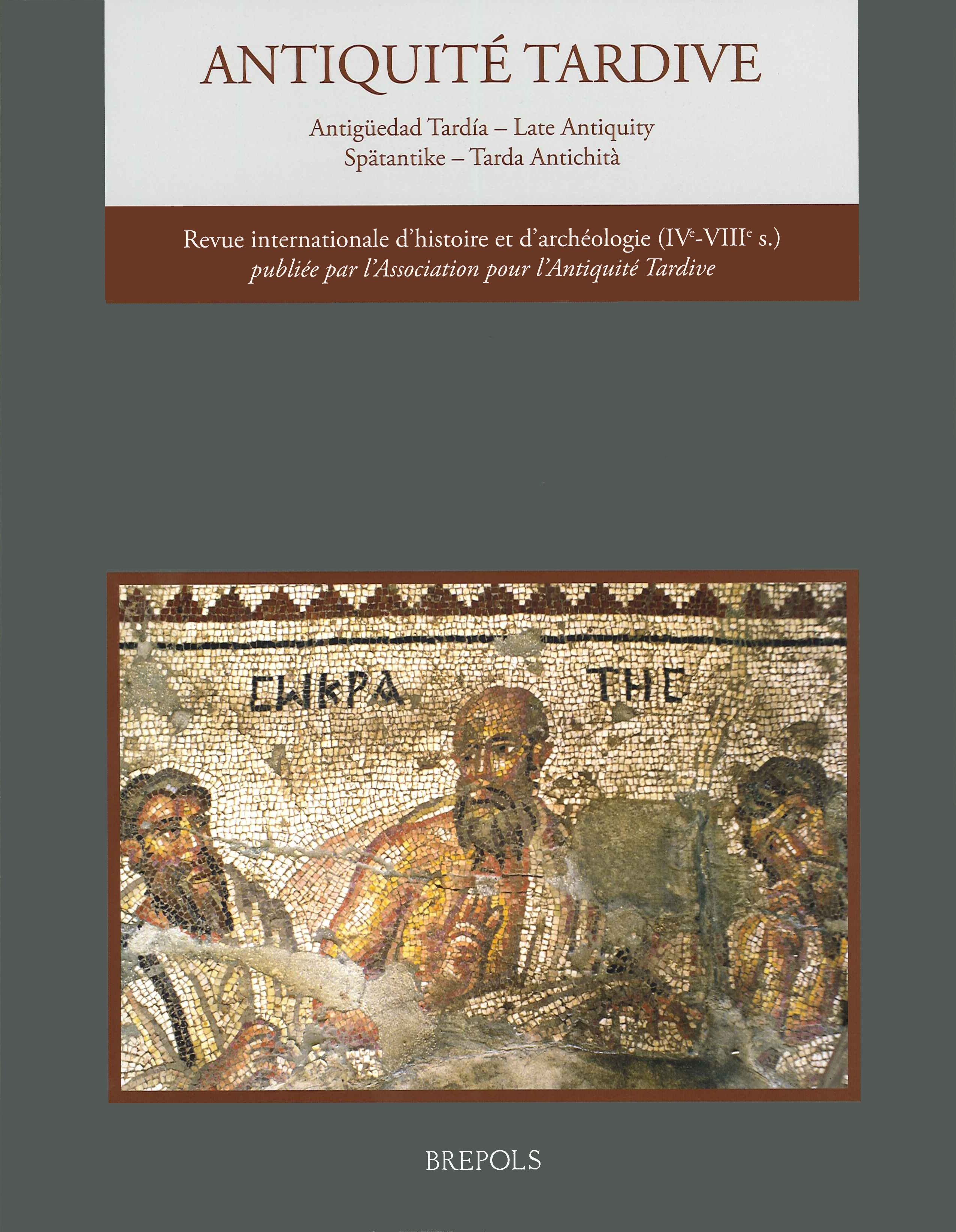
Volume 17, Issue 1, 2010
-
-
Front Matter (“Title page”, “Principales abbreviations”, “Table of contents”, “Editorial”, “Editorial board”, “Avant-propos”)
show More to view fulltext, buy and share links for:Front Matter (“Title page”, “Principales abbreviations”, “Table of contents”, “Editorial”, “Editorial board”, “Avant-propos”) show Less to hide fulltext, buy and share links for: Front Matter (“Title page”, “Principales abbreviations”, “Table of contents”, “Editorial”, “Editorial board”, “Avant-propos”)
-
-
-
Présentation du dossier
show More to view fulltext, buy and share links for:Présentation du dossier show Less to hide fulltext, buy and share links for: Présentation du dossierAuthors: J.-M. Carrié and O. LagacherieAbstractWhen he prematurely and unexpectedly died in january 2007, Jean Martin, known as a fine editor and specialist of Greek texts (Aratos, Menander comicus, Libanios, etc.) was having in progress several works which he had been meditating for long: among them a commented edition of translated texts entitled Julian dubbed Apostate’s autobiographical writings. Convinced of the great interest of that unfinished research, we gladly acceded to his daughter’s wish that such a treasure of fresh science would not get lost. We even decided, contrary to our journal’s habits, to publish the translations of Julian’s autobiographical texts, planned to be the core of the intended book because, though deprived of their relative comment, let alone their intrinsic value, they provide us with interpretations of the texts which by themselves open views from new angles. The editors’ care has been to make best use of this preliminary, inequally wrought material, sometimes merely exploratory, but, even in such a uneven form, always full of suggestions or questioning. Could this unusual kind of publication be the living testimony of higher intellectual probity, demanding method and scientific perseverance on some overabundantly treated arguments which can still be renewed, as demonstrated by Jean Martin’s unfinished achievements.
-
-
-
Jean Martin d’Aratos à Julien; Biographie de Jean Martin, publications et distinctions
show More to view fulltext, buy and share links for:Jean Martin d’Aratos à Julien; Biographie de Jean Martin, publications et distinctions show Less to hide fulltext, buy and share links for: Jean Martin d’Aratos à Julien; Biographie de Jean Martin, publications et distinctionsBy: C. Martin
-
-
-
I. Introduction au volume projeté; II. Nicoclès de Sparte, maître de l’empereur Julien; III. Notes préparatoires; IV. Julien, Lettre aux Athéniens, traduction inédite; V. Commentaire sur la Lettre aux Athéniens; VI. Julien, Le discours d’Antioche ou l’antibarbe, traduction inédite; VII. Réponse de Libanios au Misopogon, traduction inédite
show More to view fulltext, buy and share links for:I. Introduction au volume projeté; II. Nicoclès de Sparte, maître de l’empereur Julien; III. Notes préparatoires; IV. Julien, Lettre aux Athéniens, traduction inédite; V. Commentaire sur la Lettre aux Athéniens; VI. Julien, Le discours d’Antioche ou l’antibarbe, traduction inédite; VII. Réponse de Libanios au Misopogon, traduction inédite show Less to hide fulltext, buy and share links for: I. Introduction au volume projeté; II. Nicoclès de Sparte, maître de l’empereur Julien; III. Notes préparatoires; IV. Julien, Lettre aux Athéniens, traduction inédite; V. Commentaire sur la Lettre aux Athéniens; VI. Julien, Le discours d’Antioche ou l’antibarbe, traduction inédite; VII. Réponse de Libanios au Misopogon, traduction inéditeBy: J. Martin
-
-
-
Julien entre biographie et analyse historique
show More to view fulltext, buy and share links for:Julien entre biographie et analyse historique show Less to hide fulltext, buy and share links for: Julien entre biographie et analyse historiqueBy: J. BouffartigueAbstractThe ratio of biographies among the scholarly works about Julian is comparatively high, and biography is an inevitable mean to get acquainted with the history of Julian. The biographical pattern presents some advantages which are praised by ancient writers like Plutarch, who particularly appreciates its capacity of defining the êthos of a historical character. Julian’s biographers are rather cautious in performing this kind of searching, but they do not entirely avoid excesses, ascribing to Julian (or to some others around him) feelings and thoughts about which our sources do not tell us anything. Scholarly biographies of Julian are nevertheless built on the results of an activity of historical analysis whose results can be published in their own way. Those publications gradually increase the knowledge about Julian, but they as well reveal a lot of uncertainties and difficulties. The biographical way, which fills gaps and condense identities is much more seducing, but we can observe a sort of reaction against this seduction, with the idea of an antibiography which could account for Julian while keeping up his questionable and contradictory features and his elusiveness.
-
-
-
Julien: les années parisiennes
show More to view fulltext, buy and share links for:Julien: les années parisiennes show Less to hide fulltext, buy and share links for: Julien: les années parisiennesBy: M. CasellaAbstractThis article intends to scrutinize in what ways Julian’s stay in Gaul as a Caesar were decisive in Julian’s political and military education, and whether a specific ruling style and manner may be detected in the Parisian years of Julian’s government. Relying on a critical analysis of the documentation (Julian himself, Mamertinus, Ammianus, Libanios), the author examines the military and civilian aspects of Julian’s training as an apparently inexperienced ruler but quick learner. She carries out a prosopographical study of the Caesar’s circle and the administrative staff which was then on duty, combining friendly and hostile persons. Gaul offered him a training ground and he became even the experimenter of Paris as a capital. An attempt is made at reconstructing Julian’s vision of and attitude towards barbarians, Celts and Romans, and how he perceived Gaul and Paris (taking in account what was Paris like in his days in the light of recent archaeological research). The Parisian years are a valuable test for checking Julian’s adaptability — and its limits — to life in a non hellenic world.
-
-
-
Identité du prince et discours impérial: le cas de Julien
show More to view fulltext, buy and share links for:Identité du prince et discours impérial: le cas de Julien show Less to hide fulltext, buy and share links for: Identité du prince et discours impérial: le cas de JulienBy: St. BenoistAbstractThis paper considers the epigraphic evidence about Julian’s titulature and the specific discourse which can be analysed from that point of view in order to account for what was Julian’s conception of imperial power. Building upon a limited but significant number of inscriptions (less than two hundreds), we can ascertain in Julian’s and his chancellery’s discourse a much more traditional statio principis than usually surmised. It can be assumed that the most important aspects of the imperial titulature and its evolution during the 3rd and 4th centuries AD are relevant to Julian’s identity. The “Apostate” is much more an “Augustan” princeps, even if some texts can present peculiar aspects of his personality: the master of Philosophy and the pagan devout. The emperor is always presented as the protector of the Empire, an orbis terrarum identified with a single Vrbs, the eternal Rome, but now the new Romè, Constantinopolis.
-
-
-
Da eroe a dio: la concezione teocratica del potere in Giuliano
show More to view fulltext, buy and share links for:Da eroe a dio: la concezione teocratica del potere in Giuliano show Less to hide fulltext, buy and share links for: Da eroe a dio: la concezione teocratica del potere in GiulianoBy: St. ContiAbstractThis paper examines the respective value of literary, epigraphic, numismatic sources relating to a central theme of emperor Julian’s propaganda: his theocratic conception of power. He makes use of all available means of communication to propagate the idea that his empire had been wanted by the gods and that he himself had accepted the throne as a mission to fulfil for everyone’s good. The emperor shows himself as a righteous and pious man who totally places his trust in the destiny that has been traced for him: he wants to make people think that he had never desired power, but he had to obey superior will. From Julian’s propaganda comes also the identification with a series of heroes (Heracles, Achilles, Empedocles) who in the late antiquity had assumed a pagan and philosophic role, alternative to that of Jesus: during his life and even more after his death and apotheosis, Julian becomes a kind of pagan god in contraposition to the Christian God.
-
-
-
Julian’s Misopogon and the subversion of rhetoric
show More to view fulltext, buy and share links for:Julian’s Misopogon and the subversion of rhetoric show Less to hide fulltext, buy and share links for: Julian’s Misopogon and the subversion of rhetoricBy: A. QuirogaAbstractLe discours du Misopogon, composé par l’empereur Julien, constitue une invective contre les habitants d’Antioche qui s’étaient moqué de sa barbe. Une analyse rhétorique, littéraire et historique de ce discours examinera dans quelle mesure ce dernier est révélateur de l’esprit du vie siècle après J.-C. En effet, bien que la rhétorique grecque d’époque impériale soit dévalorisée, cela n’a pas affecté l’importance du Misopogon, discours qui incarne le pouvoir de la rhétorique comme instrument politique et religieux au temps d’un essor rapide du christianisme.
-
-
-
La comunità degli Elleni: cultura e potere alla corte dell’imperatore Giuliano
show More to view fulltext, buy and share links for:La comunità degli Elleni: cultura e potere alla corte dell’imperatore Giuliano show Less to hide fulltext, buy and share links for: La comunità degli Elleni: cultura e potere alla corte dell’imperatore GiulianoBy: M. CaltabianoAbstractEmperor Julian achieved two important parts of his reform project in different times. The first part consisted in the renovation of the consistorium, aimed at forming a new ruling class to help him in administrative and military affairs, and he did this in the period between the Augustan proclamation and his arrival with the army in Illyricum (waiting for the final battle with Constantius II, his cousin: spring 360-November 361).
But soon after he had the news of his cousin’s sudden death (November 361), being free to act, he engaged himself in the re-institution of an Hellenic community, gathering around himself philosophers and other pagan intellectuals whom he had met at the time of his studies in Asia Minor and Athens, in order to help him restore traditional cults. This was his preoccupation until the time he left for the Persian expedition (March 363).
My paper traces back these phases and identify the people invited by Julian to collaborate with him in the two periods, identifying the reason behind his choices. Members of the consistorium can be identified and details can be given of their social background, culture and cursus honorum. Philosophers and rhetors can also be identified, focusing on the kind of collaboration they offered.
This research shows that the new consistorium was made up of Western pagan officials, competent administrators, and loyal to the emperor. The Hellenic community, on the other hand, was formed by philosophers and rhetors of Oriental origin, but its success was limited: some of the most prestigious personalities and masters of Julian refused to take part in it as philosophers did not take interest in active politics; there were different cultural, political and religious points of view; and, finally personal ambitions were high. Julian’s project wanted a reunion of Western and Eastern traditions within the Empire but the obstacles he found were very strong.
-
-
-
Julien, l’immunitas Christi, les dieux et les cités
show More to view fulltext, buy and share links for:Julien, l’immunitas Christi, les dieux et les cités show Less to hide fulltext, buy and share links for: Julien, l’immunitas Christi, les dieux et les citésBy: G. BransbourgAbstractThe future emperor Julian, educated as a Christian and soon a hidden pagan, associated during a period of time to the supreme power by Constantius II, had the opportunity to reflect about how the Church had become so successful. More specifically, the struggle between the mainstream Christians and the followers of Arius with its political and financial implications would not get lost to him, as he had to design a grand strategy of reconquest favouring the traditional gods. Julian tried to play the army and the intermediary curial classes against a ruling plutocracy he essentially viewed as financially and ethically corrupt. For that purpose, he logically emulated the various exemptions granted to the Church and to its clergy, favouring not only the ancient religio, but also the structure that had supported it for centuries: the classic and civic polis. Behind the supposed confiscation and restoration of the municipal properties that had been considered as granted by the classical historiography, lays hidden the cornerstone of Julian’s financial policy: the likely exemption of municipal and temples’ land from Imperial taxation. In doing so, he did not have to look much further than to his own predecessor and cousin who had tried to extricate himself from a religious conflict by playing with fiscal privileges. They both used taxation as a tool to promote their favoured ideology, a rather modern even if finally unsuccessful fiscal policy.
-
-
-
La legislazione dell’imperatore Giuliano: primi appunti per una palingenesi
show More to view fulltext, buy and share links for:La legislazione dell’imperatore Giuliano: primi appunti per una palingenesi show Less to hide fulltext, buy and share links for: La legislazione dell’imperatore Giuliano: primi appunti per una palingenesiBy: E. GerminoAbstractThis essay is a first, partial skeleton of a larger work, currently under way, on the palingenesis of the Emperor Julian’s constitutions. The normative production of the last pagan Emperor requires a broader discussion leading to a comprehensive study, where a reliable reconstructive hypothesis can serve as useful background. This palingenesis covers the period from 355, when Julian was Caesar in Gaul, to his death (27 june 363), and will be conducted on all types of sources, legal, extrajuridic, epigraphic, relying on the works of the same Julian, in particular the letters, some of which are official documents with a clear normative value. In this work I have tried, for the meantime, to explain some problems of attribution emerged from a first reading of the Theodosian Code.
-
-
-
Julien législateur: un mélange des genres?
show More to view fulltext, buy and share links for:Julien législateur: un mélange des genres? show Less to hide fulltext, buy and share links for: Julien législateur: un mélange des genres?By: J.-M. CarriéAbstractHistorians never failed to look for a direct evidence of Julian’s government style in the series of his Letters. Nevertheless, the evidence from the legislative epistulae does not have the same significance whether one treats them as a “raw”, personal version later to be rewriten by the Chancellery under a “standardized” form for circulating through the provinces or whether one acknowledges in those epistulae the very form which Julian gave to his laws and which reached the inhabitants of the Empire. The first interpretation is the traditional one, which, in the case of the “scholastic law”, leads to completely dissociate Julian’s version from the text of the Theodosian Code version. Several analysts deny any direct link between these two versions and ignore or underestimate the degree of autonomy which was granted to the compilers by the specifications ascribed them by Theodosius: this latitude is particularly noticeable in the case of the choice — contradictory but easy to explain in a political perspective — of including Julian’s scholastic law into the Code’s chapter dedicated to education, that is the law whose main purpose was most in contrast to a Christianized Empire’s principles as endorsed and consecrated by the Theodosian compilation. The second interpretation — which is defended in the present article — takes into account the extent of the differences allowed between the original text of the imperial constitutions and the compiled version of the Theodosian Code, which was persuasively demonstrated by Volterra. From the moment one consider them to be original versions of Julian’s law-writing, the legislative epistulae disclose the political communication style of this emperor who carries out to an extreme level the confusion of enunciative and stylistic “genre”, being itself an effect of Julian’s unusual, overwhelming propension to theatrical performance of his self even in the use of imperial discourse.
-
-
-
Silvia Acerbi, Una nota sobre san Mercurio el Capadocio y la muerte de Juliano
show More to view fulltext, buy and share links for:Silvia Acerbi, Una nota sobre san Mercurio el Capadocio y la muerte de Juliano show Less to hide fulltext, buy and share links for: Silvia Acerbi, Una nota sobre san Mercurio el Capadocio y la muerte de JulianoBy: R. TejaAbstractThe legend of the soldier St Mercurius killing Emperor Julian gives a miraculous and providential view of the rumours that attributed the emperor’s death to a Christian soldier. The authors aim to trace the historical origins of this story — that was first included in John Malalas’s Byzantine chronicle (circa 570) — and to trace its political-religious context: Basil of Caesarea and Cappadocia, a region rich in military equestrian saints. From there, the legend would have spread to Syria, where it was heard by the Antiochian Malalas.
-
-
-
“He Forced with Gentleness”. Emperor Julian’s attitude to Religious Coercion
show More to view fulltext, buy and share links for:“He Forced with Gentleness”. Emperor Julian’s attitude to Religious Coercion show Less to hide fulltext, buy and share links for: “He Forced with Gentleness”. Emperor Julian’s attitude to Religious CoercionBy: M. MarcosAbstractControversée dès son époque, la politique religieuse de l’empereur Julien a continué à l’être par les générations suivantes. Nombre de païens ont jugé ses mesures «anti-chrétiennes» excessives, tandis que les Chrétiens les ont vécues comme des persécutions, une interprétation que l’historiographie moderne a suivi de manière générale. Cet article vise à examiner, à travers ses propres écrits, la conduite de Julien face à la coercition religieuse, en établissant une relation entre ses idées en matière de liberté religieuse, entre persuasion et contrainte, et les arguments en faveur d’une tolérance développée par les apologistes chrétiens à l’époque des persécutions.
-
-
-
Emperor Julian and the veneration of relics
show More to view fulltext, buy and share links for:Emperor Julian and the veneration of relics show Less to hide fulltext, buy and share links for: Emperor Julian and the veneration of relicsBy: J. TorresAbstractCet article examine la critique de la vénération chrétienne pour les martyrs à laquelle s’est livré l’empereur Julien. Dans son programme de réforme religieuse, ce dernier a tenté de rétablir l’hellénisme, en encourageant la renaissance des rites et des cultes païens et en discréditant le christianisme. L’attaque enflammée menée par Julien dans ses écrits contre le culte des martyrs entrait dans cette stratégie: il y exprime le plus souvent la réprobation et le mépris pour toutes les activités liées aux tombes et aux morts. Par ses lois, il établit une stricte distinction entre le monde des vivants et celui des morts; par son attitude permissive à l’égard des profanateurs de tombes et de reliques, il encouragea la violence contre les adorateurs des martyrs. Cependant, ses motifs semblent dépasser ses préférences personnelles et s’accorder avec sa politique religieuse.
-
-
-
Giuliano e Mitra
show More to view fulltext, buy and share links for:Giuliano e Mitra show Less to hide fulltext, buy and share links for: Giuliano e MitraBy: T. GnoliAbstractL’empereur Julien n’a jamais été un adepte des Mystères de Mithra. F. Cumont et J. Bidez ont été parmi ceux qui ont soutenu le mithraisme de Julien: ils ont été suivis récemment par P. Athaniassidi-Fowden et J. Bouffartigue, mais les objections qui ont été soulevées contre cette thèse, d’abord par R. Turcan, puis par R. Smith, conservent toute leur validité. Cependant, ont peut y ajouter une autre argumentation au caractère plus général. Une rapide analyse de l’attitude de Julien à l’égard des ethne orientaux et, notamment, des Perses et des «sagesses étrangères» amène à écarter son adhésion à un rite persan, ce que confirme l’attitude des intellectuels qui l’ont connu, dont les témoignages ont été souvent utilisés à l’inverse, pour soutenir la thèse du mithraisme de l’empereur.
Le culte mysthérique de Mithra au temps de Julien n’avait rien perdu de son caractère «persan»; au contraire, d’après la nouvelle documentation archéologique provenant du site de Hawarte en Syrie, on peut affirmer que le mithraisme avait conservé toutes ses particularités ethniques et culturelles qui le distinguaient de tout autre culte pratiqué dans l’Empire. À l’appui de cette thèse, on analysera deux scènes découvertes dans le nouveau mithrée syrien de Hawarte: 1/la cité des tenèbres, 2/les «Dioscures».
-
-
-
Le palais impérial d’Antioche et son contexte à l’époque de Julien. Réflexions sur l’apport des sources littéraires à l’histoire d’un espace urbain
show More to view fulltext, buy and share links for:Le palais impérial d’Antioche et son contexte à l’époque de Julien. Réflexions sur l’apport des sources littéraires à l’histoire d’un espace urbain show Less to hide fulltext, buy and share links for: Le palais impérial d’Antioche et son contexte à l’époque de Julien. Réflexions sur l’apport des sources littéraires à l’histoire d’un espace urbainBy: C. SaliouAbstractJulian’s Misopogon was posted in Antioch, according to Malalas’ Chronography, “outside of the palace, at the Tetrapyle of the Elephants, near the Regia”. A few years earlier, the sophist Libanios described the palace and its surroundings in his speech In praise of Antioch. The aim of this article is to bring to light the contribution of the literary sources to the knowledge of the palace district during the third quarter of the 4th century. The first part is devoted to the study of the name “New (city)” which is, in the Late Antiquity, the name of the island where the palace is located. In the second part, the sources relating to the palace and its surroundings, and to the other buildings in the island are systematically analysed: the Tetrapyle of the Elephants, the Regia, the palace itself, the Romanesia Gate, the Campus, and the circus. The circus was excavated, and is still partially visible. However, the archaeological excavation could not date the building. The textual evidence shows that a hippodrome did exist on the island during the reign of Theodosius I, but gives no indication on the date of its construction. The specific contribution of the written sources is to allow the study of the meanings that are attached to the components of the urban space and the way they are embedded in the collective memory and used in the construction of a civic identity. These aspects are explored in the third part of the article. The proximity of the Campus to the palace shows the importance of the military function of the emperor, particulary when in residence in Antioch. The Tetrapyle might have been devoted to the posting of imperial pronoucements, and on the opposite side of the palace, the Romanesia Gate, through which the emperor goes to the Campus, might have been a favoured place for petitioners. The toponyms “Tetrapyle of the Elephants”, “Regia”, “Campus” and “Romanesia Gate” have a clear Roman and Imperial flavour. In such a context, the assessments of Libanios and Malalas concerning the hellenistic date of the urbanization of the island or the attribution of the ornam-entation of the Romanesia Gate to Seleucos must be taken as testimonies of the self-representation of the Antiochenes in Late Antiquity, not as sources about the pre-Roman history of the Island.
-
-
-
Dai quaderni di Nicobulo. Sull’autore “bizantino” di Ps.-Bas. epp. 40-41 e sulle strane amicizie di Basilio
show More to view fulltext, buy and share links for:Dai quaderni di Nicobulo. Sull’autore “bizantino” di Ps.-Bas. epp. 40-41 e sulle strane amicizie di Basilio show Less to hide fulltext, buy and share links for: Dai quaderni di Nicobulo. Sull’autore “bizantino” di Ps.-Bas. epp. 40-41 e sulle strane amicizie di BasilioBy: F. FattiAbstractPs.-Bas. epp. 40-41 (a letter supposedly written by the emperor Julian to Basil of Caesarea, and the response of the latter) are unanimously regarded as spurious, the work of a byzantine schoolboy. But this schoolboy is extremely well-informed about people, places, and situations. His main source is undoubtedly Gregory of Nazianzus, who is also the inspirer of the main idea the forger wants to credit: that Basil was an enemy of Julian. Such representation is groundless. On the contrary, some clues exist that seem to prove the opposite is true. The apocriphal letters are the product of a milieu determined to clear the famous bishop of Caesarea of blame of having been in good terms with the emperor soon labeled as Apostate.
-
-
-
Salvian of Marseille, De gubernatione dei 5.38-45 and the “colonate” problem
show More to view fulltext, buy and share links for:Salvian of Marseille, De gubernatione dei 5.38-45 and the “colonate” problem show Less to hide fulltext, buy and share links for: Salvian of Marseille, De gubernatione dei 5.38-45 and the “colonate” problemBy: W. GoffartAbstractDes textes bien connus arrivent quelquefois à échapper longtemps à une interprétation qui satisfasse tout le monde. C’est le cas notamment de quelques chapitres fameux du De gubernatione Dei de Salvien de Marseille, qui ont trait au patronage anti-fiscal et à l’état du colon. Le «colonat» est redevenu un sujet de débats depuis l’intervention, en 1982, de J.-M. Carrié, mais risque actuellement d’être perdu de vue. Ce qui importe le plus pour les huit chapitres de Salvien, c’est de les décharger de leur redites et d’en faire ressortir un récit en ligne droite. Une paraphrase du texte en question nous occupe tout d’abord. L’attention se porte ensuite vers cinq interprétations récentes dont aucune n’arrive à maîtriser le sens de Salvien. Une étude attentive des huit chapitres est alors proposée, traçant la route par laquelle un paysan propriétaire père se transforme peu à peu en un locataire fils, c’est-à-dire en un colon. De Salvien on passe à une lettre de Sidoine Apollinaire, s’occupant elle aussi de l’état colonnaire. On constate que les deux auteurs donnent une couleur nettement servile au colon. Ces études se complètent d’un examen du ius colonatus. Il jette un coup d’œil, pour commencer, sur la conception révisée de l’esclavage agraire sous le Bas Empire et sur la thèse de J.-M. Carrié, dont l’orientation fiscale est largement admise. Pour finir, l’attention se porte vers l’état du colon, en faisant ressortir l’absence de devoirs des colons-enfants ainsi que les droits de la cellule familiale colonaire vis-à-vis du propriétaire. Le témoignage de Salvien et de Sidoine est intégré à la discussion.
-
-
-
El Dies Solis en la legislación constantiniana
show More to view fulltext, buy and share links for:El Dies Solis en la legislación constantiniana show Less to hide fulltext, buy and share links for: El Dies Solis en la legislación constantinianaBy: E. Moreno ResanoAbstractConstantine provided two measures on Sunday’s observance. The first one was the institution of a weekly market (nundinae) every Sunday in the district of Aquae Iasae (Pannonia Superior), dated between the years 316 and 321. The second one is the enactment of a general law, directed to the vicar of the pretorian praefect in the City of Rome, Helpidius, that stablished the Sunday as dies festus, and, consequently, an official and private rest day, with some exceptions.
The terms of the Constantinian dispositions on Sunday were not relative to Christianity. Namely, Constantine legislated on Sunday under the heathen denomination of Dies Solis (“the Day of the Sun”), and never as the Christian Dies Dominicus (“the Day of the Lord”). In fact, the Constantinian dispositions on Sunday indicated the Dies Solis as a day of weekly rest in order to furnish the Roman citizens a weekly space of time dedicated to the observance of vows to the Roman gods.
According to the text of the laws, the first aim of the Constantinian dispositions was the emperor’s achievement of heathen piety (pietas), following the Roman consuetudines. Taking into account that these dispositions were enacted during 323-324, the critical period previous to the second civil war between Constantine and Licinius, they could be considered as a form of Constantinian adhesion to Roman customary religious forms, in opposition with the syncretistical religious cults developed by his reival Licinius in the Eastern provinces of the Empire.
Nevertheless, the Constantinian measures on Sunday were also meant to the Christian citizens, who recognized the Sunday as the “Holy Day of the Lord” after 324. Later, in 335-336, Eusebius of Caesarea developed this identification in De laudibus Constantini, with the emperor’s approvement, but it was not until 386 that the Sunday received a legal sanction as the “Day of the Lord”.
-
-
-
Si fama non fallit fidem: les druides dans la littérature latine de l’Antiquité tardive
show More to view fulltext, buy and share links for:Si fama non fallit fidem: les druides dans la littérature latine de l’Antiquité tardive show Less to hide fulltext, buy and share links for: Si fama non fallit fidem: les druides dans la littérature latine de l’Antiquité tardiveBy: R. WiśniewskiAbstractThis paper deals with the reasons of intense, though short-lived, interest that a few Latin writers of the late 4th century, namely Ammianus, Ausonius and the author of the Historia Augusta, had in the druids. In older scholarship it was commonly believed that the druidic passages in these authors testified to the revival of indigenous Gallic priesthood in the 3rd century, and its survival in the 4th century. Nowadays scholars are more cautious about the actual renaissance of the druidism. However, even if this revival was only a literary phenomenon, the question rises about its sources.
I suggest that there were three reasons of the popularity of the druids. The first was the interest of the late ancient intelligentsia in one’s own people and family history: the druids were attractive both as a subject of research and as forefathers. The second was their philosophical profession, they were viewed as Gallic representatives of Pythagoreanism. The third was the fact that they were teachers, and so proper role models for Ausonius and his fellow-professors. The re-disappearance of the druids from the literature should be linked to the disappearance of Gallic pagan intellectuals.
-
-
-
Silver belt garniture from the tomb outside Romuliana walls
show More to view fulltext, buy and share links for:Silver belt garniture from the tomb outside Romuliana walls show Less to hide fulltext, buy and share links for: Silver belt garniture from the tomb outside Romuliana wallsBy: I. PopovićAbstractLes investigations archéologiques menées hors les murs à Romuliana en 2005 ont été l’occasion d’étudier un tombeau de la nécropole romaine tardive située au sud des remparts du palais. L’utilisation de ce tombeau remonte à la première phase de la nécropole et a été datée de la fin du iiie-début du ive siècle à la fin du vie siècle. La première sépulture est une crémation, confirmée par la présence, à proximité immédiate du mur nord-est du tombeau, de charbons, de bois et d’ossements brûlés. Dans ce dépôt, ont été trouvés un fragment de bord de coupe en argent et deux segments de ceinturon en argent travaillé, extrêmement abîmés par le feu du bûcher. Le décor du ceinturon est composé d’ornements floraux géométriques incrustés d’argent, similaires à ceux trouvés sur les sites de Sackrau Aquincum et Durostorum. Le contexte de cette inhumation, datée de l’extrême fin du iiie siècle, trouve des parallèles dans les sépultures du mémorial 1 dressé sur la colline de Magura, près de Romuliana: on y reconnaît en effet des similarités aussi bien morphologiques que décoratives dans la vaisselle d’argent et le décor du ceinturon.
-
-
-
Jean d’Antioche et ses sources latines
show More to view fulltext, buy and share links for:Jean d’Antioche et ses sources latines show Less to hide fulltext, buy and share links for: Jean d’Antioche et ses sources latinesBy: St. RattiAbstractWe are here investigating about the latin sources of John of Antioch for the imperial period. While John’s chronicle offers doubtless connexions with the Eutropius’ Breviarium, it seems unacceptable to regard the abbreviator’s latin text as John’s basic source for the reigns of Augustus to Jovian, even if we are lead to suppose that John may have enriched his research by consulting ponctually a latine source close to Eutrope. The idea that the Peanios’s Greek translation of Eutropius’ Breviarium could have been used as a source by John has also to be dropped, whereas the assumption that John could have consulted an other Greek translation should not be rejected. Thus Eutropius’ Breviarium is not a basic source to which John could have been continuoulsy enslaved. The chronicler seems more, on the contrary, to have improved an Eutropian Latin and Greek translation from other sources, especially from Dexippus.
Then we are lead to wonder whether John of Antioch could be Leo Grammaticus’ source and thus deserve to be called Leoquelle. Between John of Antioch and Zonaras — perhaps even before John —, there has existed a greek source wich Zonaras used. This source was partly reproducing informations known by latin historiographs from the last thirty years of the fourth century and which can read in quite a developped forme from Eutropius to Ammianus Marcellinus. Finally, it seems that the attribution of the Excerpta Salmasiana to John of Antioch should be refused.
-
-
-
Traduire Lydos. Notes en marge de la nouvelle édition de Jean le Lydien, Des magistratures de l’État romain …
show More to view fulltext, buy and share links for:Traduire Lydos. Notes en marge de la nouvelle édition de Jean le Lydien, Des magistratures de l’État romain … show Less to hide fulltext, buy and share links for: Traduire Lydos. Notes en marge de la nouvelle édition de Jean le Lydien, Des magistratures de l’État romain …By: D. FeisselAbstractThe new edition of ‘On the Magistracies’, published by Budé in 2006, does not offer a profoundly altered text from earlier versions (Wünsch, 1903; Bandy, 1987). But it is the first to provide a systematic commentary on the work, running to more than 1000 pages, together with a French translation which is more readable than the two earlier English translations. That translation does however still call for a series of corrections, particularly in connection with the difficulties of Late Antique administrative vocabulary. The resolutions offered below are supported by brief explanatory notes. In some cases our translation will lead to a modification of the Greek text.
-
-
-
Review of R. Bagnall (ed.), Egypt in the Byzantine World, 300-700 (Cambridge, 2007)
show More to view fulltext, buy and share links for:Review of R. Bagnall (ed.), Egypt in the Byzantine World, 300-700 (Cambridge, 2007) show Less to hide fulltext, buy and share links for: Review of R. Bagnall (ed.), Egypt in the Byzantine World, 300-700 (Cambridge, 2007)By: A. LópezAbstractCes lignes proposent le compte rendu d’un ouvrage collectif issu du Dumbarton Oaks Spring Symposium in Byzantine Studies tenu en 2004 et consacré à «l’Égypte dans le monde byzantin, 450-700». Deux principaux thèmes régissent l’ensemble du volume: l’un concerne les effets des changements et/ou des permanences qu’a manifestement connus le ve siècle mais qui n’ont laissé que très peu de témoignages; l’autre le potentiel qu’offre une histoire comparative qui inscrit l’Égypte dans contexte élargi du Proche-Orient romain tardif.
-
-
-
CIL VI, 1783,16-17: plerique meministis (e considerazioni sparse sull’impiego di plerique)
show More to view fulltext, buy and share links for:CIL VI, 1783,16-17: plerique meministis (e considerazioni sparse sull’impiego di plerique) show Less to hide fulltext, buy and share links for: CIL VI, 1783,16-17: plerique meministis (e considerazioni sparse sull’impiego di plerique)By: A. BaldiniAbstractThe pressing problem is if Theodosius I really went to Rome after the Frigidus. CIL VI, 1783 is an epigraphical statement about a Theodosian speech as soon as Nicomachus Flavianus senior was dead, that is after the battle. Scholars have different ideas: one is that Theodosius I really went to Rome, the second is that in the inscription the reference is at a senatorial delegation in Milan. My suggestion starts from the deliberation that Nicomachus Flavianus junior was the redactor of the letter in CIL VI, 1783; the HA, if it was not written by Nicomachus Flavianus junior, may be is the product of similar circles. Here, I consider some literary uses of plerique, in particular in the HA. I add also some notices on oratio (principis) in the HA, and my proposal is that Theodosian words in the tradition were not from him directely, but from an oratio principis, according to a widespread routine in Late Antiquity.
-
-
-
La subversion du genre romanesque dans le De nuptiis Philologiae et Mercurii de Martianus Capella
show More to view fulltext, buy and share links for:La subversion du genre romanesque dans le De nuptiis Philologiae et Mercurii de Martianus Capella show Less to hide fulltext, buy and share links for: La subversion du genre romanesque dans le De nuptiis Philologiae et Mercurii de Martianus CapellaBy: B. BakhoucheAbstractIn Martianus Capella’s Wedding of Philologia and Mercury, using novel as a ‘genre’ is the pretext for a work which focuses on the academic disciplines. Novel is subverted and used as an attractive package for a common handbook. I will intend to study all transgressions committed by the author: the frontiers are blurred between humanity and divinity, between microcosm and macrocosm, within the framework of a very cryptic construction. The result is polyphony within a work which intends to reflect an entirety. I will try to show that the novel intends to reflect a whole — be it cosmic, academic or literary.
-
-
-
Les monuments à auges en Cyrénaïque (Ptolémaïs et Cyrène)
show More to view fulltext, buy and share links for:Les monuments à auges en Cyrénaïque (Ptolémaïs et Cyrène) show Less to hide fulltext, buy and share links for: Les monuments à auges en Cyrénaïque (Ptolémaïs et Cyrène)By: E. JastrzębowskaAbstractStone installations referred to as “troughs” can be found in four Late Antique houses at Ptolemais and Cyrene. These large blocks of stone with a hollow carved in one of the longer sides, which is facing up, find numerous parallels in buildings of public, sacral and private character, both pagan and Christian, known from North Africa. Despite a rich topic literature, the function of these blocks remains mostly unexplained. At Ptolemais “troughs” have been recorded in the so-called House of Paulos, at Cyrene in the anonymous house by the Central Basilica, in the House of Hesychius and the so-called House of the Doric Peristyle. In all cases, the small size of the rooms or the presence of steps in the entrance preclude their use as actual horse troughs. Four such “troughs” standing in a small unit by the courtyard of the Asclepios cult complex at El-Bayda (ancient Balagrae), still active in the second half of the 4th century, are helpful in assigning a function to these installations. It is commonly known that those arriving in the sanctuary in search of a cure for their ailments were obliged to make offerings in kind to the deity they were imploring. Therefore, the “troughs” in the house of Paulos, who was a high-ranking imperial official, at Ptolemais and in the three houses at Cyrene, including that of the Libyarch Hesychius, could have served a similar purpose, as collecting points for “taxes in kind”, which would subsequently be transferred to Constantinople.
-
-
-
Comptes rendus
show More to view fulltext, buy and share links for:Comptes rendus show Less to hide fulltext, buy and share links for: Comptes rendusAbstractHistoire et archéologie de l’Antiquité tardive.
H. Amirav, B. ter Haar Romeny (eds), From Rome to Constantinople: Studies in Honour of Averil Cameron (N. Lenski); P. Blaudeau (éd.), Exil et relégation. Les tribulations du sage et du saint durant l’Antiquité romaine et chrétienne (ier-vie s. ap. J.-C.) (P. Maraval); L. Bouras, M. Parani,Lighting in Early Byzantium (J.-Ph. Carrié); A. Cutler, A. Papaconstantinou (eds.), The Material and the Ideal. Essays in Medieval Art and Archaeology in Honour of Jean-Michel Spieser (E. Zanini); K.-P. Johne, T. Gerhardt, U. Hartmann (ed.), Deleto paene imperio Romano. Transformationsprozesse des Römischen Reiches im 3. Jahrhundert und ihre Rezeption in der Neuzeit (A. Hostein); K.-P. Johne, U. Hartmann, T. Gerhardt (ed.), Die Zeit der Soldatenkaiser. Krise und Transformation des römischen Reiches im 3. Jahrhundert n. Chr. (235-284) (Fr. Paschoud); C. Kelly,Ruling the Later Roman Empire (S. Destephen); R. Marino, C. Molè, A. Pinzone (ed.), Poveri ammalati e ammalati poveri. Dinamiche socio-economiche, trasformazioni culturali e misure assistenziali nell’Occidente Romano in età tardoantica (M. Diliberto Paulsen); R. Price, M. Whitby (eds.), Chalcedon in Context. Church Councils 400-700 (S. Destephen); P. Sauzeau, T. van Compernolle (éd.), Les armes dans l’Antiquité. De la technique à l’imaginaire (E. L. Wheeler); E. Soler, F. Thelamon (dir.), Les jeux et les spectacles dans l’Empire romain tardif et dans les royaumes barbares (L. Lugaresi); C. Sotinel, M. Sartre (éd.), L’usage du passé entre Antiquité tardive et haut Moyen Âge. Hommage à Brigitte Beaujard (St. Ratti); V. Zalesskaya,Monuments of Byzantine Applied Arts. 4th-7th Centuries. Catalogue of the Hermitage Collection (L. Khrushkova).
Régions.
S. Acerbi,Entre Roma y Byzancio: la Italia de Gregorio Magno a través de su Registrum Epistularum (S. Destephen); L. Caballero Zoreda (dir.), La iglesia de San Pedro de la Nave (J.-P. Caillet); S. Destephen,Prosopographie chrétienne du Bas-Empire, 3. Le diocèse d’Asie (325-641) (Cl. Lepelley); C. Garcia MacGaw,Le problème du baptême dans le schisme donatiste (M. A. Tilley); J. Henning (éd.), Post-Roman Towns, Trade and Settlement in Europe and Byzantium. Vol. 1. The Heirs of the Roman West; Vol. 2. Byzantium, Pliska, and the Balkans (N. Christie); E. Hermanowicz,Possidius of Calama: A Study of the North African Episcopate at the Time of Augustine (N. McLynn); G. Vergone,Le epigrafi lapidarie del museo paleocristiano di Monastero (J.-P. Caillet).
Philologie et sources.
R. Delmaire, T. Mommsen, F. Richard, J. Rougé,Les lois religieuses des empereurs romains de Constantin à Théodose II (312-438). Vol. 1: Code Théodosien. Livre XVI (St. Ratti); J.-N. Guinot, F. Richard (eds), Empire chrétien et Église aux ive et ve siècles. Intégration ou “concordat”? Le témoignage du Code Théodosien (P. Van Nuffelen); A. P. Johnson,Ethnicity and Argument in Eusebius’ Praeparatio Evangelica (S. Morlet); B. Pouderon (dir.), Histoire de la littérature grecque chrétienne, 1. Introduction sous la responsabilité de Enrico Norelli et Bernard Pouderon (S. Destephen); S. Ratti,Ecrire l’histoire à Rome (H. Inglebert); S. Sconocchia, F. Cavalli, M. Baldin (ed.), Testi medici latini antichi. Le parole della medicina: Lessico e storia (J. Chandelier); Sozomène,Histoire ecclésiastique. Livres VII-IX (P. Van Nuffelen).
-
-
-
Back Matter (“Publications reçues en 2009”, “Recommendations to authors”, “Instructions aux auteurs”)
show More to view fulltext, buy and share links for:Back Matter (“Publications reçues en 2009”, “Recommendations to authors”, “Instructions aux auteurs”) show Less to hide fulltext, buy and share links for: Back Matter (“Publications reçues en 2009”, “Recommendations to authors”, “Instructions aux auteurs”)
-
Volumes & issues
-
Volume 32 (2024)
-
Volume 31 (2024)
-
Volume 30 (2022)
-
Volume 29 (2022)
-
Volume 28 (2021)
-
Volume 27 (2020)
-
Volume 26 (2019)
-
Volume 25 (2018)
-
Volume 24 (2017)
-
Volume 23 (2016)
-
Volume 22 (2015)
-
Volume 21 (2013)
-
Volume 20 (2013)
-
Volume 19 (2012)
-
Volume 18 (2011)
-
Volume 17 (2010)
-
Volume 16 (2009)
-
Volume 15 (2008)
-
Volume 14 (2007)
-
Volume 13 (2006)
-
Volume 12 (2005)
-
Volume 11 (2004)
-
Volume 10 (2003)
-
Volume 9 (2002)
-
Volume 8 (2001)
-
Volume 7 (2000)
-
Volume 6 (1999)
-
Volume 5 (1998)
-
Volume 4 (1997)
-
Volume 3 (1995)
-
Volume 2 (1994)
-
Volume 1 (1993)
Most Read This Month
