


Antiquité Tardive - Late Antiquity - Spätantike - Tarda Antichità
Revue Internationale d'Histoire et d'Archéologie (IVe-VIIIe siècle)
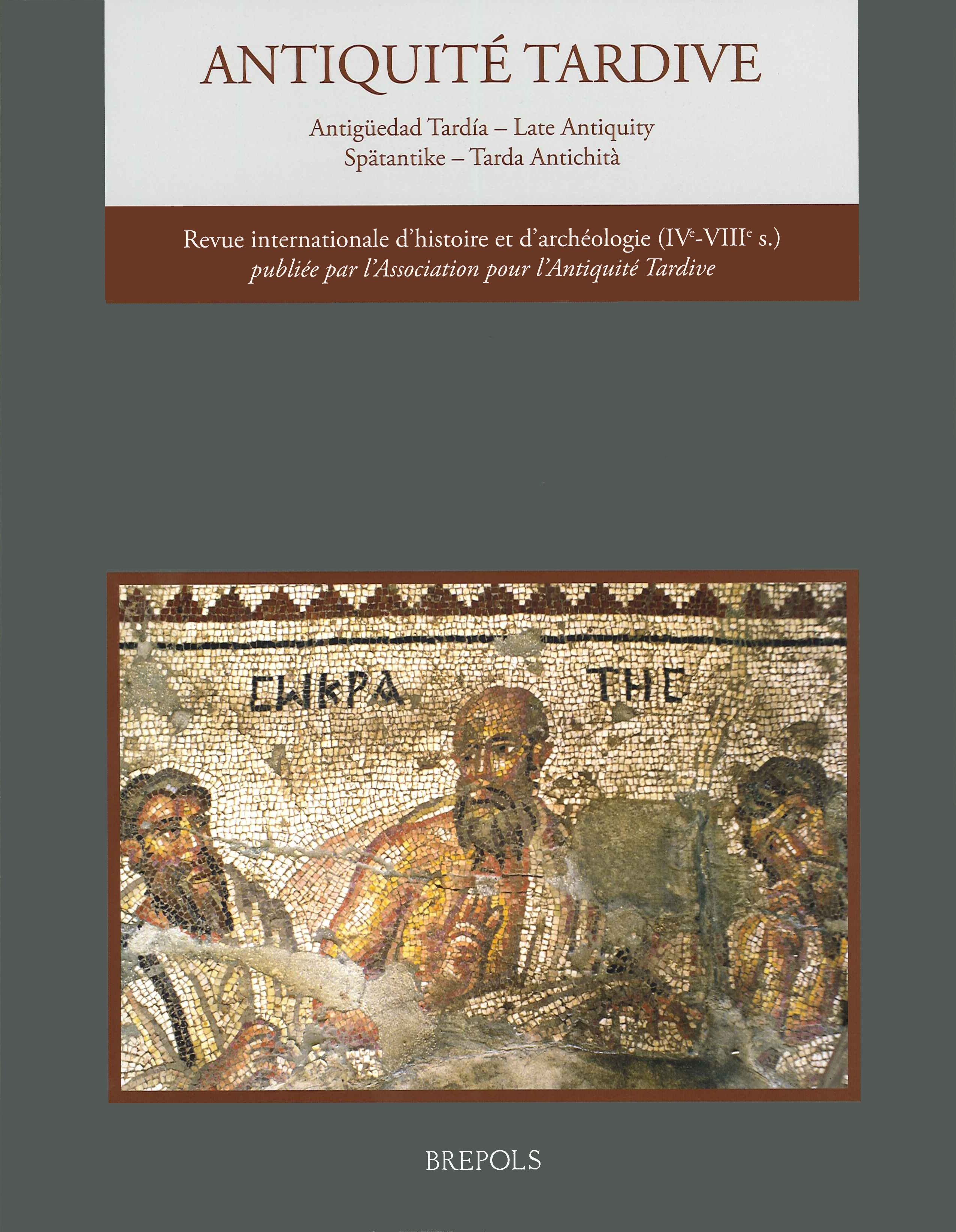
Volume 15, Issue 1, 2008
-
-
Front Matter (editorial information, title page, principales abbréviations, Table des matières, éditorial, in memoriam, Addenda et Corrigenda au no 15, 2006)
show More to view fulltext, buy and share links for:Front Matter (editorial information, title page, principales abbréviations, Table des matières, éditorial, in memoriam, Addenda et Corrigenda au no 15, 2006) show Less to hide fulltext, buy and share links for: Front Matter (editorial information, title page, principales abbréviations, Table des matières, éditorial, in memoriam, Addenda et Corrigenda au no 15, 2006)
-
-
-
Spectacles et édifices de spectacles dans l’Antiquité tardive : la mémoire prise en défaut
show More to view fulltext, buy and share links for:Spectacles et édifices de spectacles dans l’Antiquité tardive : la mémoire prise en défaut show Less to hide fulltext, buy and share links for: Spectacles et édifices de spectacles dans l’Antiquité tardive : la mémoire prise en défautBy: Fabienne DugastAbstractWhere, how long, and in what manner did the Roman games continue? While this note does not pretend to answer these questions definitively, they are nevertheless here approached in light of new studies, with special attention paid to the burden of tradition, which seems often to obscure – if unconsciously – part of history. The “effort of memory” is not an exclusively modern phenomenon. Whatever the mechanisms which trigger it might be, it is ubiquitous in all times and in all civilisations, and manifests itself by means of different modalities, be they oral or written, mythological or historical. Memory is an integral part of people’s knowledge of their own time. Whatever form it takes and whatever events or personalities it seeks to highlight, memory is necessarily selective, and the portrait is draws is partial, in every sense of the word. More often than not, the choices made by memory generate ignorance, and this ignorance is perpetuated rather than eliminated by subsequent generations, until eventually deeply embedded in the transmission of our knowledge. Late Antiquity has been profoundly affected by the capriciousness of memory. A telling illustration is provided by the Roman games, which the so-called Renaissance and following centuries preferred to have disappear with the fall of the Roman Empire and the rise of Christianity. This “faulty memory” even persists to a certain extent today.
-
-
-
Regio aliena. L'attegiamento della chiesa verso i luoghi di spettacolo nella città tardoantica
show More to view fulltext, buy and share links for:Regio aliena. L'attegiamento della chiesa verso i luoghi di spettacolo nella città tardoantica show Less to hide fulltext, buy and share links for: Regio aliena. L'attegiamento della chiesa verso i luoghi di spettacolo nella città tardoantica
-
-
-
Des lieux pour le « profane » dans l’Empire tardo-antique ? Les fêtes entre koinônia sociale et espaces de rivalités religieuses
show More to view fulltext, buy and share links for:Des lieux pour le « profane » dans l’Empire tardo-antique ? Les fêtes entre koinônia sociale et espaces de rivalités religieuses show Less to hide fulltext, buy and share links for: Des lieux pour le « profane » dans l’Empire tardo-antique ? Les fêtes entre koinônia sociale et espaces de rivalités religieusesBy: Nicole BelaycheAbstractIn a Roman empire where a variety of religious choices abounded – some of them exclusive in character – public festivals present two images which are at first sight contradictory. Promoted by the authorities, they transcended their religious dimension to become occasions for a koinônia founded on aspects of a common identity (political, social and traditional). In this respect they belong to a “secular” aspect of antiquity. Yet this consensual image, though consistent with the religious pluralism of the period, coexists with another, much closer to the standard western perception. Quite apart from the public executions which delighted the “société du spectacle” of antiquity, festivals often resulted in the unleashing of anti-Christian movements, while simultaneously uniting the Christian Fathers in opposition to them. From the anthropological point of view, this bipolarisation of the atmosphere of the festival reflects its innate character as an occasion segregated from everyday life, which permits access to the gods / to God. Historically, it corresponds to the tensions perceptible in the religious world from the second century onwards between participation in common religious debates and practices and the affirmation of identity. Such an interpretative framework would explain why (a) in the late empire festivals offered space to the “secular”; (b) as a result, they were at first little affected by religious change; and (c) since they provided an opportunity for the expression of collective identities, they were suitable occasions for denouncing the Other, if he was felt to be - or represented as - a threat to the community. With the gradual christianisation of the imperial power in the fourth century, the definition of the “sacred” underwent a change and religious rivalries intensified. Nevertheless the authorities continued to patronise and support festivals which included the “secular” element, in view of their consensual nature and their progressive disengagement from traditional religious activities. In the fifth century, when the politics, society and religion of the empire were dominated by a new concept of sacrality, this “secular” space inevitably became the object of censure and, as a result, festivals were forced to modify their raison d’être and/or their ceremonial practices.
-
-
-
L’État impérial romain face au baptême et aux pénuries d’acteurs et d’actrices dans l’Antiquité tardive
show More to view fulltext, buy and share links for:L’État impérial romain face au baptême et aux pénuries d’acteurs et d’actrices dans l’Antiquité tardive show Less to hide fulltext, buy and share links for: L’État impérial romain face au baptême et aux pénuries d’acteurs et d’actrices dans l’Antiquité tardiveBy: Emmanuel SolerAbstractThe laws of the Theodosien Code illustrate the fact that in the second half of the 4th and at the beginning of the 5th century, the Imperial State had to accept protocols established by the Church concerning baptism and the liberation – under certain conditions – of actresses and actors tied to the stage as part of the theatrical munus, as well as – though here more readily – ecclesiastical decisions relating to their excommunication and therefore to the revocation of their liberation. In a contradictory way, it was also the State’s prerogative to maintain the production of theatrical shows as part of ludi scaenici since these latter were, along with ludi circenses, components of imperial worship and the Imperial State. Faced with a dearth of actress, for the most part baptised, the Empire employed pragmatism and did not hesitate, in periods of need, to call baptised actresses back to the stage in spite of the Church’s requirements and its hostility towards ludi.
-
-
-
Spectacles in Late Antiquity: some observations
show More to view fulltext, buy and share links for:Spectacles in Late Antiquity: some observations show Less to hide fulltext, buy and share links for: Spectacles in Late Antiquity: some observationsAbstractAu cours des dernières décennies, théâtre, sport et spectacles publics sont devenus le centre d’intérêt croissant des historiens étudiant les mondes hellénistiques et romains ainsi que l’Antiquité tardive. Le présent article souhaite simplement attirer l’attention sur un certain nombre de découvertes et de nouvelles avancées dans ce domaine. Les fouilles récentes menées à Olympie ont notamment apporté une contribution importante : en révélant que le site avait manifestement conservé son activité normale en 385 de notre ère, elles pourraient bien en effet remettre en question les circonstances dans lesquelles Olympie a disparu. Par ailleurs, l’abondante publication sur les jeux du cirque fournit une information nouvelle et essentielle ; sont particulièrement remarquables les inscriptions éditées par M. Rey-Coquais sur l’hippodrome de Tyr, qui amènent des témoignages supplémentaires sur la formation et l’organisation des factions des Bleus et des Verts.
-
-
-
Il munus della pretura a Roma e a Costantinopoli nel corso del tardo impero romano
show More to view fulltext, buy and share links for:Il munus della pretura a Roma e a Costantinopoli nel corso del tardo impero romano show Less to hide fulltext, buy and share links for: Il munus della pretura a Roma e a Costantinopoli nel corso del tardo impero romanoBy: Stefano GiglioAbstractThe work, turned to analyse the title 6.4 De praetoribus et quaestoribus of CTh, is conceived in the light of the constitutional structure of the late Roman empire, of the rules concerning the senatorum lectio (based on the fact that ordo senatorius is to identify with the senate) and of the bigger influence of the senate of Rome compared with the senate of Constantinople. The legislation of the late Roman empire shows that the praetura is formally defined as munus only from the times of Marcian (CJ, 1.39.2), even though appears like this evolved at least from the times of Constantine. The different weight of the two assemblies, that involved bigger burdens to disadvantage of the senators of Rome, can be ascertained also in matter of evasion of duty of the praetura and seems to confirm a thesis relating to protostasia (introduced by Constantius II with regard to the senators of Constantinople as method of exaction in matter of praebitio tironum, then applied by Valens to all subjects of pars Orientis and never introduced into the pars Occidentis).
-
-
-
Le tribunus voluptatum, un fonctionnaire au service du plaisir populaire
show More to view fulltext, buy and share links for:Le tribunus voluptatum, un fonctionnaire au service du plaisir populaire show Less to hide fulltext, buy and share links for: Le tribunus voluptatum, un fonctionnaire au service du plaisir populaireAbstractIn this work, we study the figure of the tribunus uoluptatum, a not much known official who performed his office between the Vth and VIth centuries. We examine his date of creation – shortly before year 414 – and the cities where it is mentioned – Rome and Milan. We analyze also the law of the Theodosian Code concerning this office (XV, 7, 13), as well as the letters of the Variae of Cassiodorus, mainly the formula tribuni uoluptatum (VII, 10). We finish this study with the prosopographical notices of the tribuni uoluptatum known by the moment, and with one annex of the texts of Variae where Cassiodorus cite this official.
-
-
-
Les spectacles à Antioche d’après Libanios
show More to view fulltext, buy and share links for:Les spectacles à Antioche d’après Libanios show Less to hide fulltext, buy and share links for: Les spectacles à Antioche d’après LibaniosBy: Marinela CasellaAbstractThe subject of my contribution might seem very wide. I intend, in fact, to develop it in two main directions: the theatrical shows and those of the circus. If Antioch people’s entertainment reaches its peak in the Olympic Games and Syriarch’s spectacles, more common ones were provided by theatrical shows and chariot-races. I shall study the part of these ordinary spectacles in Antioch people’s life, beginning with generalities on the already well-known world of actors, mimes and pantomimes, without lingering however, in order to move on to what I would like to focus: the circus world, the equestrian competitions which took place in the hippodrome, and the exaltation which they aroused. About the latter, I shall particularly analyse the following aspects: horses-race as a meeting point of the different social classes, and the possibilities for the hippodrome to have had a political function; modalities of circus games organisation and financing: harmatotrophia, and hippotrophia (personal or patrimonial liturgies?); the supply of horses (belonging personally to the bouleutes, or brought by the city?); purchase and resale of horses, which bring about outlay as well as profit. I shall consider these different procedures as being in correlation with one another. I shall also go through the problem of the circus factions in Antioch, on which opinions differ in the absence of textual indications enough definite. I shall notice the strict correlation between bouleutes’ statutory obligations and the passionate phenomena which comes with equestrian games: moral criticism which Libanios carried on circus games leads to an end while accepting the whole liturgical system which would not be called into question.
-
-
-
L’iconographie d’un accessoire de mise en scène (iie-ive siècles). Problèmes d'interprétation
show More to view fulltext, buy and share links for:L’iconographie d’un accessoire de mise en scène (iie-ive siècles). Problèmes d'interprétation show Less to hide fulltext, buy and share links for: L’iconographie d’un accessoire de mise en scène (iie-ive siècles). Problèmes d'interprétationAbstractThe repertoire of theatrical iconography sometimes includes a fixed implement which highlights one Greek letter out of five, placed in a semi-circle around the upper half of a disc. This accessory is associated exclusively with stage artists, actors and musicians. It has been identified in the past as a hydraulic organ or bronteion, but its composition corresponds neither to literary descriptions nor to representations. An attentive examination shows that we should also dismiss the hypothesis of an implement for drawing lots, comparable to those used in wrestling and equestrian competitions. Several new interpretations might be offered. Berlin papyrus 13927 suggests that the letters of the motif might correspond to the different parts of a theatrical show. Clearly visible on the stage, the motif could evoke a stagehand’s levers, or even an implement intended to facilitate the synchronisation of the production. It does not allude to any specific event; its image is enough to symbolise the world of the stage in general.
-
-
-
Le théâtre antique d’Apt (France, Vaucluse) aux ve et vie siècles (avec la collaboration d'Isabelle Doray pour l'étude céramologique)
show More to view fulltext, buy and share links for:Le théâtre antique d’Apt (France, Vaucluse) aux ve et vie siècles (avec la collaboration d'Isabelle Doray pour l'étude céramologique) show Less to hide fulltext, buy and share links for: Le théâtre antique d’Apt (France, Vaucluse) aux ve et vie siècles (avec la collaboration d'Isabelle Doray pour l'étude céramologique)AbstractThis article gathers the results of the various prospection campaigns carried out in the cellars of the old city center of Apt. It relates to mainly the vestiges of the ancient theatre, and its reoccupying in the 5th and 6th centuries. This contribution also proposes to detail some design features and architectural noted in the re-use of certain spaces of the theatre, as the scene or the curvilinear frontage of the monument.
-
-
-
Le théâtre d’Oudna-Uthina (Tunisie) : diagnostic et état dans l'Antiquité tardive
show More to view fulltext, buy and share links for:Le théâtre d’Oudna-Uthina (Tunisie) : diagnostic et état dans l'Antiquité tardive show Less to hide fulltext, buy and share links for: Le théâtre d’Oudna-Uthina (Tunisie) : diagnostic et état dans l'Antiquité tardiveBy: Christian LandesAbstractThe Oudhna theatre was not included in the 1993 project of clearing ancient Uthina’s monuments. The importance of the theatre has been acknowledged, however, since Victor Guérin in the mid-19th century. In 2004, the building was studied anew, in order to assess its state of conservation, to establish its chronology, and to plan subsequent archaeological excavations. The results obtained from this preliminary study concern especially the stage wall, but other large structures within the monument (cavea, orchestra) were also assessed. The current data suggest that the theatre was build during the first half of the 2nd century but was transformed in the 6th century (perhaps already in the 4th) into a quarry which included Byzantine era “construction sheds”. Construction materials were still being recovered from it in the 18th and 19th centuries, until Paul Gauckler, then inspector of archaeological excavations within the beylic Antiquities department, had it classified as a protected landmark between 1892 and 1896.
-
-
-
L’enfant et le coq. Une allusion à la gladiature sur la mosaïque « des enfants chasseurs » de Piazza Armerina
show More to view fulltext, buy and share links for:L’enfant et le coq. Une allusion à la gladiature sur la mosaïque « des enfants chasseurs » de Piazza Armerina show Less to hide fulltext, buy and share links for: L’enfant et le coq. Une allusion à la gladiature sur la mosaïque « des enfants chasseurs » de Piazza ArmerinaAbstractThe present study tries to explain the signification of a scene which is on the mosaic so-called “The Children’s hunting”. In this scene, a cock chases a boy, what seems to be an illustration of the defeated gladiator asking for his missio. Indeed, the boy is kneeling down and raises his right hand in an aggressive context. Besides the evocation of the venatio, this mosaic describes a gladiator’s performance. At least, the allusion to the munus is not so obvious since, on the 4th century AD, the gladiature had practically disapparead whereas the venatio were very famous in Africa.
-
-
-
L'hippodrome de Constantinople. Essais de restitution architecturale du dernier état du monument
show More to view fulltext, buy and share links for:L'hippodrome de Constantinople. Essais de restitution architecturale du dernier état du monument show Less to hide fulltext, buy and share links for: L'hippodrome de Constantinople. Essais de restitution architecturale du dernier état du monumentAuthors: Jean-Claude Golvin and Fabricia FauquetAbstractUntil now, all the circus reconstruction’s attempts were confronted to the same problem: the lack of a complete comparative study able to give all the necessary arguments to support the given hypothesis. In our previous works, we have just achieved a comparative and functional study of the Roman’s circus to explain the strong links between the function and the shape of this edifice for the Roman spectacles. This comparative and functional study produced a large set of useful informations allowing an architectural reconstruction of Constantinople’s Hippodrome. This study seemed essential because this major building has not been described in the fundamental work of J. H. Humphrey, nor in recent studies, mainly those of Guilland and Dagron, allow a new reading of this monument. Regarding the archaeological data, only few parts of the hippodrome are known. These data were compared with recent studies and ancient sources, the book of the ceremonies from Constantin Porphyrogenitus. The accuracy of the information provided by the text allows to understand the functioning of the building and to reconstruct a large portion of its components (cavea, spina, kathisma and carceres). Thanks to this study, we have gained a clear idea of the architecture of the latest state of the Constantinople’s hippodrome.
-
-
-
Galerius’ jigsaw puzzle: the Caesariani dossier
show More to view fulltext, buy and share links for:Galerius’ jigsaw puzzle: the Caesariani dossier show Less to hide fulltext, buy and share links for: Galerius’ jigsaw puzzle: the Caesariani dossierBy: Simon CorcoranAbstractL’époque tétrarchique est bien connue pour nous avoir conservé des décisions impériales gravées en latin dans l’Orient grec, et plus particulièrement des textes trouvés en plusieurs exemplaires, ce qui se présente rarement dans les époques précédentes tandis qu’on en compte neuf cas entre 301 et 362. Le présent article concentre son attention sur quatre de ces textes : le premier décret sur les Caesariani de 305, la lettre sur les Caesariani, l’Edictum de Accusationibus (habituellement attribué soit à Constantin, soit à Licinius en 314 ou 320) et le deuxième décret sur les Caesariani. On cherche ici à montrer que ces quatre textes constituent en réalité un seul et même dossier mettant en corrélation trois décisions publiées par Galère durant l’été 305. Le raisonnement se fonde sur les trois points suivants : 1/ ces textes, dont les thèmes sont complémentaires, se retrouvent dans une situation d’association qui se recoupe dans une multiplicité de sites, où ils partagent également des caractères physiques similaires ; 2/ l’unique datation épigraphique explicite est 305 dans le premier décret, auquel, en réalité, la lettre sur les Caesariani tient lieu de préambule et avec lequel l’Edictum de Accusationibus devrait également être associé en raison de l’inscription de Padoue (CIL, V, 2781), ce qui trouverait une ultérieure confirmation si c’est bien l’Edictum que reproduit le texte de Corcyre de 305-306 (AÉp., 2002, 1302). L’indication de date donnée par le Code Théodosien (CTh, IX, 5, 1) est douteuse, on ne doit pas en tenir compte ; 3/ les similitudes entre les formules conclusives dans l’Edictum et dans le deuxième décret sur les Caesariani suggèrent que l’Edictum a été promulgué en même temps qu’un autre édit (le deuxième décret) et qu’une lettre (le premier décret). Le dossier, par conséquent, se compose d’un édit d’indulgence restituant des biens détenus par le fisc, d’une lettre aux préfets du prétoire annulant les injonctions fiscales abusives et prévoyant de les surveiller de plus près à l’avenir, et d’un édit général réglementant et limitant le dépôt d’accusations, qu’elles soient criminelles ou fiscales. Au total, le dossier manifeste un souci de protéger les provinciaux innocents et leurs biens contre les abus perpétrés par des fonctionnaires financiers impériaux comme les Caesariani. Le contexte de l’été 305 convient parfaitement à ce dossier, survenant peu après que Galère était devenu Auguste et au moment où il complotait pour prendre le contrôle du collège impérial à la suite du départ de Constance Chlore attendu comme imminent. L’association d’autres textes épigraphiques multiples (par exemple l’Édit sur les Prix) avec la sphère d’influence de Galère suggère en outre que ce phénomène est la marque du style personnel de gouvernement de Galère, et non pas un trait général de la période.
-
-
-
Christian emperor, vestal virgins and priestly colleges: reconsidering the end of roman paganism
show More to view fulltext, buy and share links for:Christian emperor, vestal virgins and priestly colleges: reconsidering the end of roman paganism show Less to hide fulltext, buy and share links for: Christian emperor, vestal virgins and priestly colleges: reconsidering the end of roman paganismBy: Rita Lizzi TestaAbstractLes mesures prises par Gratien contre le paganisme en 382 nous sont connues essentiellement par la Relatio III de Q. Aurelius Symmachus et par les Epistulae 72 et 73 d’Ambroise de Milan, que la tradition historiographique a versées au dossier de l’affaire de l’autel de la Victoire. La présente contribution examine ces textes en discutant la nature des décisions qui s’y trouvent décrites. Celles-ci ne furent pas dirigées – comme on le pense généralement – contre tous les sacerdoces païens de Rome, pas plus qu’ils ne provoquèrent la réquisition de tous les fundi templorum, mais bien plutôt renouvelèrent l’ordre d’enlever l’autel de la Victoire de la curie sénatoriale et concernèrent certains des privilèges propres aux Vestales, tels que le stipendium, l’exemption des munera, les annonae et le droit de ce collège à hériter, à l’avenir, d’agri.
-
-
-
In ecclesia contra ecclesiam: algunos ejemplos de disputas, violencias y facciones clericales en las iglesias tardoantiguas hispanas
show More to view fulltext, buy and share links for:In ecclesia contra ecclesiam: algunos ejemplos de disputas, violencias y facciones clericales en las iglesias tardoantiguas hispanas show Less to hide fulltext, buy and share links for: In ecclesia contra ecclesiam: algunos ejemplos de disputas, violencias y facciones clericales en las iglesias tardoantiguas hispanasAbstractIn these pages are set out the suits which, inside the clergy, encouraged the life in the Hispanic Churches of the late Antiquity. So it makes emphasis on the factions and fights of power in the different local churches, in front of a false uniformity and stability of the ecclesiastical organization, with a special attention to the Visigoth age. It is not going to try here to do a systematic recount about how many episodes of clashes, in a diocesan see itself, are documented, but to declare some of the examples more significant of such fact, despite the treatment, sometimes crafty one, which our sources have dealt with it.
-
-
-
Towards an aesthetic paradigm of Late Antiquity
show More to view fulltext, buy and share links for:Towards an aesthetic paradigm of Late Antiquity show Less to hide fulltext, buy and share links for: Towards an aesthetic paradigm of Late AntiquityBy: Marco FormisanoAbstractLe présent article part d’une considération de caractère général à propos de l’étude de la littérature de l’Antiquité tardive : bien que la période en question ait été réévaluée dans le cadre des sciences de l’Antiquité et quand bien même elle représente désormais un domaine privilégié de la recherche historique et archéologique, diverses sont les raisons qui rendent opaque l’étude de la production littéraire tardoantique. On se réfère ici, d’un côté aux difficultés dues au curriculum académique des spécialistes de littérature tardoantique, de l’autre à l’incompréhension ou, mieux encore, à la dévalorisation de formes expressives différentes, auxquelles normalement, dans une perspective moderne, on n’accorde pas de valeur littéraire au sens propre (illuminant est, en ce sens, le renvoi à Riegl pour l’histoire de l’art). On veut ici souligner la nécessité d’élaborer une méthode d’interprétation esthétique et littéraire différente de celles qui sont adoptées pour la littérature des époques précédentes, mais aussi plus indépendante du paradigme historiographique dominant dans les études sur l’Antiquité tardive.
-
-
-
Vorstellung von Tod und Jenseits in der Frühchristlichen Grabinschriften der Oikumene
show More to view fulltext, buy and share links for:Vorstellung von Tod und Jenseits in der Frühchristlichen Grabinschriften der Oikumene show Less to hide fulltext, buy and share links for: Vorstellung von Tod und Jenseits in der Frühchristlichen Grabinschriften der OikumeneAbstractThe project “Mors secundum epigrammata christiana antiqua” is based on the compilation of inscriptions of the third to the sixth century from the Oikumene. These inscriptions speak about death and afterlife and display similarities and differences of ideas about life after death in East and West. Important themes in both West and East are the community with God or Christ, which is already prominent in the early inscriptions from the West, and statements referring to the eternal life, which can generally be found from the fourth century onward. In the East, invocations of God are particularly numerous and show the affectionate interest and solicitude of the living for the post mortem fortune of their dead. However, resurrection and final judgement are not an important theme either in the East nor in the West; the hereafter is depicted very positively, in contrast to the negative or indifferent afterlife of paganism. The refrigerium, a famous theme in the Christian Latin epitaphs of the 3rd and 4th century, does not appear in the grave inscriptions of the East. When merits are mentioned, the persons often belong to elevated social spheres. The forgiveness of sins is rarely mentioned in the grave inscriptions of East or West and hardly ever with reference to the afterlife; clearly, contrary to standard views, it was not important in a funerary context and gains importance only in the Middle Ages.
-
-
-
La fontaine Utere felix de Carthage, une installation de banquet de l'Antiquité tardive et son décor
show More to view fulltext, buy and share links for:La fontaine Utere felix de Carthage, une installation de banquet de l'Antiquité tardive et son décor show Less to hide fulltext, buy and share links for: La fontaine Utere felix de Carthage, une installation de banquet de l'Antiquité tardive et son décorBy: Éric MorvillezAbstractThe Utere Felix fountain decorated with an array of mosaics, sculptures and paintings with marine themes was discovered in 1919 at Carthage near the Byrsa Hill. This little monument, object of polemics between archaeologists, was quickly forgotten to such an extent that its track got lost. Thanks to record documents, it was possible to accurately locate the fountain again in the town plan, to understand its hydraulic operation and to complete the already very precise description made by Raymond Lantier and published in Bulletin du Comité des Travaux historiques et scientifiques. A comparison with the other preserved stibadia with fountain of the same type, like the one of El Ruedo (province of Cordoba) or at Faragola (Pouilles, Italy) enabled to grasp the peculiarities of this 4th century facility, like the spray of flowers on the seat or the form of the apsis basin with niches and outgoing water jets forming a half circle. The themes of mosaics and paintings decoration are analysed by comparison with decorative arrays coming from monuments of Rome (paintings of the Domus under Farnesina ai Ballauri, Hypogeum of Via Livenza) or from North Africa (houses in Utique, Trifolium House of Dougga, House of the New Hunt or House of the Fishing in Bulla Regia).
-
-
-
Picturing ideal beauty: the saints in the rotunda at Thessaloniki
show More to view fulltext, buy and share links for:Picturing ideal beauty: the saints in the rotunda at Thessaloniki show Less to hide fulltext, buy and share links for: Picturing ideal beauty: the saints in the rotunda at ThessalonikiBy: Bente KiilerichAbstractLes saints, tant vivants que dans l’au-delà, forment un sujet actuellement très apprécié des études concernant l’Antiquité tardive. Dans le domaine iconographique, l’ensemble le plus magnifique de saints est représenté par les quinze portraits de martyrs en mosaïque conservés sur la coupole de la Rotonde de Saint-Georges à Thessalonique. Étrangement, le discours contemporain de l’iconographie hagiographique néglige largement ces images exceptionnelles. La raison en est probablement de l’incertitude de leur datation. Pourtant, qu’on les place dans les dernières décennies du ive siècle, aux alentours de 450, ou au début du vie siècle, ces mosaïques fournissent une importante information sur l’origine et le développement de la représentation des saints. Cet article pose le problème de la genèse de l’image individualisée du martyr, en particulier la question de son rattachement à une tradition authentique liée à son portrait funéraire. Une des caractéristiques distinctives des images du monument de Thessalonique est la variété des représentations : les portraits des martyrs sont nettement individualisés, différenciés par âge, chevelure, barbe, traits physiognomoniques, couleurs, etc. Toutefois, indépendamment de la question de l’origine et de l’authenticité de ces portraits, les couleurs particulières des tesselles utilisées pour rendre les chevelures et les yeux montrent que, dans la Rotonde, les mosaïstes ont donné la priorité à une esthétique de “lumière colorée’, principe qui leur a permis de représenter la beauté idéale des hommes saints dans l’au-delà.
-
-
-
Des mois et des Apôtres : à propos d'une cuillère d’argent inscrite trouvée dans la Saône
show More to view fulltext, buy and share links for:Des mois et des Apôtres : à propos d'une cuillère d’argent inscrite trouvée dans la Saône show Less to hide fulltext, buy and share links for: Des mois et des Apôtres : à propos d'une cuillère d’argent inscrite trouvée dans la SaôneBy: François BaratteAbstractThe decoration of a silver spoon found in the Saône river in Lyons, dated from the 6th century, allows to collocate it in a group which should illustrate the twelve months of the year. This object provides an additional indication of the existence of coherent dozens of spoons, dedicated, for instances, to the Apostles. Two other elements of the decoration on the handle, a cross and an ivy-leaf, give the opportunity to go back over another group of late spoons which use the same patterns, coming mainly from graves in Occident. Their function is again discussed, to dismiss the hypothesis of objects specifically destined for a funeral use.
-
-
-
Chronique d'historiographie tardo-antique
show More to view fulltext, buy and share links for:Chronique d'historiographie tardo-antique show Less to hide fulltext, buy and share links for: Chronique d'historiographie tardo-antiqueAbstractThis survey paper comments on several recent publications: two books about scholars who worked on the Historia Augusta, two editions of aretalogical biographies (Jerome’s Lifes of Monks and Eunapius’ Lifes of Philosophers and Sophists), a volume of papers read in a conference on Ammianus 26-31, a new volume of the Historia Augusta Colloquiums and a book by Fr. Chausson on fictional kinships in late antique imperial families.
-
-
-
Un distique vénatoire tardo-antique. À propos d'une inscription latine sur une lance d'apparat de la nécropole mérovingienne de Cutry
show More to view fulltext, buy and share links for:Un distique vénatoire tardo-antique. À propos d'une inscription latine sur une lance d'apparat de la nécropole mérovingienne de Cutry show Less to hide fulltext, buy and share links for: Un distique vénatoire tardo-antique. À propos d'une inscription latine sur une lance d'apparat de la nécropole mérovingienne de CutryAbstractDuring the excavations carried out in the Merovingian necropolis of Cutry (Meurthe-et-Moselle), the archaeologists brought to light a male burial dating from the second half of the 6th century containing an exceptional object: a prestigious spear, datable – by analogy with some other weapons of the same type – of the 5th century. On its blade there is a Latin inscription which so far has not been deciphered. In my article I propose the following reading of this text: HAEC INT[E]R V[ASTAS] STRINGAT VENABVLA SI[L]VAS QVI GAUDET RABID[IS] OBUIU[S I]RE FERIS “Let draw this spear in vast forests Who enjoys to go against the wild animals”. If we suppose that the distich was not copied from an older spear and it was written specifically for the weapon found in the necropolis of Cutry, we cannot but be struck by its correct versification and the construction of the verses which evokes the poetry of Augustean period. The fine workmanship of the spear points unambiguously towards the Gallo-Roman aristocracy whose literary taste is well-known to us owing to the writings of Ausonius, Rutilius Namatianus and Sidonius Apollinaris. However, a comparison between the distich and their works does not deliver obvious analogies. Therefore, the text restored above appears to be a phenomenon: its writing on a prestigious hunting weapon, its impeccable versification, its light form, its Ovidian construction and, finally, its assonances which evoke the medieval léonins – all this make it an exceptional epigram which enriches our knowledge on late antique poetry.
-
Volumes & issues
-
Volume 32 (2024)
-
Volume 31 (2024)
-
Volume 30 (2022)
-
Volume 29 (2022)
-
Volume 28 (2021)
-
Volume 27 (2020)
-
Volume 26 (2019)
-
Volume 25 (2018)
-
Volume 24 (2017)
-
Volume 23 (2016)
-
Volume 22 (2015)
-
Volume 21 (2013)
-
Volume 20 (2013)
-
Volume 19 (2012)
-
Volume 18 (2011)
-
Volume 17 (2010)
-
Volume 16 (2009)
-
Volume 15 (2008)
-
Volume 14 (2007)
-
Volume 13 (2006)
-
Volume 12 (2005)
-
Volume 11 (2004)
-
Volume 10 (2003)
-
Volume 9 (2002)
-
Volume 8 (2001)
-
Volume 7 (2000)
-
Volume 6 (1999)
-
Volume 5 (1998)
-
Volume 4 (1997)
-
Volume 3 (1995)
-
Volume 2 (1994)
-
Volume 1 (1993)
Most Read This Month
