


Antiquité Tardive - Late Antiquity - Spätantike - Tarda Antichità
Revue Internationale d'Histoire et d'Archéologie (IVe-VIIIe siècle)
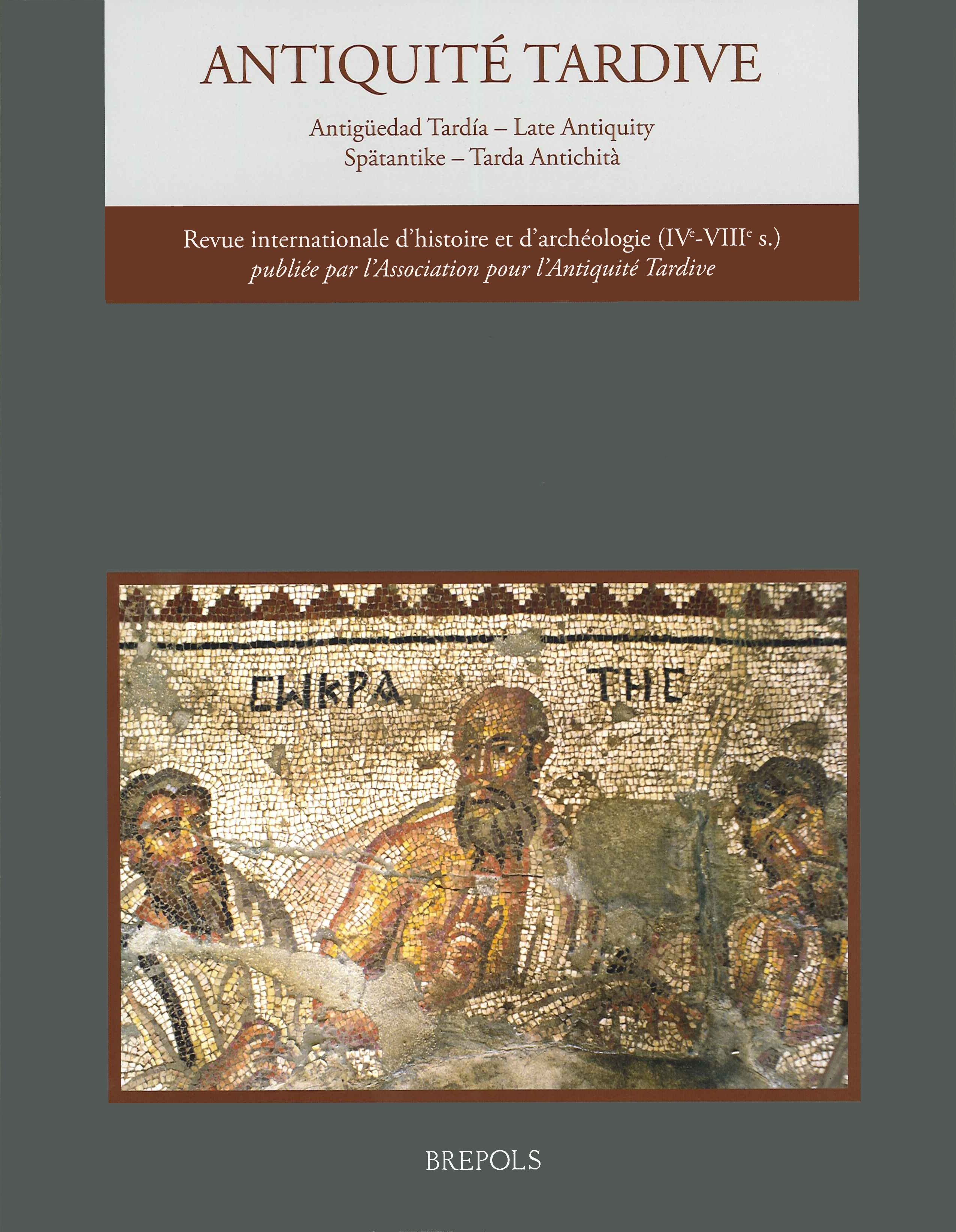
Volume 12, Issue 1, 2005
-
-
Front Matter (editorial information, title page, principales abbréviations, Table des matières, éditorial, erratum, in memoriam, avant-propos, Programme du Colloque, Glossaire des termes techniques)
show More to view fulltext, buy and share links for:Front Matter (editorial information, title page, principales abbréviations, Table des matières, éditorial, erratum, in memoriam, avant-propos, Programme du Colloque, Glossaire des termes techniques) show Less to hide fulltext, buy and share links for: Front Matter (editorial information, title page, principales abbréviations, Table des matières, éditorial, erratum, in memoriam, avant-propos, Programme du Colloque, Glossaire des termes techniques)
-
-
-
Vitalité de l’industrie textile à la fin de l’Antiquité : considérations économiques et technologiques
show More to view fulltext, buy and share links for:Vitalité de l’industrie textile à la fin de l’Antiquité : considérations économiques et technologiques show Less to hide fulltext, buy and share links for: Vitalité de l’industrie textile à la fin de l’Antiquité : considérations économiques et technologiquesAbstractThe starting point of this introductory report as well as of this whole scientific conference is the spectacular renewal of studies in the structures of fabrics and the technology of ancient textiles which has been carried out by the specialists, taking advantage of a series of a huge harvesting of textile relics in various archaeological excavations: it allows us to use the term “revolution”. Late Antiquity may no longer be considered the major breaking point in the history of fabric and dress which for a long it has been believed to be. There was no break in the weaving technology: the horizontal drawloom with treadles is a far later invention. Earlier looms were still used, but with improvements and renewed expertise which enabled to diversify and complexify the products. Similarly, the period was not one of staggering invention as regards dress, but one of graduated diffusion of innovations, most of which had appeared in the first and second centuries of the Roman empire. The political and cultural unification of the ancient world favoured exchanges between different weaving traditions and dressing attitudes – inside and outside the Mediterranean world – which lead to a process of globalization. A special attention is drawn on the interaction between innovative techniques, the attraction immediately created by new products on the users’ consumer behaviour and taste, and eventually the organizational patterns of the textile production. This moment is well-timed, since the “revolution” in the practical and technical knowledge of fabrics, dyeing, and techniques is redrawing the chronological and geographical map of the textile branch of late antique economy. A major concern of this paper is also to reinstate the textile branch in its actual rank within the ancient economy, which has been – and is still now – too often undervalued by past and present historiography. An attempt is made for building hypothetical models in that direction.
-
-
-
Tissus et vêtements dans l’Antiquité tardive, Bibliographie raisonnée
show More to view fulltext, buy and share links for:Tissus et vêtements dans l’Antiquité tardive, Bibliographie raisonnée show Less to hide fulltext, buy and share links for: Tissus et vêtements dans l’Antiquité tardive, Bibliographie raisonnée
-
-
-
Tessuti e indumenti nel contesto economico tardoantico: i prezzi
show More to view fulltext, buy and share links for:Tessuti e indumenti nel contesto economico tardoantico: i prezzi show Less to hide fulltext, buy and share links for: Tessuti e indumenti nel contesto economico tardoantico: i prezziBy: Federico MorelliAbstractPrices, when compared to labour and food costs, are an essential element for evaluating textile items, not only from an economic, but also from a cultural, social, and ideological point of view. Diocletian’s Edictum de pretiis gives innumerable informations on the prices of textile materials and products, mainly flax made. The quantity of informations in the Edictum allows to compare the prices of the various products, between themselves and also with food and labour prices. However, in some cases at least, the relations between the figures seem to be distorted by the own interests of the state administration, and also by an insuficient attention to – or understanding of – the actual mechanics of economy. The fourth century, with its great devaluations, offers several price levels: on one hand, the Diocletianic prices stay unchanged during decades in the requisitioning of vestis militaris; on the other hand, market prices jump vertiginously. Such conditions make it very difficult to compare the prices of textile items with those of other commodities. For the period from fifth to height centuries it is possible to apply a unitarian treatment to informations gathered from various areas and periods. The evidence given by some literary texts – e.g. the story of John the Almonsgiver’s gonachion told by Leontios of Neapolis; that of Florentios’ casula told by Augustine; that of Pinianus’ garments narrated by Gerontios – can be compared with the data from other literary, juridical and papyrological texts related to subsistence prices and salaries. Beside the economic stability and homogeneity of data from various areas, we can thus ascertain on one hand the high value that is ascribed to textiles, such as to grade them, along with monetary assets, buildings and valuables, as means of accumulation of wealth; on the other hand, the gap between items of current consomption and luxury goods. Those various categories of products are addressed to completely different spheres, and they reflect the social imbalances of Late Antiquity.
-
-
-
Avancées des recherches sur les tissus de provenance égyptienne conservés dans les collections publiques françaises
show More to view fulltext, buy and share links for:Avancées des recherches sur les tissus de provenance égyptienne conservés dans les collections publiques françaises show Less to hide fulltext, buy and share links for: Avancées des recherches sur les tissus de provenance égyptienne conservés dans les collections publiques françaisesAuthors: Dominique Bénazeth and Marie-Hélène RutschowscayaAbstractD. Bénazeth and M.-H. Rutschowscaya, curators in the Coptic Section of the Louvre Museum, present the results of fifteen years of researches engaged on textiles once found in Egypt and now kept in French public collections. Catalogues and publications of numerous items, identification of the pieces formerly reported, scientific analysis, works of conservation, give a new idea of the material. Here a few cases have been chosen to illustrate the reconstruction of clothes and large pieces. Technological aspects, concerning dyes and confection of the clothes, are followed by reflexions on the production and date of the preserved textiles.
-
-
-
A Matter of material : Changes in textiles from Roman sites in Egypt’s Eastern Desert
show More to view fulltext, buy and share links for:A Matter of material : Changes in textiles from Roman sites in Egypt’s Eastern Desert show Less to hide fulltext, buy and share links for: A Matter of material : Changes in textiles from Roman sites in Egypt’s Eastern DesertAbstractDe récentes trouvailles textiles provenant des carrières, des postes fortifiés et de ports du désert oriental d’Égypte offrent de riches possibilités d’enquête sur les évolutions chronologiques et de comparaisons d’un site à l’autre, pour le filage et le tissage. Sur les sites côtiers, les tissus de fibres végétales sont plus courants que sur les sites de l’intérieur, où l’on préfère les produits en laine. Le fait est censé répondre aux conditions climatiques. L’abondance des soures textuelles permet de classer les groupes de population sur les divers sites et d’étudier les différences entre habillement civil et militaire. Les sergés sont nettement plus fréquents dans les positions militaires que dans les sites à prédominance civile. On peut distinguer plusieurs types de sergés, avec des changements au cours du temps. Les sergés à réduction égale en chaîne et trame sont présentés comme étant des restes de couvertures de laine, ou des manteaux de type sagum: des tissus de ce genre, provenant de sites des débuts de la période romaine, ressemblent aux manteaux de laine rectangulaires trouvés dans l’Europe du nord, tandis que ceux d’époque tardive diffèrent par le sens du tissage et risquent de refléter des un usage ou une origine différents. Les sergés “serrés” sont interprétés comme derivant de capes ou de manteaux semi-circulaires ou ovales tels que, par exemple, la paenula. Eux aussi changent au cours du temps, passant du sergé diagonal aux sergés diamentés ou en chevrons.
-
-
-
Aperçus sur l’art de la teinture en Égypte romaine : analyses de colorants des textiles des praesidia du désert oriental
show More to view fulltext, buy and share links for:Aperçus sur l’art de la teinture en Égypte romaine : analyses de colorants des textiles des praesidia du désert oriental show Less to hide fulltext, buy and share links for: Aperçus sur l’art de la teinture en Égypte romaine : analyses de colorants des textiles des praesidia du désert orientalAuthors: Dominique Cardon, Jan Wouters, Ina Vanden Berghe, Ghislaine Richard and René BreniauxAbstractThe archaeological sites of Maximianon, Krokodilô and Didymoi are small Roman fortresses (praesidia) situated in the Eastern Desert of Egypt on the caravan roads leading from Koptos on the Nile valley to the harbours of Myos Hormos and Berenike, respectively. The huge rubbish heaps that have been found next to these forts have yielded hundreds of textile fragments and even parts of worn out garments, nearly all made of wool. The study of these remains is bringing important information on textile production in the antique world during the three first centuries of the Christian era. In this paper we discuss two discoveries resulting from a first series of dye-analyses of this corpus : the identification of true sea-shell purple in the weft yarns of the clavi decorating three fragments of tunics, the purple dye being mixed with kermes in two of these instances ; a second important contribution of these analyses to the history of dyeing is to show that dyers were systematically using two clearly distinct types of madder dye according to the range of colours they wanted to obtain, either orange-reds and pinks, and blacks, or violet, mauve and purple tones.
-
-
-
Témoignages textiles des relations entre Égypte et Proche-Orient (VIIe-IXe siècles)
show More to view fulltext, buy and share links for:Témoignages textiles des relations entre Égypte et Proche-Orient (VIIe-IXe siècles) show Less to hide fulltext, buy and share links for: Témoignages textiles des relations entre Égypte et Proche-Orient (VIIe-IXe siècles)AbstractThe textile material found in Egypt includes a lot of imported items. Gayet’s excavations at Antinoe produced sassanian garments, characterized by a highly refinite art of sewing, fine weaving and a typical repertoire of decorative patterns. On the other hand, the origin of tapestries and woolen tabbies is more problematic, since decisive criteria are lacking. In the same way, silks and tapestries of byzantine style, when found in Egypt, may be either imports or local imitations. The area of origin of textile imports, anyhow, extends as far as central Asia.
-
-
-
Le vêtement dans l’antiquité tardive : rupture ou continuité ?
show More to view fulltext, buy and share links for:Le vêtement dans l’antiquité tardive : rupture ou continuité ? show Less to hide fulltext, buy and share links for: Le vêtement dans l’antiquité tardive : rupture ou continuité ?By: François BaratteAbstractOne of the most visible phenomena in the evolution of clothing in late Antiquity is the transformation of the toga into a ceremonial dress, moreover characterized by its excessive decoration. Actually, such a rich ornamentation floods the whole range of garments, wether patterned or simply geometrical. Those changes have to be connected with the remainder of fabrics, which act as a powerful medium for conveying images. On the other hand, shapes stop evolving and the sewn tunic holds an ever-increasing place. This evolution sheds light on the importance of dress in late antique society and culture. It not only protects the body : it is equally able to change someone’s personality. It can also reveal, in the contemporaries’ eye, the moral behaviour of its bearer. Therefore it is primarily a matter of proprieties: everybody, especially in his dress, must stay at his rank. This acounts for the scandal of disguise and dress inversion. As a matter of fact, people frequently dress for the others. The offspring of technique, dress is also regarded for economic reasons. When offered as a gift, it may represent a considerable capital.
-
-
-
L’abito nel quotidiano: l’apporto della documentazione papirologica
show More to view fulltext, buy and share links for:L’abito nel quotidiano: l’apporto della documentazione papirologica show Less to hide fulltext, buy and share links for: L’abito nel quotidiano: l’apporto della documentazione papirologicaBy: Simona RussoAbstractAlthough the documentary papyri frequently allow us to know many aspects of everyday life in greco-roman Egypt, a considerable part of the vocabulary related with dress is still unknown. Therefore we are unable to know the names and/or typology of cloaks, tunics, etc. On the single ground of the term karakallion, this paper intends to show the innumerable linguistic, interpretative, and also archaeological problems with which papyrologists are confronted in their work.
-
-
-
Los tejidos coptos del museo de Montserrat. Presentación de la colección
show More to view fulltext, buy and share links for:Los tejidos coptos del museo de Montserrat. Presentación de la colección show Less to hide fulltext, buy and share links for: Los tejidos coptos del museo de Montserrat. Presentación de la colecciónAbstractThe aim of this paper is to present a short introduction to the Coptic Fabric Collection in the Museum of Montserrat. After an initial research, we are ready to exhibit a small selection of some samples from the variety of the collection showing the typology and chronology together with an hypothesis about the function of the pieces and their iconographic patterns. Numerous decorative fragments of orbiculi, tabulae and clavi as well as complete tunics, shawls and veils (coming from the Necropolis of Antinoe), with a chronological range between the 4th and 8th centuries A.D., that include traditional hellenistic and Byzantine specimen, make up this particular collection. This paper presents the beginning of a series of studies which we hope will contribute to the research of the textile world and more precisely to the type of clothing used during the late antique period. We hope that in a not too distant future, after the process of restoration has been completed, we shall be able to present all the fabrics.
-
-
-
Tuniques à manches courtes et sans manches dans l’habit monastique égyptien (IVe - début VIIe siècle)
show More to view fulltext, buy and share links for:Tuniques à manches courtes et sans manches dans l’habit monastique égyptien (IVe - début VIIe siècle) show Less to hide fulltext, buy and share links for: Tuniques à manches courtes et sans manches dans l’habit monastique égyptien (IVe - début VIIe siècle)AbstractThe tunic was one of the most important elements of monk’s vestment. A tunic could be long- or shortsleeved or without sleeves at all. It was worn in every occasion: for work as well as to participate in the liturgy or in others ceremonies, to go to refectory or to sleep. This article presents the shortsleeved and the sleeveless tunics worn by the monks. The iconographical representations of monks dressed with such tunics are less frequent that those of monks dressed with longsleeved tunics, however the writing sources bring a huge number of attestations of the custom of wearing shortsleeved and sleeveless tunics. It is then interesting to match these different witnesses and to compare them with the clothes found in archaeological excavations. It is necessary to study the fashion and the way of production of the tunics worn by the laity at this period and their vocabulary as well, to understand the origin of monastic clothes. This vocabulary, during the period from 4th to the begining of 7th century AD, is predominantly Greek: in this time, the Coptic language used to appropriate directly some Greek words. Three words: κολόβιον, λεβίτων, χιτών could signify the shortsleeved and/or the sleeveless tunics in the monastic literature. It is not always easy to determinate which of these designations was applied for which fashion of the tunic. Only λεβίτών seems to be unambiguous, and the words κολόβιον and χιτών are still more obscure. Contrary to κολόβιον and χιτών, which indicated the tunics worn by all, women and men as well, the λεβίτων could be considered as a word proper to monastic vocabulary.
-
-
-
Los tejidos en la arquitectura de la Antigüedad tardía. Una primera aproximación a su uso y función
show More to view fulltext, buy and share links for:Los tejidos en la arquitectura de la Antigüedad tardía. Una primera aproximación a su uso y función show Less to hide fulltext, buy and share links for: Los tejidos en la arquitectura de la Antigüedad tardía. Una primera aproximación a su uso y funciónBy: Gisela RipollAbstractThe textual and iconographic documentation related to the use and function of textiles in late antique architecture enables to suggest a preliminary classification of the various kinds of textiles, embroideries and objects. The most frequently documented items are door and window curtains, draperies, carpets, tapestries, veils for baptism or baptismal font, window blinds, straw carpets … In that corpus of textiles there have been equally included other items which directly played a part in the architectural furniture, specially the liturgical apparatus, like altar clothes, altar fronts, cushions, covers for seats or cathedras cushions, footrest cushions,…Such preliminary classification in its turn enables to address some questions to production, trading, customers and papal gifts.
-
-
-
Tissus et culte des reliques
show More to view fulltext, buy and share links for:Tissus et culte des reliques show Less to hide fulltext, buy and share links for: Tissus et culte des reliquesAbstractWhether we know them from texts or from actual remains, those textiles that were connected to the cult of relics may be classified in three categories: relics in the strict sense of the word – remains of dresses worn by biblical figures, martyrs and other saints –, textiles in which relics were wrapped, and pieces of textile that had been in contact with relics and had therefore acquired a talismanic value : brandea or “contact relics”.
-
-
-
L’habit et l’ordre social : le témoignage de l’Histoire Auguste
show More to view fulltext, buy and share links for:L’habit et l’ordre social : le témoignage de l’Histoire Auguste show Less to hide fulltext, buy and share links for: L’habit et l’ordre social : le témoignage de l’Histoire AugusteAbstractThree passages in the Historia Augusta will be examined: 1°) Alex. Sev. 42, 1. The uestis balnearis mitigates the egalitarian nakedness of the baths ; 2°) Tac. 16, 1-2. Five representations of the Emperor are compared; among others, the image of the uenator which draws attention towards the segmenta of tunics, that of the clamydatus towards the military uniform and its possible grades; 3°) Alex. Sev. 27, 1. The project of a distinctive dress for civilian officials met with the theodosian constitution of 382 which instituted the wearing of a contrastingly coloured tablion for an increasing bureaucracy.
-
-
-
Le vêtement dans les sources juridiques du Bas-Empire
show More to view fulltext, buy and share links for:Le vêtement dans les sources juridiques du Bas-Empire show Less to hide fulltext, buy and share links for: Le vêtement dans les sources juridiques du Bas-EmpireBy: Ronald DelmaireAbstractThis article surveys the laws of the Late Empire concerned with textiles, dress and dressing sellers. They relate to the private life (components of patrimony, sale, bequest), confiscations, fiscal supplies (levy and distribution of military uniform), restricting the use of textiles or garments such as those which the emperor alone was permitted to wear (paragauds, silk, purple) or prohibiting the use of barbarian dress in Rome. Unfortunately, the Codes’ main focus is on repressing what is forbidden, while telling hardly anything about protocol and statutary dress.
-
-
-
Female dress, third-sixth century: The messages in the media
show More to view fulltext, buy and share links for:Female dress, third-sixth century: The messages in the media show Less to hide fulltext, buy and share links for: Female dress, third-sixth century: The messages in the mediaBy: Mary HarlowAbstractL’habillement est un élément indispensable pour construire l’identité du groupe comme de l’individu : il matérialise des messages relatifs au statut social et économique, au rang et à l’ethnicité du porteur. Les données littéraires aussi bien que visuelles qui portent sur le vêtement masculin de l’Antiquité tardive mettent en évidence les influences directrices jumelles de l’armée et des groupes “barbares” qui se trouvaient alors au centre du pouvoir. Mais l’évolution et l’importance des modifications apportées au vêtement féminin restent beaucoup plus difficiles à cerner. Dans cette contribution on tirera parti d’un échantillon de sources permettant de proposer une vue d’ensemble sur les formes de costume de femme les plus répandues dans l’Empire. Par rapport aux vêtements amples et drapés du Haut empire, on peut constater le développement d’une mode où la coupe et le montage de vêtements en tissu broché et leur disposition superposée entraînent une style plus linéaire. Ce qui rend plus complexe l’interprétation de cet habillement est que les critères encadrant la rhétorique sur le vêtement féminin diffèrent de ceux qui portent sur celui des hommes. Les textes de la période tardive, notamment ceux des Pères de l’Église, eux-mêmes héritiers d’une perspective gréco-romaine et juive sur le sexe et la société, y surimposent un ascétisme chrétien dans l’optique duquel le vêtement proclame le caractère moral de la femme.
-
-
-
Dress accessories, culture and identity in the late Roman period
show More to view fulltext, buy and share links for:Dress accessories, culture and identity in the late Roman period show Less to hide fulltext, buy and share links for: Dress accessories, culture and identity in the late Roman periodBy: Ellen SwiftAbstractCette communication envisage certaines des façons dont les accessoires du vêtement ont pu être utilisés dans l’Antiquité tardive, en tenant compte du fait que les articles de vêtement peuvent être utilisés pour construire les identités plutôt que pour les refléter et que leur signification peut changer selon le contexte (par exemple, le contexte chronologique). L’utilisation du contexte archéologique quand on examine la façon dont les accessoires du vêtement étaient utilisés (en ce cas, dans la sépulure) se révèle être essentiel pour toute enquête sur leur signification et leur emploi dans une société donnée. La fréquence d’un article particulier employé d’une manière spécifique, suggère-t-on ici, montre, premièrement, que celui-ci avait une fonction ou un emploi symbolique particulier et, deuxièmement, révèle l’existence dans une aire donnée d’un décodage culturel permettant d’identifier les personnes originaires d’un même groupe culturel. Ces principes sont illustrés d’abord en examinant le lien étroit entre colliers de corail et boucles d’oreille dans les tombes de la zone du haut-Danube, ensuite en étudiant les types de bracelet dans la zone du haut-Danube en examinant la façon dont les bracelets et les bagues sont portés dans les sépultures de cette région. La prépondérance de l’association boucles d’oreille-colliers de corail dans une même tombe suggère que plusieurs articles du style romain de civilisation sont délibérément utilisés ensemble, dans le but, peut-être, de conférer à la sépulture un statut ou une identité particuliers. On montre comment le matériau dans lequel est fabriqué un bracelet influe sur son positionnement sur le poignet gauche ou droit. Ainsi certains articles tels que des bagues et des bracelets de fer manifestent-ils une préférence nette pour la main ou le poignet gauche. On en conclut que ces combinaisons représentent une culture partagée dans l’emploi des accessoires du vêtement. La position des bracelets dans le groupe de tombes dit “étranger” du cimetière de Lankhills, à Winchester (Angleterre) est alors examinée et comparée aux tendances rencontrées dans la zone du haut-Danube, avec pour résultat de fournir des preuves supplémentaires d’une identité étrangère pour ce groupe de tombes.
-
-
-
Vestito e corpo nel pensiero dei Padri tardoantichi
show More to view fulltext, buy and share links for:Vestito e corpo nel pensiero dei Padri tardoantichi show Less to hide fulltext, buy and share links for: Vestito e corpo nel pensiero dei Padri tardoantichiBy: Valerio NeriAbstractThe key passage in the biblical tradition as regards the origin of dress is the famous narration in Gen. 3, 7 ss. about the sin of Adam and Eve. It is generally interpreted by the Fathers in an allegorical way, with the exceptions on the one hand of Athanase and Basil, who regard the origin of dress as a consequence of the separation of man from God brought about by sin and of the attention to the needs of the body, which are closely linked, and of Augustine on the other, who regards the origin of shame and the necessity of dress as a result of a visible lack of rational control on the sexual desire, which is the consequence and the punishment of the original sin. The foundations of the patristic attitudes to the relation between dress and body are laid by the Paedagogus of Clement of Alexandria. The dress must conceal most of the body and not attract the gazing eye. This is the main justification for the simplicity of dress and the lack of adornment and colour preached by the Fathers. They are inclined to be less severe when the luxury of dress, instead of sexual appeal, conveys social ostentation, chiefly when mature men and married women are concerned, then acting as a mark of political and religious authority.
-
-
-
Influenze religiose sulla scelta dell’abito nei primi secoli cristiani
show More to view fulltext, buy and share links for:Influenze religiose sulla scelta dell’abito nei primi secoli cristiani show Less to hide fulltext, buy and share links for: Influenze religiose sulla scelta dell’abito nei primi secoli cristianiAbstractThis study based on iconography (mainly funeral), archaeology and texts aims at showing how the influence of the Christian religion on the modes of dressing equally applied to cut, fabric, colour and decoration not only of clothes themselves, but also headgear and shoes, in order to lead the faithfull towards a simple and moral way of living and limit the exuberance of dressing. The function of dress is to cover the body and thereby to insulate and protect the soul. These restrictions on dress code express themselves in two forms: one private, looking for simplicity and banning luuxury and pomp, the other public, manifesting itself in the systematic intervention of the ecclesiastical authorities, through sermons and letters as well as through explicit canonical norms. Members of the clergy initially dressed in the same manner as laymen. A differentiation appeared only at the end of the VIth century, as a result of novelties introduced by German ethnic groups. Monks, alternatively, differentiated themselves by a severe dress uniformly worn by all of them: dark tunic, coarse clogs, a woolen waistband. As a symbol of his new life, the monk removed his secular clothes and put on his new uniform, frequently at a deposition ceremony. Spinning, weaving, sewing and embroidery were activities for women which received a positive assessment from the Holy fathers.
-
-
-
Conclusioni
show More to view fulltext, buy and share links for:Conclusioni show Less to hide fulltext, buy and share links for: ConclusioniAbstractStarting from the contributions presented in the three main sections of the Colloque, some general remarks are presented, with the aim of underlining the main results of the meeting and at the same time of suggesting possibilities of further investigations. They concern the nature and limits of the material sources; the connection between their different classes and their historical interpretation; the relations between the dress worn and the dress represented; the contribution of the study of cloth and clothing to a better understanding of Late Antiquity.
-
-
-
The birth of Late Antiquity
show More to view fulltext, buy and share links for:The birth of Late Antiquity show Less to hide fulltext, buy and share links for: The birth of Late AntiquityAbstractL’idée selon laquelle l’ “Antiquité tardive” est une période distincte dotée de son existence propre n’est pas une invention de ces cinquante dernières années, mais a une longue histoire qui remonte au début du 20e siècle. Riegl a montré que l’art de l’époque romaine tardive possédait ses caractères propres, distincts et tout à fait positifs. L’école de la Religionswissenschaft a attiré l’attention sur une religiosité spécifique de l’époque tardive. En se fondant sur ces nouveaux points de vue, Spengler a construit sa “Magische Kultur”. Quand il eut fini d’écrire son Saint Augustin et la fin de la culture antique, Marrou se rendit compte qu’il venait de décrire le représentant d’une civilisation intellectuelle originale, d’une culture dont son livre est resté l’exposé de référence. Les spécialistes qui, de nos jours, travaillent sur l’Antiquité tardive ont pu faire fond sur le travail de ces prédécesseurs, tout comme sur celui de bien d’autres qui ont traité cette période soit comme l’arrière-saison de l’Antiquité classique, soit comme le début de la chrétienté médiévale. Mais que l’historien/ne traite l’époque romaine tardive comme une période dotée de son existence propre, ou qu’il/elle la rattache étroitement à ce qui précède ou à ce qui suit, son choix en faveur de telle ou telle périodisation est, d’ordinaire, fortement influencé par des considérations étroitement en rapport avec son propre univers.
-
-
-
Dating Arnobius: why discount the evidence of Jerome?
show More to view fulltext, buy and share links for:Dating Arnobius: why discount the evidence of Jerome? show Less to hide fulltext, buy and share links for: Dating Arnobius: why discount the evidence of Jerome?By: M. J. EdwardsAbstractDans la Chronique, Jérôme attribue à l’année 326/327 la conversion d’Arnobe et la rédaction de l’Adversus Nationes, date qui a paru être contredite par la notice du De viris illustribus où le floruit d’Arnobe est placé sous le règne de Dioclétien. L’A. entreprend de démontrer que les deux notices ne se contredisent pas, que rien ne s’oppose à une rédaction de l’Adversus Nationes en 326/327 et que des éléments internes militent même en faveur de cette datation.
-
-
-
Un rang impérial nouveau à l’époque de la quatrième tétrarchie : Filius Augustorum 1ère Partie. Inscriptions révisées : problèmes de titulature impériale et de chronologie
show More to view fulltext, buy and share links for:Un rang impérial nouveau à l’époque de la quatrième tétrarchie : Filius Augustorum 1ère Partie. Inscriptions révisées : problèmes de titulature impériale et de chronologie show Less to hide fulltext, buy and share links for: Un rang impérial nouveau à l’époque de la quatrième tétrarchie : Filius Augustorum 1ère Partie. Inscriptions révisées : problèmes de titulature impériale et de chronologieBy: Alexandra StefanAbstractTen Greek and Latin inscriptions which make use of the title Filius Augustorum are here under examination; they invite us to reopen a study of the fourth tetrarchic college which will be continued in a second part. In this first part, most of these epigraphs are reedited with textual emendations and for all of them more precise datings and historical interpretations are proposed. In order to check the previous views that the title Filius Augustorum was instituted on the 11th of November 308, merely as a quite unimportant addition to the title Caesar, it proved necessary, in such a period of deep disagreements, to relate each document to its originating from a specific political area. This approach to the problem allowed us to attach a chronological meaning to some differences attested in Maximinus’ and Constantine’s imperial titulatures. Since most of these inscriptions style those two emperors either as Caesar (n. 1-2) or as Filius Augustorum (n . 3-8), while mainly originating from the regions submitted to Galerius’ direct administration, there is a clear indication that the new title was established in order to supersede that of Caesar and consequently to design a new imperial rank, superior to that of Caesar and closer to that of Augustus. With this new development of the tetrarchic theology, Galerius tried to pacify Maximinus’ violent protest against Licinius’ appointment straight to the rank of Augustus, which is echoed by Lactantius and Eusebius. Nevertheless Maximinus’ opposition went on, taking forms attested by some papyri and coins issued at Antiochia and Alexandria. He even seems to have dictated to Galerius the compromise made visible by the twofold titulature which we restored at Kabyle for Maximinus (n. 9), as well as by the coinage at Nicomedia. In that way, an evolution of Maximinus’ and Constantine’s official titulature in the central and oriental parts of the Empire may be reconstructed, which allows a more precise dating of the inscriptions that style them Caesar (until the end of December 308), Filius Augustorum (from January 309 onwards), or Augustus (from (possibly) May 310) and bears witness to the outstanding crisis between 308 and 311.
-
-
-
Der comes Romanus, der Heermeister Theodosius und die drei letzten Akte der ‘Lepcis-Magna-Affaire’ (a. 373-377)
show More to view fulltext, buy and share links for:Der comes Romanus, der Heermeister Theodosius und die drei letzten Akte der ‘Lepcis-Magna-Affaire’ (a. 373-377) show Less to hide fulltext, buy and share links for: Der comes Romanus, der Heermeister Theodosius und die drei letzten Akte der ‘Lepcis-Magna-Affaire’ (a. 373-377)By: Altay CoşkunAbstractAmmianus Marcellinus takes the conflict between the citizens of Lepcis Magna and the comes rei militaris per Africam Romanus as a prime example to illustrate the policies of Valentinian I (AD 364- 375). The emperor is criticised for the extent of corruption under his rule as well as for his leniency towards criminal but high-ranking officials (27. 9. 1-4; 28. 6. 1-29). Satisfaction for the sufferings of the Tripolitan city was allegedly owed solely to sempiternus Iustitiae vigor, since the latter prevented the culprits from escaping their due punishment which they had undergone mainly during the reign of Gratian (AD 375-383) (30. 2. 9-12). For the sake of these intentions, the ‘moral historian’ is prepared to blur the plot significantly, even accepting various inconsistencies within his account, which, in turn, are mirrored in modern literature. Notwithstanding, some scholars have shed light on events behind the scenes by revealing facets of factionalism at court or of the more general dispute between civil- and military-minded officials. But, on the whole, a systematic decomposition of the entire drama is required to differentiate clearly between suggestions and basically reliable facts. Thus the dispatch of the elder Theodosius to Africa in AD 373 as well as the scrutiny of Romanus’ correspondence, which furthered the final three acts of the affair, were obviously due to the suspicion that the count had some responsibility for Firmus to rebel. However, the incriminations turned out to be unfounded and Romanus was therefore reinstated, a fact hitherto ignored and further buried under the inept conjecture of proscripti instead of praescripti (28. 6. 26). These circumstances also have a considerable impact on the understanding of the trial at Milan in AD 377, last in the chain of events but the first and only compromise.
-
-
-
Le « pouvoir du peuple » : une émeute à Hippone au début du Ve siècle connue par le sermon 302 de saint Augustin pour la fête de saint Laurent
show More to view fulltext, buy and share links for:Le « pouvoir du peuple » : une émeute à Hippone au début du Ve siècle connue par le sermon 302 de saint Augustin pour la fête de saint Laurent show Less to hide fulltext, buy and share links for: Le « pouvoir du peuple » : une émeute à Hippone au début du Ve siècle connue par le sermon 302 de saint Augustin pour la fête de saint LaurentAbstractSaint Augustine’s sermon 302 is a monitory discourse delivered around AD 409/412 at Hippo in the aftermath of the brutal lynching of a corrupt imperial agent by some of the common people exasperated by his exactions. We analyse this riot in its social context and explain some of its implications for our understanding of the political culture and behaviour of the urban plebs in late Antiquity. Analysis reveals that the man killed was a custom officer acting in collusion with the tax collectors in the port of Hippo. The rioting crowd was composed not only of merchants and their servants, but also of craftsmen and shopkeepers, their employees and the young men of their families. The anatomy of the riot reveals that the murder of the corrupted officer was perpetrated only after the popular grievances had been loudly expressed and the authorities had failed in punishing the criminal. The murder is also viewed by the activists and their passive supporters alike as a capital punishment and as a right of the people. This popular disturbance may have been a “governmental catastrophe” to the authorities and it surely called into question the credibility of Augustine as a bishop and patron for his failure to intervene in favour of the victims of the corrupted officer before the riot. Nevertheless, the measures considered by Augustine to counteract a new riot are additional evidence of the vigour of this form of popular intervention in the life of the city.
-
-
-
L’onomastique romaine dans le monde protobyzantin : quelques témoignages négligés
show More to view fulltext, buy and share links for:L’onomastique romaine dans le monde protobyzantin : quelques témoignages négligés show Less to hide fulltext, buy and share links for: L’onomastique romaine dans le monde protobyzantin : quelques témoignages négligésBy: Avshalom LaniadoAbstractThis article discusses evidence for early Byzantine onomastics from 6th century Greek scholia referring to several Latin legal texts. The first of these scholia is to be found in the so called Paraphrasis Theophili, the only extant Greek version of Justinian’s Institutes (II, 20, 29). This scholion deals with the Latin terms nomen (kyrion onoma), cognomen (eponymon) and praenomen (chrematismos), and explains the last of them by the example of provincial governors who include the names of their benefactors in their polyonymies. This remark, for which there seems to be no parallel in early Byzantine literature, is of special interest for the study of administrative and social history. The benefactors referred to in this scholion are powerful persons, known in contemporary Latin texts as advocati, intercessores, patroni or suffragatores, whose influence on the emperor may be decisive in matter of appointments. The inclusion of their names in polyonymies is, however, difficult to demonstrate on the basis of the epigraphical and papyrological evidence now available (some polyonymies are discussed in detail). The article discusses some similar phenomena in the onomastics of the late republic and the early empire, and argues that the emergence of this practice in polyonymies of early Byzantine provincial governors can best be explained by the evolution of the suffragium (sale of offices) at the end of the 4th century and the beginning of the 5th. The second scholion discussed in this article refers to a rescript of Gordian III (Codex Justinianus VI, 23, 4). The author of this scholion gives the imperial gentilicia Iulius and Flavius as examples for praenomen/chrematismos. This suggests that he has in mind the widely attested practice by which late Roman military and civil officials adopted the genticilium of the emperor and placed it as their first name. The same scholion includes the term patronymia, which is, however, absent from the original rescript. According to the author, patronymia is the inclusion of ancestors’ (progonoi) names in polyonymies of dignitaries (archontes). The third scholion, which refers to a rescript of Diocletian (Codex Justinianus IX, 25, 1), defines patronymia as the indication of the name of the father. As for praenomen/chrematismos, the author gives two pairs of names, Paulus Aemilius and Aelius Sentius, and adds that this had been the custom (ethos) in Beirut and Tyre. While the examples are rather literary reminiscences which have nothing to do with either Beirut or Tyre, there seems to be no reason to doubt that a certain onomastic practice, which is not easy to define, survived in these two cities longer than elsewhere in the late Roman East. The last case which is examined in this article is that of a problematic rescript by Diocletian (Codex Justinianus VII, 16, 9), which seems to consider the cognomen as incompatible with servile status. It is argued that this difficulty should not be attributed to an error in the manuscript tradition, and that the authors of Greek scholia referring to this rescript, writing just a few years after the promulgation of the Justinian Code, were aware of this difficulty. The article concludes with three appendices which study the onomastic terms kyrion onoma (and its equivalents), patronymia/patronymikon, and chrematismos.
-
-
-
Re Teodorico costruttore di flotte
show More to view fulltext, buy and share links for:Re Teodorico costruttore di flotte show Less to hide fulltext, buy and share links for: Re Teodorico costruttore di flotteAbstractThis article examines a group of letters of the Variae concerning the building of an Ostrogothic fleet by Theoderic. These letters, though well known, lack detailed analysis in modern historiography. The author deals with the relationship between the Goths (and Germanic peoples in general) and the sea. It is possible to maintain that even if navigation was not an obstacle to barbaric settlement in the empire, maritime culture did not characterize the traditions of the Goths. Gothic mentality viewed the sea with the same feeling of distrust as the Romans did.
-
-
-
Building worlds apart. Walls and the construction of communal monasticism from Augustine through Benedict
show More to view fulltext, buy and share links for:Building worlds apart. Walls and the construction of communal monasticism from Augustine through Benedict show Less to hide fulltext, buy and share links for: Building worlds apart. Walls and the construction of communal monasticism from Augustine through BenedictBy: Hendrick DeyAbstractCet article cherche à explorer les origines et le développement de l’enceinte monastique, de l’Afrique d’Augustin à l’Italie de Benoît, en rapprochant les données textuelles et les maigres traces archéologiques. Alors que les monastères envisagés par Augustin étaient des structures plus ou moins ouvertes au monde extérieur, les monastères en Italie, à l’époque de Benoît, sont devenus des espaces circonscrits dans une enceinte imperméable. L’expérience de la vie communautaire menée dans une clôture diffère fondamentalement de celle d’une communauté physiquement ouverte sur l’extérieur. Ainsi la présence ou l’absence de murs périphériques autour des monastères a pu exercer une forte influence sur la conception et la réalité quotidienne de la vie conduite à l’intérieur. Dans la dernière partie de l’article, l’auteur suggère que la pensée “semi-pélagienne» et en particulier les écrits de Jean Cassien ont influencé la théologie monastique et propose d’interpréter l’apparition de murs autour des monastères en Italie au VIe siècle comme la représentation architectonique d’un nouveau paradigme de la vie cénobitique.
-
-
-
Le corpus des Panegyrici latini dans deux ouvrages récents
show More to view fulltext, buy and share links for:Le corpus des Panegyrici latini dans deux ouvrages récents show Less to hide fulltext, buy and share links for: Le corpus des Panegyrici latini dans deux ouvrages récentsBy: Antony HosteinAbstractThis survey article considers two recent publications dealing with the corpus of the Panegyrici Latini: a new edition with translation in Italian and an essay derived from an English PhD. Reading them provides a good opportunity for presenting a comprehensive overview of recent research on this famous collection. A major emphasis is put on the role of epidictic rhetoric and on the relationship between emperors and provincials as they appear in these speeches.
-
-
-
Considerazioni ulteriori su Sozomenos, HE, 1, 5, 1 e sulle edizioni della Storia di Eunapio
show More to view fulltext, buy and share links for:Considerazioni ulteriori su Sozomenos, HE, 1, 5, 1 e sulle edizioni della Storia di Eunapio show Less to hide fulltext, buy and share links for: Considerazioni ulteriori su Sozomenos, HE, 1, 5, 1 e sulle edizioni della Storia di EunapioBy: Antonio BaldiniAbstractWithout embarking in a detailed discussion of some important recent publications, the Author briefly considers the problem of the two editions of Eunapius’ History, and further the related question of the confutation by Sozomen of a pagan version of Constantine’s conversion. These reflections on the materials at our disposal and some developments in learning lead us to confirm the existence of two editions of Eunapius’ History. The first one was a self-governing formulation, the second one was a rewriting taking account of the Annales of Nicomachus Flavianus senior. As a corollary, Sozomen’s confutation is addressed against the pagan version of Constantine’s conversion, which is to be found in the first edition of Eunapius’ History, thus confirming previous studies which were recently challenged.
-
-
-
Une décennie de recherches historiques sur l’Italie ostrogothique
show More to view fulltext, buy and share links for:Une décennie de recherches historiques sur l’Italie ostrogothique show Less to hide fulltext, buy and share links for: Une décennie de recherches historiques sur l’Italie ostrogothiqueAbstractThe conferences which commemorated the 1500th Anniversary of the Ostrogothic settlement in Italy opened a decade of innovative studies on Ostrogothic Italy (493-554). The resolute personality of king Theoderic the Great still concentrates, as it previously did, the attention of historians, both to his building activities and his ability to preserve “civilitas”. However, the bolder studies are to be found either in relation to the institutional definition of the power held in Italy by the Ostrogothic kings or in the debate about the ethnic character traditionnaly attributed to the Gothic people. The authors of the period under consideration, Cassiodorus, Ennodius of Pavia, Jordanes, the Anonymus Valesianus, are the subjects of numerous editions, translations and new commentaries which stimulate this growing interest in the Ostrogothic period among the specialists of late Antiquity.
-
-
-
La monétarisation en Égypte et en Syrie-Palestine du IVe à la fin du VIIe siècle : le témoignage de l’archéologie
show More to view fulltext, buy and share links for:La monétarisation en Égypte et en Syrie-Palestine du IVe à la fin du VIIe siècle : le témoignage de l’archéologie show Less to hide fulltext, buy and share links for: La monétarisation en Égypte et en Syrie-Palestine du IVe à la fin du VIIe siècle : le témoignage de l’archéologieBy: Cécile MorrissonAbstractThis review article is based on H. C. Noeske’s monumental work on coin finds in the dioceses of Egypt and Oriens in the Late Antique and Early Byzantine period. The catalogue (vol. 2) publishes in the Francfort school format all hoards and site finds known to the author, either from his personal examination (notably the circa 12,000 coins from the Egyptian pilgrimage site of Abu Mina) or from publications. The corpus of some 100,000 specimens thus assembled and the (almost too numerous) figures and graphs derived therefrom (vol. 3) are commented upon in volume 1. In Egypt bronze coin finds (reflecting rather production than circulation) reach a maximum in the late 4th c. The great gap starting from the 430s to 498 is in fact observed also in the West (e.g. in Africa) and is compensated for (not only in Egypt or Palestine) by plentiful cast imitations. After the monetary reform of Anastasius I, the situation in the two dioceses largely differs : the new heavy bronze coin (follis) and its fractions penetrate in Oriens rather quickly if not dominantly but are very late and rare in Egypt which applies the reform along specific lines going back to Ptolemaic metrology. As regards bronze the diocese remains thus isolated down to the Arab conquest or even later ; the 12 nummi coin being imitated again in the late 7th c. In Syria and Palestine, Umayyad Arab-Byzantine imitations are much more plentiful, but this major phenomenon is hardly considered in the book. This article gives supplementary information on that topic and discusses some of the issues raised by the circulation of gold in the long run : the influence of military payments and the Valentinianic refining of gold on hoarding patterns, possible reasons for the lack of 5th c coins in hoards, longer hoarding periods in 6th c deposits, contrast between the contracted ones of the Persian war (610-616 ca) and the extended ones of the late 7th c which the Arab conquest did not influence, Byzantine solidi penetrating Umayyad territories down to the major break induced by Abd al-Malik’s reform. The present data on gold and bronze coin finds are clear evidence for the greater wealth of both dioceses as compared with Illyricum, Pontus and Asiana or even many parts of the West and their high degree of monetization, source of the later power and prosperity of the Umayyad Caliphate.
-
-
-
Bulletin critique
show More to view fulltext, buy and share links for:Bulletin critique show Less to hide fulltext, buy and share links for: Bulletin critiqueAbstractBulletin critique Histoire et archéologie de l’Antiquité tardive Régions Philologie et sources Notes de lecture Comité de rédaction de la revue et Conseil d’administration de l’Association pour l’Antiquité Tardive Principales abréviations de la revue Publications reçues par la revue entre janvier et décembre 2004 Recommendations to authors Instructions aux auteurs
-
Volumes & issues
-
Volume 32 (2024)
-
Volume 31 (2024)
-
Volume 30 (2022)
-
Volume 29 (2022)
-
Volume 28 (2021)
-
Volume 27 (2020)
-
Volume 26 (2019)
-
Volume 25 (2018)
-
Volume 24 (2017)
-
Volume 23 (2016)
-
Volume 22 (2015)
-
Volume 21 (2013)
-
Volume 20 (2013)
-
Volume 19 (2012)
-
Volume 18 (2011)
-
Volume 17 (2010)
-
Volume 16 (2009)
-
Volume 15 (2008)
-
Volume 14 (2007)
-
Volume 13 (2006)
-
Volume 12 (2005)
-
Volume 11 (2004)
-
Volume 10 (2003)
-
Volume 9 (2002)
-
Volume 8 (2001)
-
Volume 7 (2000)
-
Volume 6 (1999)
-
Volume 5 (1998)
-
Volume 4 (1997)
-
Volume 3 (1995)
-
Volume 2 (1994)
-
Volume 1 (1993)
Most Read This Month
