


Antiquité Tardive - Late Antiquity - Spätantike - Tarda Antichità
Revue Internationale d'Histoire et d'Archéologie (IVe-VIIIe siècle)
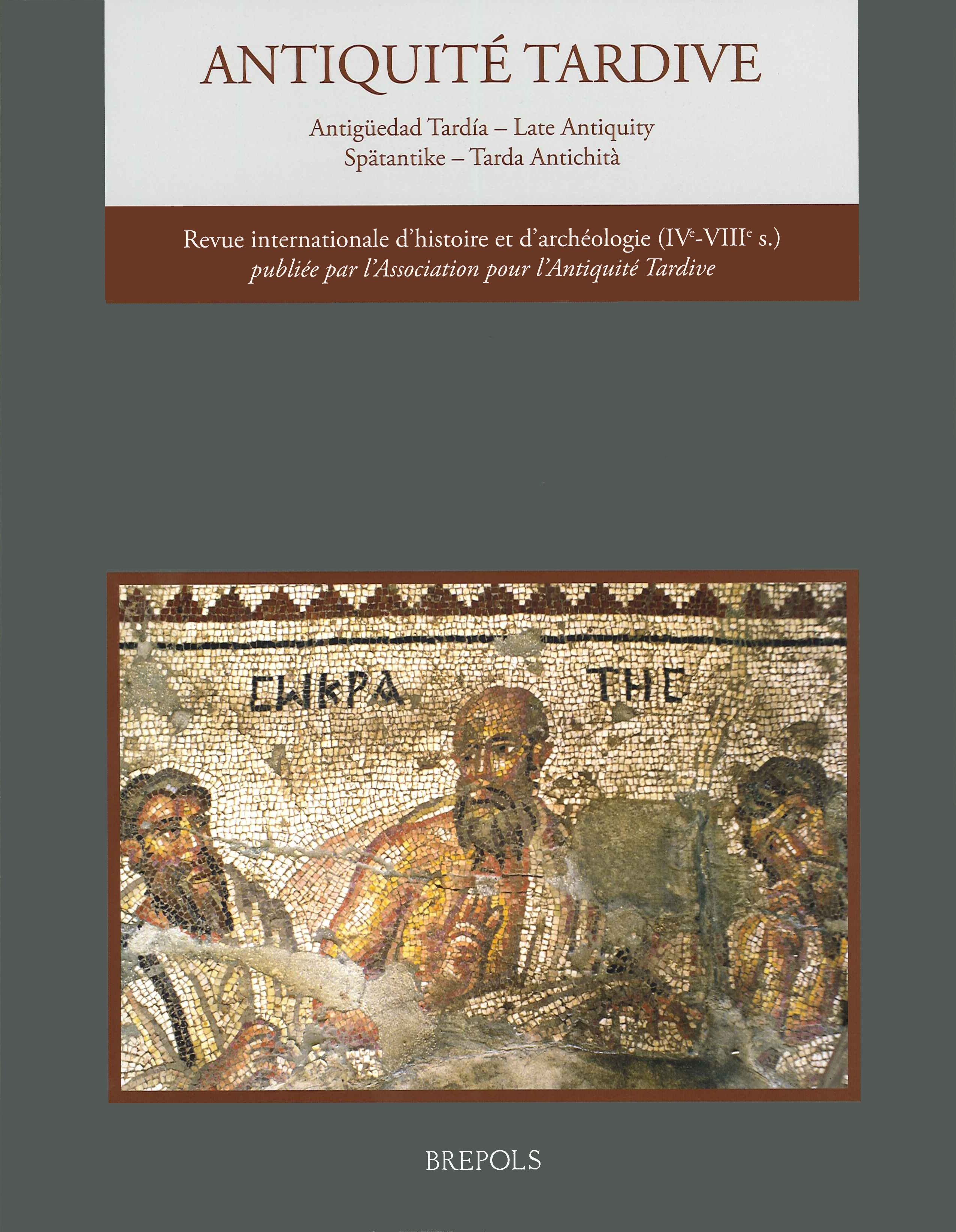
Volume 27, Issue 1, 2020
-
-
Front Matter (« Table des matières », « Éditorial », « In memoriam : Pierre Riché (1921-2019) », « Comité de rédaction de la Revue et Conseil d’administration de l’Association pour l’Antiquité tardive », « Principales abréviations de la Revue »)
show More to view fulltext, buy and share links for:Front Matter (« Table des matières », « Éditorial », « In memoriam : Pierre Riché (1921-2019) », « Comité de rédaction de la Revue et Conseil d’administration de l’Association pour l’Antiquité tardive », « Principales abréviations de la Revue ») show Less to hide fulltext, buy and share links for: Front Matter (« Table des matières », « Éditorial », « In memoriam : Pierre Riché (1921-2019) », « Comité de rédaction de la Revue et Conseil d’administration de l’Association pour l’Antiquité tardive », « Principales abréviations de la Revue »)
-
-
-
L’alimentation dans l’Antiquité tardive: une introduction
show More to view fulltext, buy and share links for:L’alimentation dans l’Antiquité tardive: une introduction show Less to hide fulltext, buy and share links for: L’alimentation dans l’Antiquité tardive: une introductionAuthors: Paul Reynolds, Gisela Ripoll, Fabienne Dugast and Caroline Michel d’Annoville
-
- 1 - Les coutumes alimentaires durant l’Antiquité tardive - données textuelles
-
-
-
El vocabulario latino sobre la alimentación en la Antigüedad Tardía : de Anthimus a Isidoro de Sevilla
show More to view fulltext, buy and share links for:El vocabulario latino sobre la alimentación en la Antigüedad Tardía : de Anthimus a Isidoro de Sevilla show Less to hide fulltext, buy and share links for: El vocabulario latino sobre la alimentación en la Antigüedad Tardía : de Anthimus a Isidoro de SevillaBy: Isabel VelázquezAbstractIn this study some terms related to food in Late Antiquity are analysed in two works of very different type, Anthimus’ De obseruatione ciborum epistula and the Etymologies of Isidore of Seville, comparing the latter with some terms present on Visigothic slates. The objective of the analysis is to show the survival of a classical vocabulary and its possible evolution in later times, as elements to take into account for the construction of a possible Latin lexicon on food.
-
-
-
-
La terminologie relative à l’alimentation dans les glossaires gréco-coptes
show More to view fulltext, buy and share links for:La terminologie relative à l’alimentation dans les glossaires gréco-coptes show Less to hide fulltext, buy and share links for: La terminologie relative à l’alimentation dans les glossaires gréco-coptesAuthors: Nathan Carlig and Antonio RicciardettoAbstractFour out of the eleven Greek-Coptic and Greek-Latin-Coptic glossaries listed in the Mertens-Pack3 database of Greek and Latin literary papyri developed at the CEDOPAL (University of Liège: http://web.philo.ulg.ac.be/cedopal/base-de-donnees-mp3/) contain words related to eating practices. In this paper, we will analyse the formal features (writing support, writing, layout, signs) and the content of these four papyri dated to between the end of the 6th and the 7th/8th centuries. We will try to clarify what role the semantic field related to eating practices plays in these texts, and to identify their context of production.
-
-
-
Recommandations diététiques et thérapeutiques dans l’Égypte byzantine (284-641) : l’apport de la papyrologie
show More to view fulltext, buy and share links for:Recommandations diététiques et thérapeutiques dans l’Égypte byzantine (284-641) : l’apport de la papyrologie show Less to hide fulltext, buy and share links for: Recommandations diététiques et thérapeutiques dans l’Égypte byzantine (284-641) : l’apport de la papyrologieAbstractThe c. 100 Greek literary medical papyri from the Byzantine period (284-641) are much more numerous than the papyri containing culinary texts. Several of them deal with questions of dietetics and nourishment. They preserve both theoretical treatises and prescriptions of medicaments to be taken per se, often prepared with ingredients also used for cooking. In this paper, the analysis of both the external (provenance, date, format, layout, script) and the internal (language, genre, content) aspects of these papyri is followed by an assessment of the information they provide, not only about the practice and teaching of medicine in Byzantine Egypt, but also about the alimentary and dietary customs of a quick-changing multicultural society.
-
-
-
Food and social boundaries in late antique Syria-Mesopotamia. Syriac Christians and Jewish dietary laws and alimentary practices
show More to view fulltext, buy and share links for:Food and social boundaries in late antique Syria-Mesopotamia. Syriac Christians and Jewish dietary laws and alimentary practices show Less to hide fulltext, buy and share links for: Food and social boundaries in late antique Syria-Mesopotamia. Syriac Christians and Jewish dietary laws and alimentary practicesBy: Sergey MinovAbstractLe propos principal de cet article concerne les différentes façons dont le discours touchant le domaine alimentaire a été utilisé par les chrétiens syriaques pendant l’Antiquité tardive pour parvenir à construire une identité collective distincte, indépendante du judaïsme, et établir des frontières sociales avec les Juifs. Il examine comment les règles alimentaires bibliques ont été réinterprétées par les exégètes syriaques, comme Aphrahat (IVe siècle) et Jacques de Sarough (VIe siècle), qui se sont efforcés de montrer le caractère inadapté des prescriptions pour les chrétiens. Il examine également la façon dont les hymnes comme les Canons prescrivaient d’éviter les repas entre chrétiens et juifs. Enfin, il aborde la question complexe du rapport entre ce discours discursif du christianisme indépendant des juifs et du judaïsme et la réalité sociale non moins complexe de la Syro-Mésopotamie tardoantique.
-
-
-
Le régime des boissons dans l’œuvre de Jonas de Bobbio
show More to view fulltext, buy and share links for:Le régime des boissons dans l’œuvre de Jonas de Bobbio show Less to hide fulltext, buy and share links for: Le régime des boissons dans l’œuvre de Jonas de BobbioBy: Alban GautierAbstractWritten in the 7th century between Italy and Gaul, the works of Jonas of Bobbio include the Vita Columbani and Vita Iohannis, and probably also the Vita Vedastis and Regula cuiusdam ad uirgines. Those four works contain many allusions to drink and episodes in which ale, wine and other beverages are consumed. The analysis of that whole corpus, compared when necessary with aspects of the works of Columbanus, shows that Jonas did not merely reproduce the classical discourse, derived from both Greco-Roman and Judeo-Christian literature, which condemned ale and condoned a moderate consumption of wine. Conversely, he replaced it with a “new regime of drinks” - an already medieval one which, instead of highlighting one beverage above others, insisted on the conditions of consumption and tried to detect the presence of the devil in wine as well as in ale.
-
- 2 - Aliments et alimentation : production, distribution, consommation
-
-
-
Les textes sur l’alimentation à l’époque tardive et à l’époque wisigothique (ive-vie siècles)
show More to view fulltext, buy and share links for:Les textes sur l’alimentation à l’époque tardive et à l’époque wisigothique (ive-vie siècles) show Less to hide fulltext, buy and share links for: Les textes sur l’alimentation à l’époque tardive et à l’époque wisigothique (ive-vie siècles)By: Javier ArceAbstractIn this article, I propose to use the text of the Hermeneumata Pseudo-Dositheana (see Dionisotti 1982, pp. 83-125), written, according to the editor, at the end of the 4th century, as evidence for the diet of a family of medium status in Gaul. The text demonstrates that the daily diet of a “middle class” Roman family was mainly vegetarian. We can observe the same continuity in the Visigothic period in Spain, according to the evidence of the slates written in Latin from the 6th-7th centuries, and other literary texts.
-
-
-
-
El comercio y el consumo de especias en Occidente, desde la creación de la república romana hasta la restauración imperial carolingia
show More to view fulltext, buy and share links for:El comercio y el consumo de especias en Occidente, desde la creación de la república romana hasta la restauración imperial carolingia show Less to hide fulltext, buy and share links for: El comercio y el consumo de especias en Occidente, desde la creación de la república romana hasta la restauración imperial carolingiaAbstractThe Romans discovered oriental spices in the first half of the 3th century BC, following the conquest of Magna Grecia. From then on, its consumption gradually increased among the elites and caused, despite the criticism from the most conservative sectors of the society, a growing of strong currency. Spices circulated between the Far East and the eastern Mediterranean along two networks of land and sea routes. Rome tried to increase its control over these routes with variable results. The growing consumption of exotic condiments was reflected in Apicio’s cookbook, literature and imperial customs tarifs. After the fall of Western Empire, the supply of spices, in both Mediterranean basins, was reduced and lost variety, but did not collapse. After bottoming in the second quarter of the 7th century, following the Islamic expansion, trade was reactivated by different circuits to those created by Rome.
-
-
-
Consistency and change: zooarchaeological investigation of Late Antique diets and husbandry techniques in the Mediterranean region
show More to view fulltext, buy and share links for:Consistency and change: zooarchaeological investigation of Late Antique diets and husbandry techniques in the Mediterranean region show Less to hide fulltext, buy and share links for: Consistency and change: zooarchaeological investigation of Late Antique diets and husbandry techniques in the Mediterranean regionBy: Michael McKinnonAbstractLa comparaison de restes zooarchéologiques provenant de trois régions du monde méditerranéen - 1/ le centre-ouest de l’Italie ; 2/ l’Afrique du Nord centrale ; 3/ la Grèce et la mer Égée - révèle des aspects de continuité et de changement dans l’introduction d’animaux dans les pratiques alimentaires et économiques au cours de l’Antiquité tardive. Un certain nombre de dispositifs sont manifestement touchés, comme en témoignent les modifications apportées à la taille et à la nature de l’élevage d’ovinés-caprinés dans de nombreuses régions, en particulier dans le centre-ouest de l’Italie. D’autres éléments, tels que la demande constante de porc dans les grands sites urbains jusqu’à la fin de l’Antiquité, ou plus généralement l’apport et la fréquence de divers types d’animaux dans les sites ruraux plus petits, montrent une cohérence temporelle plus marquée entre la période romaine et les phases postérieures de l’Antiquité tardive. Des explications possibles de ces phénomènes sont explorées, notamment la manière dont les grands sites urbains concentrent de multiples demandes de denrées alimentaires (y compris les viandes) et ont pu, à leur tour, exercer une pression sur les pratiques d’élevage locales et distantes selon les besoins, y compris dans des états apparemment « en déclin » lors de la transition entre l’époque romaine et l’Antiquité tardive.
-
-
-
La alimentación monástica en la antigüedad tardía a partir de las regulae monachorum
show More to view fulltext, buy and share links for:La alimentación monástica en la antigüedad tardía a partir de las regulae monachorum show Less to hide fulltext, buy and share links for: La alimentación monástica en la antigüedad tardía a partir de las regulae monachorumAbstractThe article discusses all issues related to food and diet in monasteries over the 6th and 7th centuries, from the type of food and drink that were permitted, to spiritual as well as broad cultural matters such as fasting and eating during festivities. The article raises these issues and discusses them by analysing the Rule of Benedict and the three Hispanic rules (Leander, Isidore and Fructuosus). The paper thus attempts to provide a broad overview and illustration of these daily-life matters in late Antique monasteries.
-
- 3 - Lieux de stockage et de conservation
-
-
-
I magazzini del Porto di Classe
show More to view fulltext, buy and share links for:I magazzini del Porto di Classe show Less to hide fulltext, buy and share links for: I magazzini del Porto di ClasseBy: Andrea AugentiAbstractThis paper considers the birth and the transformations of the port of Classe (Ravenna) between the 5th and the 9th century. The main subject are the warehouses of the port: these buildings are analyzed in full detail and compared to other similar structures within the wider contemporary context, including some examples from Eastern Europe. But the story of Classe is also a story of decline of a city that was connected to nearby Ravenna. In the 7th century, when Mediterranean trade starts to fade, the port of Classe is progressively abandoned, and houses and wooden dwellings are built within and on top of the ancient warehouses. These transformations mark the end of an era, Late Antiquity, and the beginning of a new one: the early Middle Ages.
-
-
-
-
Stocker et conserver son alimentation dans les campagnes. Le cas du nord-est de la Gaule à la fin de l’Antiquité (iiie-ve siècle de notre ère)
show More to view fulltext, buy and share links for:Stocker et conserver son alimentation dans les campagnes. Le cas du nord-est de la Gaule à la fin de l’Antiquité (iiie-ve siècle de notre ère) show Less to hide fulltext, buy and share links for: Stocker et conserver son alimentation dans les campagnes. Le cas du nord-est de la Gaule à la fin de l’Antiquité (iiie-ve siècle de notre ère)AbstractPlant storage for food is necessary to ensure a varied diet all year long, and to keep the seedlings. Rural settlements of Late Antiquity store different products: cereals, legumes, fruits, fodder plants, straw, wood, etc. Several ways of conserving plants coexist. The storage of small quantities is realised without specific installation, in ceramics or in chests. The storage of larger volumes requires specialized equipment such as underground silos for conservation in a confined atmosphere and buildings for conservation in a renewed atmosphere.
An inventory of granaries from rural settlements of Late Antiquity shows continuity with the previous centuries. However, several characteristics are specific to the end of Antiquity such as the reuse of domestic rooms as a storage space or the fortification of buildings. Research on storage and conservation modes and equipment will help to better understand the specificities of Late Antiquity and early Middle Ages, such as the resurgence of the confined-atmosphere storage.
-
- 4 - L’art de la table
-
-
-
À propos du fonctionnement des installations de banquet en sigma. Nouvelles observations, entre Orient et Occident
show More to view fulltext, buy and share links for:À propos du fonctionnement des installations de banquet en sigma. Nouvelles observations, entre Orient et Occident show Less to hide fulltext, buy and share links for: À propos du fonctionnement des installations de banquet en sigma. Nouvelles observations, entre Orient et OccidentBy: Eric MorvillezAbstractThe perpose of this study is to analyse the present state of knowledge on sigma banquet facilities, the discoveries of which have multiplied in recent years, both in the East and the West, and to propose some unknown examples. After the analysis of few of possible cases of the depiction of the place of furniture on mosaic floors, the sigma-fountains will be subject of review. Indeed, since the discovery of the stibadium of the villa of Faragola (Apulia), other spectacular arrangements of sigmas-fountains have been discovered in Rome on the site of Rinascente, or in Portugal, at the villa of Horta da Torre (Fronteira), while the remains of known benches have been entirely re-examined (the so-called Baths of Elagabal at the foot of the Palatine) or have been reassessed (Italica, Cañada Honda). Finally, several new sigmas in masonry have come to light, in Seville and Antioch as well as in Libya in Al Latrun, some of them dating to the 5th and 6th centuries (in Salone e.g.), or even to the 7th century in religious contexts such as that of the Illa del Re (Menorca). It is therefore not only the structure, the decoration and the possible water games of these table couches that are specified, but also the chronology that now spans the end of the 3rd to the 7th century.
-
-
-
-
Vaisselle d’argent, nourriture et service de table
show More to view fulltext, buy and share links for:Vaisselle d’argent, nourriture et service de table show Less to hide fulltext, buy and share links for: Vaisselle d’argent, nourriture et service de tableBy: François BaratteAbstractSilverware is an essential part of the luxury of the table in the Roman world, especially in Late Antiquity. It belongs to the decor of the reception room just like mosaics or paintings, and is part of the staging that characterizes a banquet. However, its relationship with the food it accompanies is complex. Objects preserved in treasures, texts and images provide some clarification on this subject. They highlight the existence of indissociable groups, often emblematic, but also draw attention to the essential characteristics of silver dishes, especially their increasingly spectacular size, which should be related to the organization of dining rooms. The presence of inscriptions also characterizes this dish: they have an important role, because they often provide a key to understand the decor of the object that carries them.
-
-
-
Darstellungen neutestamentlicher Mahlszenen auf den Ciboriumsäulen von San Marco in Venedig
show More to view fulltext, buy and share links for:Darstellungen neutestamentlicher Mahlszenen auf den Ciboriumsäulen von San Marco in Venedig show Less to hide fulltext, buy and share links for: Darstellungen neutestamentlicher Mahlszenen auf den Ciboriumsäulen von San Marco in VenedigAbstractAmong the most unusual and at the same time the most unknown monuments of late antique and early Byzantine art are the four Ciborium columns of San Marco. With 369 figures and 95 scenes in their nine registers with nine arcades, they are the richest monument in figures and scenes of the early Christian and early Byzantine period. They depict scenes from the Apocrypha and the New Testament that begin with the prehistory of the Nativity of Mary and end with the Ascension of Christ and the enthroned Godfather. Although their dating in the 6th century has been proven conclusively by Thomas Weigel in 1997, most scenes have not been studied in detail. Among these scenes are three little known or unpublished scenes of New Testament meals that deserve in their peculiarities to be presented to a scientific audience: the iconography of the wine miracle at Cana, the sinner at the meal of the Pharisee Simon, which is the first known representation of this scene, and the Last Supper.
-
- Varia
-
-
-
“So Great an Empire”. Military valor and the decline and fall of the Roman Empire
show More to view fulltext, buy and share links for:“So Great an Empire”. Military valor and the decline and fall of the Roman Empire show Less to hide fulltext, buy and share links for: “So Great an Empire”. Military valor and the decline and fall of the Roman EmpireBy: Dino MilinovićAbstractLes historiens peuvent-ils spéculer sur un quelconque sentiment de honte, de gloire ou de tout autre type lorsqu’ils appréhendent certaines périodes et phénomènes historiques spécifiques ? Ont a souvent évoqué des éléments « irrationnels » pour expliquer la naissance de l’Antiquité tardive et l’évolution de la société romaine et de sa culture après l’époque des Antonins. Il suffit de rappeler l’expression d’Eric Dodds, « Age of Anxiety » pour qualifier cette période, suivie de celles de Kurt Weitzmann, « Age of Spirituality », ou encore de Peter Brown, « Age of Ambition ». Je voudrais revenir sur l’un des phénomènes considérés comme étant pleinement à l’origine du déclin et de la chute de l’Empire romain : l’abandon de la valeur militaire, l’une des principales thématiques de l’ouvrage monumental d’Edward Gibbon qui a eu une influence considérable sur des générations de chercheurs. Je m’attarderai sur la période du Bas Empire (du iie au ve siècle) pour tenter de voir si cet aspect crucial de l’histoire romaine a véritablement laissé des traces - majeures ou simplement fluctuantes - dans l’art officiel et privé du moment. S’il est vrai que « the last sparks of the military flame were finally extinguished in the minds of the Roman », de quelle manière cela s’est-il reflété dans l’imagerie traditionnelle de la guerre qui a joué un rôle important dans l’iconographie politique romaine depuis la République ? L’article vise à rappeler comment des éléments « irrationnels » d’une société, telle que l’idée d’une valeur militaire, peuvent se combiner pour former un « caractère national » ou les traits d’un Zeitgeist, appelé anxiété, spiritualité, ambition ou simplement épuisement nerveux.
-
-
-
-
En torno a la independencia semántica de los términos gentilitas y paganismus en los Sermones de Máximo de Turín. Verificación de una hipótesis
show More to view fulltext, buy and share links for:En torno a la independencia semántica de los términos gentilitas y paganismus en los Sermones de Máximo de Turín. Verificación de una hipótesis show Less to hide fulltext, buy and share links for: En torno a la independencia semántica de los términos gentilitas y paganismus en los Sermones de Máximo de Turín. Verificación de una hipótesisBy: Esteban NoceAbstractOur analysis of the sermo XLVIII of Maximus of Turin led us recently to hold that the author did not use the terms gentilis-gentilitas and paganus-paganismus as synonymous, but resorted to each one of them in order to allude to two entities not only different, but opposed in their fundamental characteristics. The aim of this paper is to support the plausibility of such a hypothesis through the examination of all the references to gentilitas contained in the work of Maximus. We hope to demonstrate that, in effect, his Sermones present a conception of the gentilitas that is not only homogeneous but also completely independent of paganismus.
-
-
-
Les aménagements liturgiques des cathédrales de Genève, du ve au ixe siècle. Étude chronologique comparative
show More to view fulltext, buy and share links for:Les aménagements liturgiques des cathédrales de Genève, du ve au ixe siècle. Étude chronologique comparative show Less to hide fulltext, buy and share links for: Les aménagements liturgiques des cathédrales de Genève, du ve au ixe siècle. Étude chronologique comparativeAuthors: Charles Bonnet and Michèle GaillardAbstractThe aim of this paper is to study the liturgical arrangements realized in the transition space between the choir and the nave of the church, in order to obtain a better understanding of the link between the cathedral and the other monuments of the cult, in particular the baptisteries. The presented data are related to the one published on other sites: the cathedrals of Aosta, Tournai, Cologne, and Trier, and other buildings in western Europe. In the southern cathedral of Geneva, we observe, with a certain precocity, the emergence of a solea and an ambo, as in Aosta (half a century earlier), in Grado and Boppard during the same period, and in Tournai a little later. During the 6th century, this type of architectural element spreads throughout western Europe, and is in competition (or in complementarity) with more opened arrangements connecting the cathedral to the baptistery, as it is the case in the northern cathedral of Aosta, recently modified. During the 7th-8th centuries, the situation became more complex in Geneva, when, on the east of the baptistery, a third church was constructed, whose liturgical arrangements were those of a martyrial church. In the Carolingian period, this building was considerably enlarged on the western side (at exactly the same place where the baptistery was disappearing) and provided with arrangements similar to those of the cathedral of Cologne at the same time. This shows that it was now used as a cathedral, at the detriment of the two ancient churches that disappeared soon after. These constructions can be seen in relation with the application of the Carolingian liturgical reform, which was inspired by the image of Rome, as it can be seen in the Ordo Romanus IV, written in the Frankish kingdom.
-
-
-
Les tentures fleuries peintes à Baouît. Remarques iconographiques et iconologiques
show More to view fulltext, buy and share links for:Les tentures fleuries peintes à Baouît. Remarques iconographiques et iconologiques show Less to hide fulltext, buy and share links for: Les tentures fleuries peintes à Baouît. Remarques iconographiques et iconologiquesAuthors: Bente Kiilerich and Hjalmar TorpAbstractIn the monastery of Apa Apollô at Bawit, paintings imitating textiles decorate the walls in many of the chapels excavated by Jean Clédat (1901-1902, 1903-1905) and Jean Maspero (1913). These textile imitations, situated below the figural representations, display various stylized floral and vegetal designs arranged in regular lozenge formations (diaper patterns). Some tapestries are laid out as framed panels, giving the impression of wallpaper; others are rendered as curtains (vela) suspended from rods and rings. In addition, there are a few instances of painted friezes with floral ornaments. Such imagery with nonfigural representation is often interpreted as purely ornamental; still, we argue here that the tapestries painted in the chapels at Bawit had religious and theological significance.
-
Volumes & issues
-
Volume 32 (2024)
-
Volume 31 (2024)
-
Volume 30 (2022)
-
Volume 29 (2022)
-
Volume 28 (2021)
-
Volume 27 (2020)
-
Volume 26 (2019)
-
Volume 25 (2018)
-
Volume 24 (2017)
-
Volume 23 (2016)
-
Volume 22 (2015)
-
Volume 21 (2013)
-
Volume 20 (2013)
-
Volume 19 (2012)
-
Volume 18 (2011)
-
Volume 17 (2010)
-
Volume 16 (2009)
-
Volume 15 (2008)
-
Volume 14 (2007)
-
Volume 13 (2006)
-
Volume 12 (2005)
-
Volume 11 (2004)
-
Volume 10 (2003)
-
Volume 9 (2002)
-
Volume 8 (2001)
-
Volume 7 (2000)
-
Volume 6 (1999)
-
Volume 5 (1998)
-
Volume 4 (1997)
-
Volume 3 (1995)
-
Volume 2 (1994)
-
Volume 1 (1993)
Most Read This Month
