


Antiquité Tardive - Late Antiquity - Spätantike - Tarda Antichità
Revue Internationale d'Histoire et d'Archéologie (IVe-VIIIe siècle)
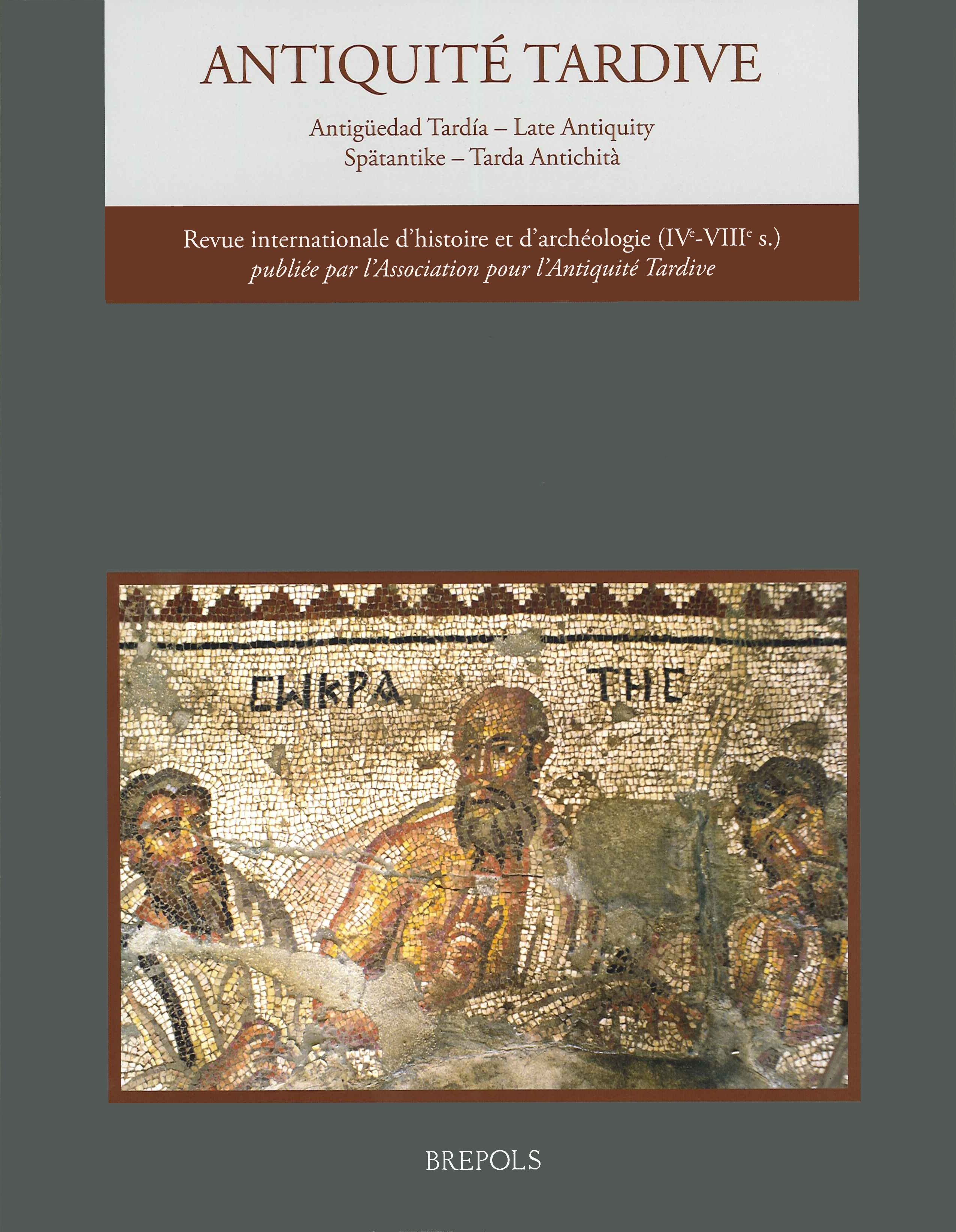
Volume 24, Issue 1, 2017
-
-
Front Matter ("Comité de rédaction de la Revue et Conseil d’administration de l’Association pour l’Antiquité tardive", "Principales abréviations de la Revue", "Tables des matières", "Éditorial")
show More to view fulltext, buy and share links for:Front Matter ("Comité de rédaction de la Revue et Conseil d’administration de l’Association pour l’Antiquité tardive", "Principales abréviations de la Revue", "Tables des matières", "Éditorial") show Less to hide fulltext, buy and share links for: Front Matter ("Comité de rédaction de la Revue et Conseil d’administration de l’Association pour l’Antiquité tardive", "Principales abréviations de la Revue", "Tables des matières", "Éditorial")
-
- 1 - Comment voyage-t-on ? -
-
-
-
Visions of travel and their realization
show More to view fulltext, buy and share links for:Visions of travel and their realization show Less to hide fulltext, buy and share links for: Visions of travel and their realizationAbstractDurant l'Antiquité tardive, une grande partie de la population de l'Empire romain voyageait, volontairement ou non; d'autres rêvaient de le faire. Quoiqu’il en soit, le nombre de documents fiables dont les voyageurs pouvaient disposer était plus faible qu’on a souvent voulu le dire. Il existait peu de cartes précises et la cartographie restait méconnue y compris de ceux qui possédaient des cadrans solaires portables capables d’identifier un lieu par sa latitude. La représentation de l’Empire restait donc schématique, à l’image d’un puzzle formé par l’ensemble des provinces. L’analyse montre que l’Itinéraire d’Antonin, pourtant d’importance unique a priori, présentait un assemblage inégal et désorganisé de différentes localités qui en faisait un document difficilement consultable. De la même façon, la valeur des deux anciennes cartes qui nous sont parvenues reste douteuse. Bien qu’il prenne la forme d’itinéraires censés aider le voyageur, le tracé complexe des routes de la carte de Peutinger est trompeur. La dimension des cartes réduit du reste leur fonctionnalité au-delà de la promotion de la puissance de Rome. Bien que détaillée, la carte de Madaba ne dessine aucune route : elle était destinée aux chrétiens avertis et n’avait pour objectif que d’informer les confréries et les pèlerins sur leur monde depuis l’époque de l’Ancien Testament. [Trad. de la Rédaction]
-
-
-
-
La viabilità tardoantica: riflessioni e problemi aperti
show More to view fulltext, buy and share links for:La viabilità tardoantica: riflessioni e problemi aperti show Less to hide fulltext, buy and share links for: La viabilità tardoantica: riflessioni e problemi apertiBy: Patrizia BassoAbstractBetween the 4th and 5th centuries BC, the use, management and hierarchies of Roman roads changed. In particular, at that period the itineraria (Antonini, Burdigalense and Tabula Peutingeriana) and the milestones, together with the literary texts, attest on one hand the vitality of roads due to military and pilgrimage purposes, on the other hand the problems regarding their maintenance.
The milestones from the Tetrarchic period became acts of tribute to the emperors by the local jurisdictions (cf. text in dative and the decrease of mileage indication), demonstrating a different management of the roads. In fact, the dedications to the central power may indicate a new role of the provinces/towns in the maintenance and care of the roads passing through their territory, together with the voluntary declaration of loyalty and devotion to the emperors.
In the context of the late antique political transformations, deep changes are observed in the hierarchy between the roads, strictly related to the changes of urban and rural settlement: between the 4th and 5th centuries a few roads lost their importance, in favour to others (such as waterways) which before had had only a secondary use. The paper explains the phenomenon, and in Roman Cisalpina in particular. [Author]
-
-
-
Passer la frontière. L'exemple africain
show More to view fulltext, buy and share links for:Passer la frontière. L'exemple africain show Less to hide fulltext, buy and share links for: Passer la frontière. L'exemple africainBy: Stéphanie GuédonAbstractThe literary, epigraphic and archaeological testimonies relating to the circulation across the vast Roman frontier of Africa Proconsularis, dating back to the period between the 3rd century and the time of Augustine of Hippo, are regularly taken to support the hypothesis of specific devices intended to control the entry points into the Empire. The analysis of this evidence becomes all the more crucial as no written testimony provides proof of a general Roman doctrine regarding formalities related to the crossing of the limits of Roman territory. The interpretation of the African documentation remains debatable, however. The new examination undertaken through this study aims at establishing the reality and the extent of an official control at the boundaries of the province during Late Antiquity. [Author]
-
-
-
Il cursus publicus in età tardoantica: storia di un servizio di stato tra conservazione e mutamento
show More to view fulltext, buy and share links for:Il cursus publicus in età tardoantica: storia di un servizio di stato tra conservazione e mutamento show Less to hide fulltext, buy and share links for: Il cursus publicus in età tardoantica: storia di un servizio di stato tra conservazione e mutamentoAbstractThe cursus publicus was streamlined during Diocletian's reign (see Lemcke 2016); it was born from the transformation of the vehiculatio that was created by Augustus. The ancient system in the 4th century did not provide the new requirements of transportation and the increased needs of communication between the Emperor and the provincials. The author examines the new system, the usage rights, the users, and the infrastructures in the perspective of their effective and integral tool for the Roman administration. It is clear the system was not a postal service, as it has been often presented. The development of the cursus publicus is studied from the late Tetrarchy to the 6th century, through three principal steps.
The supplement to paper aims to study the milestone of Pistunina-Messina (inv. ME 22391), the only extant copy of imperial period in Sicily. It is a very important archaeological evidence of the dynastic politic propaganda of Constantine. The inscription partly mutilated is a dedication to the Emperor and likely to two Caesares, Crispus and Constantine the Second, between 321 and 324 AD. The milestone was connected also with the road networks, the stations of cursus publicus, the econ omic system and the Sicilian provincial administration. [Author]
-
-
-
I luoghi di sosta: funzioni, spazi, contesti
show More to view fulltext, buy and share links for:I luoghi di sosta: funzioni, spazi, contesti show Less to hide fulltext, buy and share links for: I luoghi di sosta: funzioni, spazi, contestiBy: Enrico ZaniniAbstractLate antique itineraries and juridical sources show that both the Roman road system and the related post stations network were still active in Late Antiquity. Roads and stations were primarily used by public officers travelling under the aegis of the cursus publicus, but literary sources confirm that they were also used by private people, travelling for different purposes.
Many different words (mansio, stathmos, statio, mutatio, deversorium, praetorium, etc.) indicate the places used by travellers for resting and, if the case, for changing horses, pack- and draught-animals. Unfortunately, this relative abundance of written sources is not paralleled by a similar amount of archaeological data, since the archaeological research agenda had only just recently focused on "minor" settlements located along the roads. While many smaller or larger archaeological sites located along the roads have been tentatively recognised as places associated with post station functions, mainly on the basis of their toponymy, we still lack a proper research framework to archaeologically identify such a function. A more or less close relationship with a road pathway, the presence of a large paved courtyard surrounded by stables and warehouses, the existence of a baths building or a larger, isolated, thermal complex seem to be assumed as possible archaeological indicators of a site that performed the function of resting place, may be in association with other functions as well.
Despite of the difficulty in precisely identifying the place and the typology of any single part of the system, the road stations network provides on the whole a very interesting study case for an experiment of contextual archaeology, intended to evaluate the role that those settlements had within the scenery presented by the overall transformation of landscapes and the settlement patterns in Late Antiquity. [Author]
-
-
-
Sulle vie dell'Impero tra IV e VI secolo. Il ruolo della Chiesa nel sistema tardoantico di mobilità
show More to view fulltext, buy and share links for:Sulle vie dell'Impero tra IV e VI secolo. Il ruolo della Chiesa nel sistema tardoantico di mobilità show Less to hide fulltext, buy and share links for: Sulle vie dell'Impero tra IV e VI secolo. Il ruolo della Chiesa nel sistema tardoantico di mobilitàBy: Cristina CorsiAbstractSince the second half of the 4th century, the transportation system of the whole empire started to undergo transformations and adaptations. In the first phase, these changes can mainly be seen in the infrastructures of road stations and other stopping places. In most cases these consisted in creating Christian places of worship in the immediate vicinity of the complex which offered services to road traffic. Already during the same 4th century, however, a growing interest in the system of communication networks was noticeable on the part of the Church. This interest was initially implemented only in a set of recommendations for Christian travellers, with regard to increasing the number of Christian hosts to house the faithful during their pilgrimage journey. At the same time, the Church, through its representatives from the clergy, the monks, and many of the élites of the Christian community, and even of the Imperial family, started creating buildings for use in assisting the pilgrims and other kinds of travellers. In a rather short period of time, already before the mid-5th century, the Church was thought of as the institution in charge of managing the road transport system. [Author]
-
-
-
I porti nel Mediterraneo tardo-antico. Alcune riflessioni
show More to view fulltext, buy and share links for:I porti nel Mediterraneo tardo-antico. Alcune riflessioni show Less to hide fulltext, buy and share links for: I porti nel Mediterraneo tardo-antico. Alcune riflessioniAuthors: Sauro Gelichi and Carlo BeltrameAbstractWhat happened to the Mediterranean harbour installations after the Imperial period? How can we interpret that qualitative and, at least in part, quantitative, collapse which appears from a superficial analysis of the archaeological remains? Does the problem of the lack of visibility of the evidence for late antique harbour contexts – caused by both natural and anthropic phenomenona effecting their disappearance whether due to their lesser monumentaly, hence less striking construction techniques – exist? Is it possible, in the end, that the knowledge of harbour engineering, developed after the Augustan period, due especially to the use of concrete with pozzolana, was lost or no longer used? Having provided an overview of the results of recent investigations that have focused on a number of Mediterranean harbours built in the Late Antique period and the Late Antique phases of harbour contexts founded in the imperial period, this article wishes to go beyond the traditional approach, founded on the concept of the "decline" of the functionality and of the monumentality of the harbours, based often only on traditional sources. Taking into consideration obviously the deep technological and topographical differences of harbours in the two halves of the Mediterranean, and using, for comparison the insediative logic of harbours of the North European coastal landscape, we analyse the processes that occurred in the Mare Nostrum in a phenomenon marked by the physical remodeling of the harbours for reduced necessities, both of functional type and especially of ideological type. We intend thus to consider this shift as a sort of return to "normality" and the late antique period, here under special scrutiny, appears once again as a crucial moment where such landscapes are evident. In this period, indeed, we record opposite signs of behaviour, which range from the extreme of new harbour models closer to those of the ancient world to the return to a widespread, and almost total, use of the wood. However this recovery of the "normality" uses at least part of the now unnecessarily imperial installations and, in case of the foundation of new harbours, uses techniques and materials that are less monumental but no less functional than those of earlier times, at least with regard to their reduced needs. [Author]
-
-
-
Les équipements spécifiques des chevaux pour la monte et les attelages (IVe-VIIIe siècle)
show More to view fulltext, buy and share links for:Les équipements spécifiques des chevaux pour la monte et les attelages (IVe-VIIIe siècle) show Less to hide fulltext, buy and share links for: Les équipements spécifiques des chevaux pour la monte et les attelages (IVe-VIIIe siècle)AbstractStudies of transport methods during Late Antiquity make it possible nowadays to overcome the generally accepted views on harness, stirrup or saddle. For forty years now, scholars have been able to demonstrate how capable the Romans were in the West in making use of equids for transport. Indeed, by analysing and cross-checking literary, iconographical and archaeological data, it seems that this period is marked by numerous advances, and even if this was relatively slow, there was continuous progress. Thus, the Middle Ages should no longer be considered the period of "major innovations", raising horse-riding to new heights with respect to Antiquity. This article aims to describe specific horse equipment for the saddle, stirrups and for the harness during Late Antiquity in the West, showing their efficiency as well as their flaws and also presents some rare iconographic documents of the period concerning this theme. [Transl. by the Redaction]
-
-
-
Les dangers du voyage : banditisme et insécurité sur les routes au IVe siècle et au début du Ve siècle
show More to view fulltext, buy and share links for:Les dangers du voyage : banditisme et insécurité sur les routes au IVe siècle et au début du Ve siècle show Less to hide fulltext, buy and share links for: Les dangers du voyage : banditisme et insécurité sur les routes au IVe siècle et au début du Ve siècleBy: Bruno PottierAbstractAssaults and murders of travellers by bandits are frequently mentioned in the sources of the 4th and beginning of the 5th century, especially in patristics. However, this risk seems to have been overemphasized by bishops and hagiographical writers for rhetorical and moral reasons, even if it caused real anxiety to travellers. Only temporary closures of communication on major roads were perceived by contemporary authors as a real concern. The perception of some cases of regional banditry, often linked to military disorder or local subsistence crises, will be discussed for Thracia in 378, the vicinity of Rome in 382-383, and of Antioch in 385-387, and the regions surrounding Isauria in 403-407. The State punctually enforced measures supposed to limit these assaults. It restricted, for example, the use of horses and weapons in Campania in 365, and enabled in 391 travellers to kill their aggressors without restriction, widening the right of self-defence. [Author]
-
- 2 - Les protagonistes du voyage, leurs motivations, leurs équipements -
-
-
-
Imperial journeys in the 4th century: burdens and utilitas publica
show More to view fulltext, buy and share links for:Imperial journeys in the 4th century: burdens and utilitas publica show Less to hide fulltext, buy and share links for: Imperial journeys in the 4th century: burdens and utilitas publicaBy: Javier ArceAbstractLes voyages des empereurs romains présentent deux aspects qui méritent d’être soulignés, indépendamment de la marge de mobilité qu’ils révèlent, surtout au IVe siècle, et du suivi que nous pouvons faire de leurs parcours et séjours dans divers lieux. Ces deux aspects sont, d’une part les charges qu’ils entraînent pour les provinciaux, d’autre part la publica utilitas exprimée par Constance II dans une de ses lois (CTh 8, 5, 3). L’objectif de l’article est de mettre en évidence ces deux aspects opposés en utilisant la documentation disponible. Il présente de même une série de considérations et de précisions sur les termes utilisés pour désigner les lieux de résidence des empereurs, qui ne coïncident pas forcément avec de grands édifices aux espaces multiples, comme certains archéologues l’ont prétendu (par exemple la villa de Cercadilla [Corduba] ou Piazza Armerina en Sicile). Il se réfère également à trois déplacements d’empereurs ou de césars dans la Péninsule ibérique, qui sont les seuls que nous connaissions à l’époque tardive, et à leurs motivations : celui de Maximien Hercule 296/297, celui du césar Constant en 411 et celui de Majorien en 460. [Auteur]
-
-
-
-
La naissance de Constantinople et la fin des voyages impériaux (IVe-Ve siècle)
show More to view fulltext, buy and share links for:La naissance de Constantinople et la fin des voyages impériaux (IVe-Ve siècle) show Less to hide fulltext, buy and share links for: La naissance de Constantinople et la fin des voyages impériaux (IVe-Ve siècle)AbstractThe foundation of Constantinople as a new or second capital of the Roman Empire brought about a change in the orientation of the movements of the imperial court. These movements are mainly known to us through the legal documentation, since emperors on the move enacted a large number of laws of which a small part has been preserved in the two legal compilations of late Antiquity, the Theodosian Code and the Justinian Code. Even though these preserved laws do not necessarily represent the emperors’ day to day activity, they constitute nevertheless the primary source of information for reconstructing the geography and chronology of their travels, for which Constantinople was the hub, since the city stood exactly between the Danubian and Euphrates frontiers. By the end of the 4th century, official trips were limited to the regions close to the capital and, after 450, to the vicinity of Constantinople. This progressive sedentarisation of imperial power represented a concentration of authority and did not in any way manifest its impotence. [Author]
-
-
-
Le voyage des pèlerins chrétiens dans le Proche-Orient Antique au témoignage de l'archéologie (IVe-VIIe siècles)
show More to view fulltext, buy and share links for:Le voyage des pèlerins chrétiens dans le Proche-Orient Antique au témoignage de l'archéologie (IVe-VIIe siècles) show Less to hide fulltext, buy and share links for: Le voyage des pèlerins chrétiens dans le Proche-Orient Antique au témoignage de l'archéologie (IVe-VIIe siècles)By: Bertrand RibaAbstractOne of the reasons that led to a long journey during Late Antiquity was the attraction of the Holy Land, towards which the religious aspirations of the faithful converged from all over the Empire from the time of the Peace of the Church. So many journeys emphasized the pilgrims’ concern to be closer to God by approaching places made sacred by the memory of a biblical story or by the presence of a martyr’s tomb. This practice, coupled with the expansion of the cult of relics, was a major element that contributed to the creation of sacred spaces in the Christian Near East. This article proposes to address this phenomenon in the light of archaeology. It aims to offer a comprehensive reading of pilgrimage-related remains to consider what they tell us about this particular category of travellers. [Author]
-
- 3 - Images du voyage -
-
-
-
Le De reditu suo de Rutilius Namatianus : élégie ou voyage vers l'au-delà ?
show More to view fulltext, buy and share links for:Le De reditu suo de Rutilius Namatianus : élégie ou voyage vers l'au-delà ? show Less to hide fulltext, buy and share links for: Le De reditu suo de Rutilius Namatianus : élégie ou voyage vers l'au-delà ?By: Stéphane RattiAbstractThe literary forerunners of Rutilius Namatianus’ De reditu suo, are well-known but offer no rationale for this writer’s use of elegiacs in the narrative of his journey back home. This journey from Ostia to Gaul could well be more than a mere personal account - what if it were a katabasis in disguise, a trip from the land of the living to the afterworld fraught with danger every step of the way? This may account for the Virgilian allusions to the Underworld; the De reditu suo in the historical context of a triumphant Christianity is, furthermore, a farewell to Roman paideia and a eulogy to a vanishing world. As he celebrates what used to be, Rutilius hopes and is confident it will return. But these are no longer the epic times of an expanding empire: hence, his choice of the elegiac metre over hexameter and the nostalgic tone of his poem. [Author]
-
-
-
-
Sidoine Apollinaire voyageur
show More to view fulltext, buy and share links for:Sidoine Apollinaire voyageur show Less to hide fulltext, buy and share links for: Sidoine Apollinaire voyageurBy: Étienne WolffAbstractSidonius travelled extensively. We can arrange his movements into four types: the official journey or one related to public life (trips to Rome, Arles and Toulouse); the pastoral journey (once he became bishop); the social trip (to visit friends); the forced journey (his journey into exile in 475). The letters of Sidonius (his poems are of little use for the subject at hand here) are artistic letters, which often exclude prosaic and concrete details and veil the reality under literary reference. They often frustrate us by omitting material aspects that we would expect. However there is a lot more information than is generally thought, as we try to demonstrate in an analysis of the letter I, 5, where Sidonius describes his trip from Lyon to Rome in 467. [Author]
-
-
-
Itinerari di viaggio nella Vita Germani di Costanzo di Lione
show More to view fulltext, buy and share links for:Itinerari di viaggio nella Vita Germani di Costanzo di Lione show Less to hide fulltext, buy and share links for: Itinerari di viaggio nella Vita Germani di Costanzo di LioneBy: Vincenza ZangaraAbstractThe Vita Germani, the hagiography of Germanus, bishop of Auxerre, was written by Constantius of Lyon around 475-480 and commissioned by Patiens, bishop of Lyon. It deals with the many ecclesiastical missions and extensive travels which Germanus accomplished both within and beyond the borders of Gaul. In Constantius’ account, Germanus’ travels are the narrative structure within which his many miracles are described, in order to sketch a model of episcopal holiness befitting the purposes of his church. In this paper I will examine Germanus’ travels within Gaul, specifically the journey from Auxerre to Arles, and that to the Alpine pass which he crossed in his last journey to Ravenna. [Author]
-
-
-
La thématique du voyage et la figure du poète-voyageur dans l'œuvre de Venance Fortunat : entre rhétorique, poétique et construction de soi
show More to view fulltext, buy and share links for:La thématique du voyage et la figure du poète-voyageur dans l'œuvre de Venance Fortunat : entre rhétorique, poétique et construction de soi show Less to hide fulltext, buy and share links for: La thématique du voyage et la figure du poète-voyageur dans l'œuvre de Venance Fortunat : entre rhétorique, poétique et construction de soiAbstractThe theme of the journey and the figure of the poet-traveller hold an important place in the poetic work of the Christian and Italian poet Venantius Fortunatus who came to Gaul in the 560s, in the Merovingian period, where he was to spend the rest of his life. In the Carmina and in Vita Martini, apart from the importance of the rhetoric, spiritual and meta-poetic topos of the poet-traveller, generic variations on the theme of the journey must be added, since this can take the form of a letter, elegy or even an epic. The theme of the journey in Fortunatus culminates in the book relating the journey which completes the Vita Martini: the book indeed concludes by the return to Italy which Fortunatus never lived to see again. Hence, the theme of the journey in Fortunatus is as much involved in a self-building as in the execution of a poetic work in which the figure of the poet-traveller may be one of the keys. [Transl. by the Redaction]
-
-
-
Columbanus's journeys
show More to view fulltext, buy and share links for:Columbanus's journeys show Less to hide fulltext, buy and share links for: Columbanus's journeysBy: Ian WoodAbstractColomban quitta le monastère de Bangor, en Irlande du Nord, aux environs de 590 et mourut à Bobbio en 615. Entre ces deux dates, il voyagea beaucoup dans le royaume des Francs. Ses plus importants déplacements sont rapportés en détail dans la Vita Columbani écrite par Jean de Bobbio, qui donne de précieuses informations sur les modes de transport, notamment à travers le voyage que Colomban entreprit de Luxeuil à Nantes et de Nantes en Austrasie jusqu’à Bregenz aux environs de 610. Jean livre également d’importants témoignages de son propre voyage de Bobbio à Suse et de Bobbio à Rome. Son récit nous éclaire sur les routes et les rivières en lien avec les voyages durant la fin du VIe et le début du VIIe siècle. Ces informations peuvent notamment être confrontées aux témoignages archéologiques concernant la navigation sur la Loire et le Rhin à l’époque romaine tardive. [Trad. de la Rédaction]
-
-
-
La simbologia del viaggio
show More to view fulltext, buy and share links for:La simbologia del viaggio show Less to hide fulltext, buy and share links for: La simbologia del viaggioBy: Anna FerrariAbstractAfter some remarks on the relation that links travel and literature together, and a short investigation of the vocabulary of travel, which reveals some interesting symbolic meanings, the paper considers how the journey is represented in some literary texts dating back to Late Antiquity. The symbolic meaning of the travel can be examined with reference to the ideas of time and space (because of its direction and the timing of its stages), centre and periphery, identity and difference, flight and return, sedentariness and nomadism, truth and fiction, reality and imagination, and so on. In the case of Christianity, it widely enriched the symbolism of travel and journeys: they became a metaphor for the entire life and represented the human road to heaven, namely through pilgrimage and preaching. Journeys preserved their symbolic meanings for pagans, too, especially with respect to the emperors’ journeys and celebration of triumphs. Travelling was also typical of many barbarian tribes: their nomadism was felt to be just the opposite of the Romans’ sedentarism. Finally, travelling has an important symbolic function in the descriptions of imaginary places and especially of the heavens, both in Christian and pagan literature: the journey, which usually aims at a joining together, can also emphasize the differences and the distance and keep ideal places and reality apart. [Author]
-
-
-
La représentation figurée du voyage dans l'Antiquité tardive : le fort ascendant de la volonté divine
show More to view fulltext, buy and share links for:La représentation figurée du voyage dans l'Antiquité tardive : le fort ascendant de la volonté divine show Less to hide fulltext, buy and share links for: La représentation figurée du voyage dans l'Antiquité tardive : le fort ascendant de la volonté divineAbstractWe here consider the principal evidence for the representation of journeys, both on monumental and movable items, in pagan and profane as well as, of course, Christian contexts, where they numerically dominate, though are not so widespread. It appears that a true documentary aspect of these representations is rather limited, due to the frequent repetition of more or less ancient models. Only the military movements on the column of Arcadius and the translation of relics on an ivory plaque now preserved in Trier positively stand apart in this respect. Otherwise, it can be seen clearly enough that, in representing some of the travel related events – or any event interpretable as such –, the concern to emphasize the favour of a divine power was primarily behind what was depicted. [Author]
-
- Varia
-
-
-
Historia Augusta contra Christianos II. Nouvelles considérations sur la παιδεία païenne et sur l'ambiance antichrétienne dans l'Histoire Auguste
show More to view fulltext, buy and share links for:Historia Augusta contra Christianos II. Nouvelles considérations sur la παιδεία païenne et sur l'ambiance antichrétienne dans l'Histoire Auguste show Less to hide fulltext, buy and share links for: Historia Augusta contra Christianos II. Nouvelles considérations sur la παιδεία païenne et sur l'ambiance antichrétienne dans l'Histoire AugusteAbstractThe present essay furthers the research on the Paganism and covert anti-Christian polemics of the Historia Augusta whose first, programmatic instalment co-authored with S. Ratti appeared in the penultimate issue of this journal. Eleven enigmatic passages come under detailed scrutiny here; they are culled from the Lives of Hadrian (14. 2; 25. 5-7; 25. 9), Aelius (5. 7), Antoninus (9. 2; 12. 4), Macrinus (12. 5), Diadumenianus (5. 6), Heliogabalus (27. 2), and Alexander Severus (37. 7; 41. 6-7). The main result is that, while our anonymous writer deploys, often with ill-intent, topics, motives and actual, one-word quotes from the Septuagint, the New Testament and Pauline hagiography, he cleverly juggles allusions to Paganism that showcase both his classical learning and his peculiar sense of humour. The conclusion provisionally contends that the disinclination of the HA from the very start to be accurate on historical matters was modelled on the falsehood-ridden Lives of the saints so widespread in the late 4th century and suggests that the philological core of what was to become our collection had been undertaken in a fit of piqué as a reaction to the (earliest?) books of Hieronymus’ Vulgate. [Author]
-
-
-
-
La confusión como estrategia retórica. María y Jesús en b Shabat 104b y b Sanedrín 67a
show More to view fulltext, buy and share links for:La confusión como estrategia retórica. María y Jesús en b Shabat 104b y b Sanedrín 67a show Less to hide fulltext, buy and share links for: La confusión como estrategia retórica. María y Jesús en b Shabat 104b y b Sanedrín 67aAbstractDiscussions on Jesus’ family have led to animated debates both in Antiquity and in contemporary historiography. Due to the paucity of sources, historians have resorted to the wide range of materials available on that subject, including the tale about Mary in the Babylonian Talmud found in Shabbat 104b and in Sanhedrin 67a. Throughout the 20th century, scholars have sought to understand in those texts the role of prominent figures, such as Ben Stada, Pantira or Pappos ben Yehuda; some of them have even tried to find trails of the historical Jesus. Recently, however, other historians have focused the analysis not on the historical Mary, but on Mary’s image in the Bavli, its motivations and its aims. Nevertheless, most scholars have held that the confusion that appears in the Talmudic text when explaining Jesus’ family was the result of rabbinical ignorance.
In this paper, we seek to demonstrate that the confusion apparent in b Shabbat 104b and in b Sanhedrin 67a is not a consequence of ignorance. It is, in fact, a discursive device oriented to: 1/desacralize Mary’s figure and, accordingly, that of Jesus; 2/invert the accusations of carnality and impudicity that had constructed the Adversus Iudaeos’ literature. Such position implies rabbinical knowledge of the Christian narrative, not only through the New Testament but also through direct interaction. This view is supported by the existence of an important degree of contact between Jews and Christians in the formative centuries of both talmudim, in agreement with current studies on the relations between both religious communities in the east of the Roman Empire and in the Sasanian Empire during Late Antiquity. [Author]
-
-
-
Estudios sobre la Hamartigenia de Prudencio II: lectura y análisis de su Prefacio
show More to view fulltext, buy and share links for:Estudios sobre la Hamartigenia de Prudencio II: lectura y análisis de su Prefacio show Less to hide fulltext, buy and share links for: Estudios sobre la Hamartigenia de Prudencio II: lectura y análisis de su PrefacioAbstractTypology and allegory pervade the preface of Prudentius’ Hamartigenia, which traces the origin of sin back to Cain’s sacrifice, wrong division, and fratricide. Typology links both Adam to Christ and Cain to Marcion, and allegory presents fratricide as an assault of the flesh upon the mind, her sister. But Marcion and his sacrifice are also types of Mani and the main rite of the Manichaean church, the sacred meal of the Electi. On the basis of contending churches, Prudentius deploys Manichaean concepts and images, only recognisable to initiates, and gives them a new meaning compatible to the Nicene faith. Manichaean readership is thus exhorted to conversion. This preface anticipates the themes and communicative approach of the subsequent Hamartigenia, and shows the influence of Ambrose’s De Cain et Abel and some of Augustine’s anti-Manichaean works. [Author]
-
-
-
A newly excavated private house in Jerash. Reconsidering aspects of continuity and change in material culture from Late Antiquity to the early Islamic period
show More to view fulltext, buy and share links for:A newly excavated private house in Jerash. Reconsidering aspects of continuity and change in material culture from Late Antiquity to the early Islamic period show Less to hide fulltext, buy and share links for: A newly excavated private house in Jerash. Reconsidering aspects of continuity and change in material culture from Late Antiquity to the early Islamic periodAbstractDepuis 2011, le Projet germano-danois du quartier nord-ouest de Gerasa mène des recherches archéologiques sur la zone la plus élevée de l’ancienne ville enceinte. En 2014, les fouilles ont débuté sur la « terrasse orientale », qui s’étend sur environ 3 000 m2 et surplombe l’Artémision d’époque romaine. Cette zone était recouverte par d’importants déblais qui enfermaient les vestiges d’un habitat domestique du début de l’époque islamique, détruit par le tremblement de terre de 749 et jamais réoccupé depuis. Une maison privée a été en partie fouillée (secteur K). Elle ne recouvre aucune phase ni romaine ni byzantine et a été abandonnée à la suite du tremblement de terre avec l’ensemble de son mobilier. L’absence de phases chronologiques antérieures, le mobilier ainsi que la destruction soudaine de cette habitation en font un exemple important qui permet d’entreprendre une étude des permanences et des changements de la culture matérielle de l’Antiquité tardive au début de l’époque islamique. L’habitat et les découvertes de ce secteur sont présentés ici pour la première fois et contextualisés dans l’arc chronologique des VIIe-VIIIe siècles. [Trad. de la Rédaction]
-
-
-
Circulation aux abords de Cularo et de Gratianopolis
show More to view fulltext, buy and share links for:Circulation aux abords de Cularo et de Gratianopolis show Less to hide fulltext, buy and share links for: Circulation aux abords de Cularo et de GratianopolisBy: Renée ColardelleAbstractThis article aims to provide the present known data for establishing the circulation on the outskirts of the village of Cularo, which had had a minor enclosure in the 3rd century, and then became Gratianopolis with the rank of capital city at the end of the 4th century. Grenoble/Gratianopolis is situated at the crossroads of three untameable rivers (the Isère, the Drac and the Verderet), and is hence not in favour of an easy circulation outside the town, on the left bank of the river Isère. The geographical and hydrological context of the site leads the author to analyse the floods that have marked the city over the centuries. In taking into account the archaeological observations of this phenomenon as well as the burial level on the right bank of the same river in the 4th century, the author highlights the circulation level on that side, which is incompatible with the bridge situated upstream from the city. [Transl. by the Redaction]
-
-
-
Porphyry sculptures from Sirmium
show More to view fulltext, buy and share links for:Porphyry sculptures from Sirmium show Less to hide fulltext, buy and share links for: Porphyry sculptures from SirmiumBy: Ivana PopovićAbstractAu cours des fouilles archéologiques de la partie nord-est du complexe du palais impérial à Sirmium (site 85), effectuées entre 2012 et 2015, 50 fragments de porphyre ont été découverts dans une couche de gravats qui s’étendait autour et à l’intérieur d’un bâtiment en forme de tholos, dont on avait constaté, en 2014, les empreintes des bases de quatre piliers massifs. Sur le sol du bâtiment, a été trouvée une monnaie de Maximien Hercule de l’an 301, indiquant que la construction s’est déroulée à l’époque de la première Tétrarchie. Après la conservation, la restauration et la reconstruction des fragments de porphyre, il est apparu clairement qu’il s’agissait de trois têtes humaines fragmentées, d’un buste posé sur un globe, d’un autre buste identique au précédent mais fragmenté, des parties d’une sculpture (?) et des fragments d’une structure architecturale. Ces trouvailles indiquent au moins deux étapes dans la mise en place de ces sculptures, qui étaient posées sur des consoles ou dans des niches du bâtiment en forme de tholos. La tête fragmentée d’un tétrarque, probablement Dioclétien ou Galère, appartient à la première étape ; l’autre tête représente une figure d’homme sans cheveux ni barbe, sans doute un prêtre égyptien. La tête fragmentée dont reste une partie du front et du sommet du crâne avec les contours des cheveux et d’un diadème consistant en deux rangs de perles, appartient à la deuxième étape, qui peut être liée à la construction d’un mur circulaire autour du bâtiment. Il est possible qu’il s’agisse du portrait de Constance II. La datation des bustes impériaux posés sur un globe reste difficile à préciser, étant donné qu’il s’agit d’exemplaires uniques.
Le bâtiment en forme de tholos et les sculptures de porphyre ont été détruits pendant le règne de Valentinien Ier à la fin du IVe siècle, quand l’affectation de l’espace où le bâtiment se trouvait a été changée. La destruction définitive des sculptures en porphyre a été réalisée par les chrétiens, qui les associaient aux représentations de leurs persécuteurs, notamment Dioclétien et Galère. [Auteur]
-
-
-
Signum dei o signum deae nel panegirico del 313? Costantino, l'imitatio Augusti e l'Italia istituzionale nel IV secolo
show More to view fulltext, buy and share links for:Signum dei o signum deae nel panegirico del 313? Costantino, l'imitatio Augusti e l'Italia istituzionale nel IV secolo show Less to hide fulltext, buy and share links for: Signum dei o signum deae nel panegirico del 313? Costantino, l'imitatio Augusti e l'Italia istituzionale nel IV secoloBy: Domenico VeraAbstractCommunément admise à la suite de J. Godefroy, la leçon signum dei d’un passage du panégyrique prononcé à Trèves en 313 (Pan. Lat. 12, 25) ne se vérifie pas dans les manuscrits par lesquels nous est parvenu ce texte. On maintient donc ici la leçon signum deae attestée dans au moins deux rameaux indépendants de la tradition manuscrite issue de l’archétype. Il n’y a, par contrecoup, aucune raison de penser à la dédicace d’une statue de Constantin représenté comme un dieu et d’interpréter l’épisode de manière religieuse. Ainsi que l’ont soutenu H. Grégoire et surtout M. Radnoti-Alföldi, le signum deae en question devait correspondre à une victoriola en or reproduisant la statue de la Victoire érigée à l’initiative d’Auguste dans la curia Iulia. La victoriola du Sénat, ainsi que le don d’une couronne et d’un bouclier à l’Italie, évoquaient de manière explicite les honneurs accordés à Auguste et son auto-présentation comme libérateur de la république dans les Res Gestae. Passés sous silence par Nazarius en 321, ces honneurs doivent être reliés à l’atmosphère festive de la libération de Rome du “tyran” Maxence. Comme cela devait apparaître plus clairement en 315 dans la dédicace de l’arc, le Sénat et les cités d’Italie proposaient au nouveau souverain des orientations politiques : quant au Sénat, la collaboration avec le prince ; et quant à l’Italie, la tutelle des autonomies municipales. Des dédicaces contemporaines effectuées à Cirta par d’éminents dignitaires africains reprennent le thème de l’imitatio Augusti attestée chez le panégyriste de 313 ; ce qui fait penser à l’accueil, par Constantin, des propositions sénatoriales et à leur diffusion dans les provinces par les voies de la propagande impériale. [Auteur]
-
-
-
Christianity and local culture in late antique Egypt
show More to view fulltext, buy and share links for:Christianity and local culture in late antique Egypt show Less to hide fulltext, buy and share links for: Christianity and local culture in late antique EgyptBy: Ariel G. LópezAbstractCet article s’attache à montrer que la christianisation de l’Égypte à l’époque tardo-antique représente une rupture fondamentale dans l’histoire culturelle du pays. Les tentatives récentes de trouver les traces de traditions égyptiennes dans la littérature chrétienne, l’art et les documents égyptiens de cette période sont dénués de fondement. Elles empruntent davantage aux présupposés des antiquisants et égyptologues modernes qu’aux véritables sources. L’histoire de l’Égypte de cette époque ne peut se comprendre que comme celle d’une composante d’un ensemble bien plus important, à savoir l’Empire romain tardif. [Trad. de la Rédaction]
-
-
-
Slavery and the Church in Visigothic Spain: the donation and will of Vincent of Huesca
show More to view fulltext, buy and share links for:Slavery and the Church in Visigothic Spain: the donation and will of Vincent of Huesca show Less to hide fulltext, buy and share links for: Slavery and the Church in Visigothic Spain: the donation and will of Vincent of HuescaBy: Ulrike RothAbstractL’article a pour objet le réexamen du témoignage fourni par la donation et le testament de Vincent de Huesca (VIe siècle) à propos de l’esclavage. Afin d’arriver à une vision renouvelée de la pratique de l’esclavage dans l’Espagne wisigothique, la discussion porte essentiellement sur le peculium et la structure des familles serviles. En particulier, en comparant le document avec les sources d’époque romaine, on démontre que la servitude des esclaves mentionnés dans la donation et le testament est de même nature que celle des esclaves romains. On ne peut donc pas considérer ce document comme la preuve d’un changement dans les conditions du travail agricole des serui, ni ces serui comme des paysans indépendants ou des fermiers. Au contraire, les perspectives que le document ouvre à notre compréhension de la nature de l’esclavage dans l’Espagne wisigothique conduisent à nuancer l’idée d’une convergence, souvent postulée, du statut des esclaves et de celui des pauvres de condition libre, dans cette région à cette période. [Auteur]
-
-
-
The seventh-century six-foil church of Aragats in Armenia: origin of the plan and its role in the architectural development of eastern Christianity
show More to view fulltext, buy and share links for:The seventh-century six-foil church of Aragats in Armenia: origin of the plan and its role in the architectural development of eastern Christianity show Less to hide fulltext, buy and share links for: The seventh-century six-foil church of Aragats in Armenia: origin of the plan and its role in the architectural development of eastern ChristianityBy: Armen KazaryanAbstractCette étude architecturale du seul monument tardo-antique de ce type en Arménie, l’église de plan hexafolié près du site d’Aragats, s’impose comme une nécessité pour mieux comprendre l’origine de ce parti. On s’accorde à faire remonter sa construction à la charnière des années 630-640 à partir de l’analyse de sa décoration. L’hypothèse formulée ici, selon laquelle le plan hexafolié tirerait son origine d’une importante construction de Constantinople, le martyrium Sainte-Euphémie, repose sur les études menées par H. Goldfus sur cet édifice. Cette construction intervient à un moment où les relations entre les élites politiques et religieuses d’Arménie et l’Empire byzantin deviennent étroites : les reliques d’Euphémie de Chalcédoine sont transférées à Constantinople en 628, et le Catholicos Yezr accepte les décisions du Concile de Chalcédoine en 631. Dans ce contexte, il est vraisemblable que le maître d’ouvrage arménien s’est alors tourné vers le modèle de Constantinople en lien avec le culte de la sainte en question. On examine également ici ce qui ressort de l’approche artistique de l’architecte d’Aragats en lien avec les formes intérieures de Sainte-Sophie de Constantinople. L’analyse du modèle de l’église d’Aragats permet donc de montrer la large portée géographique des relations dans l'architecture tardo-antique. Enfin, on insiste sur le caractère innovant du plan hexafolié d'Aragats et le rôle important de cette église dans le développement de l’architecture arménienne du VIIe siècle. [Trad. de la Rédaction].
-
-
-
Remigius and the 'Important News' of Clovis rewritten
show More to view fulltext, buy and share links for:Remigius and the 'Important News' of Clovis rewritten show Less to hide fulltext, buy and share links for: Remigius and the 'Important News' of Clovis rewrittenAuthors: Graham Barrett and George WoudhuysenAbstractCet article est un nouvel examen de la Lettre austrasienne n° 2, adressée par Rémi, évêque de Reims, à Clovis, roi des Francs. Nous proposons une nouvelle transcription du texte, accompagnée d’une traduction et suivie d’une étude des interprétations proposées du Moyen Âge à nos jours, ainsi que d’un commentaire linéaire. La conclusion propose une révision radicale de la date et de la signification de la lettre. Nous démontrons que cette dernière ne doit pas être datée nécessairement du début du règne de Clovis, ni à la suite d’une campagne spécifique, et qu’elle ne peut être interprétée comme une preuve ni de la prise de contrôle par Clovis de l'administration de la province romaine de Belgique seconde, ni du fait qu'il aurait reçu de l'empereur une charge officielle. Nous affirmons que la lettre doit être datée de la fin du règne de Clovis et qu’elle doit être lue comme une preuve de continuité dans le style - plutôt que dans la substance - du gouvernement du monde romain. [Auteurs]
-
- Chronique
-
-
-
Jeu de l'allusion dans l'Histoire Auguste ou vide de l'interprétation ? À propos de David Rohrbacher, The Play of Allusion in the Historia Augusta
show More to view fulltext, buy and share links for:Jeu de l'allusion dans l'Histoire Auguste ou vide de l'interprétation ? À propos de David Rohrbacher, The Play of Allusion in the Historia Augusta show Less to hide fulltext, buy and share links for: Jeu de l'allusion dans l'Histoire Auguste ou vide de l'interprétation ? À propos de David Rohrbacher, The Play of Allusion in the Historia AugustaBy: Stéphane RattiAbstractFollowing on the footsteps of A. Cameron, The Last Pagans of Rome, Rohrbacher’s The Play of Allusion in the Historia Augusta equivocates by refusing to put the HA before 385 and feints inasmuch as, for all that Rohrbacher admits the existence of a great many Christian allusions alongside numerous borrowings from the works of Jerome, neither the polemical quality of the collection nor its religious stance seems to exist in his eyes, more Cameroniano. Like his model, he returns to Syme’s old model of the self-indulging, rogue grammaticus, yet with a twist of his own which is the raison d’être of the book – the Historia Augusta is not completely pagan, owing to the all-embracing fondness of the Anonymous for the games of literary allusion and citation.
Rohrbacker has clearly drawn the thread of his verbosity far finer than the staple of his argument. His modus operandi, or rather what passes off as such, is strictly doxographical: literary scholarship of the past two or three decades looms large, with a magisterial disregard for the Quellenforschung and all attending Spezialforschung. The political, religious and intellectual context of the Theodosian era was not even allowed to play a part. Since the author has not read nearly as much Greek, Latin and secondary literature as someone who would have us read the Historia Augustaas a mere jeu d’esprit needs to, and since he falls signally short of the standards of critical thought and intellectual powers without which such a thesis cannot be upheld, the book ends up being a clumsily formalistic attempt to rob the collection of everything that makes it attractive to scholars.
The present contribution attempts to provide the reader with a detailed overview of the contents, showcasing their abundant weaknesses and following the elusive thread of the author’s originality in a book that most resembles an apparatus fontium writ large. [Author]
-
-
-
-
Bulletin critique
show More to view fulltext, buy and share links for:Bulletin critique show Less to hide fulltext, buy and share links for: Bulletin critiqueAbstractHistoire et archéologie de l'Antiquité tardive
Silke-Petra Bergjan, Beat Näf, Märtyrerverehrung im frühen Christentum. Zeugnisse und kulturelle Wirkungsweisen (Sylvain Destephen) ; Marco Buonocore (dir.), Gaetano Marini (1742-1815). Protagonista della cultura europea. Scritti per il bicentenario della morte (Isabelle Mathian) ; R.W. Burgess, M. Kulikowski, Mosaics of Time. The Latin Chronicle Traditions from the First Century BC to the Sixth Century AD, Volume I: A Historical Introduction to the Chronicle Genre from its Origins to the High Middle Ages (Vivien Essoussi) ; Gereon Siebigs, Kaiser Leo. Das oströmische Reich in den ersten drei Jahren seiner Regierung (Sylvain Destephen) ; Ville Vuolanto, Children and Asceticism in Late Antiquity. Continuity, Family Dynamics and the Rise of Christianity (Sylvain Destephen)
Régions
François Baratteet al., Basiliques chrétiennes d'Afrique du Nord, II, Monuments de la Tunisie (Jean-Pierre Caillet) ; Sabine Fialon, Jean Meyers (dir.), La Passio sanctae Salsae (BHL 7467). Recherches sur une passion tardive d'Afrique du Nord (Éric Fournier) ; Christina Maranci, Vigilant Powers: Three Churches of Early Medieval Armenia (Patrick Donabédian) ; Dietrich Willers, Bettina Niekamp, Der Dionysosbehang der Abegg-Stiftung (François Baratte)
Philologie et sources
Pauline Allen, Bronwen Neil (dir.), The Oxford Handbook of Maximus the Confessor (Sylvain Destephen) ; Jean Chrysostome, Homélies sur l'impuissance du diable, introduction, texte critique, traduction et notes par Adina Peleanu (Sylvain Destephen) ; Marie-France Guipponi-Gineste (dir.), La Renaissance de l'épigramme dans la latinité tardive, actes du colloque de Mulhouse (Laury-Nuria André) ; D. Hollard, F. López Sánchez, Le Chrisme et le Phénix. Images monétaires et mutations idéologiques au IVe siècle (Jean-Marc Doyen) ; Joshua Lollar, To see into the life of things: the contemplation of nature in Maximus the Confessor and his predecessors (Pascal Mueller-Jourdan)
-
-
-
Back Matter ("Publications reçues en 2015", "Instructions aux auteurs", "Recommendations to authors", "Volumes de la Bibliothèque de l'Antiquité Tardive")
show More to view fulltext, buy and share links for:Back Matter ("Publications reçues en 2015", "Instructions aux auteurs", "Recommendations to authors", "Volumes de la Bibliothèque de l'Antiquité Tardive") show Less to hide fulltext, buy and share links for: Back Matter ("Publications reçues en 2015", "Instructions aux auteurs", "Recommendations to authors", "Volumes de la Bibliothèque de l'Antiquité Tardive")
-
Volumes & issues
-
Volume 32 (2024)
-
Volume 31 (2024)
-
Volume 30 (2022)
-
Volume 29 (2022)
-
Volume 28 (2021)
-
Volume 27 (2020)
-
Volume 26 (2019)
-
Volume 25 (2018)
-
Volume 24 (2017)
-
Volume 23 (2016)
-
Volume 22 (2015)
-
Volume 21 (2013)
-
Volume 20 (2013)
-
Volume 19 (2012)
-
Volume 18 (2011)
-
Volume 17 (2010)
-
Volume 16 (2009)
-
Volume 15 (2008)
-
Volume 14 (2007)
-
Volume 13 (2006)
-
Volume 12 (2005)
-
Volume 11 (2004)
-
Volume 10 (2003)
-
Volume 9 (2002)
-
Volume 8 (2001)
-
Volume 7 (2000)
-
Volume 6 (1999)
-
Volume 5 (1998)
-
Volume 4 (1997)
-
Volume 3 (1995)
-
Volume 2 (1994)
-
Volume 1 (1993)
Most Read This Month
