Browse Books
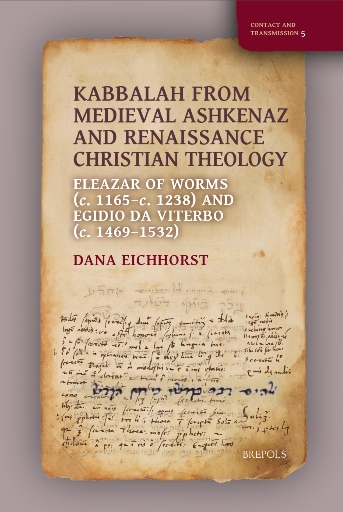
Kabbalah from Medieval Ashkenaz and Renaissance Christian Theology
Eleazar of Worms (c. 1165–c. 1238) and Egidio da Viterbo (c. 1469–1532)
The preoccupation of Christian theologians and scholars with the Hebrew language and sources at the dawn of the sixteenth century resulted in the transfer of a vast corpus of medieval Hebrew texts into Christian intellectual discourse and networks. These Hebrew sources were meticulously collected copied translated and subjected to rigorous study. These collections include texts that originate from medieval Ashkenaz the majority of which can be attributed to Eleazar ben Yehuda of Worms (c. 1165–c. 1238). Rabbi Eleazar was a prominent Jewish scholar of his time and a member of one of the most prestigious families in Jewish communities of the German Rhineland and Palatinate.
However the history of medieval Ashkenazic writings has been neglected in scholarship which has favoured other Jewish (primarily Sephardic) sources in tracing the infl uence of medieval Jewish mysticism on Christian theology and Kabbalah. This book takes the hitherto disregarded Ashkenazi Hebrew sources as its point of departure. It focuses on the work of Eleazar as a main representative of the Ḥaside Ashkenaz and on his mag num opus Sode Razayya which discusses all matter of the divine and the mundane sphere. The book explores how Eleazar’s work was a potentially interesting source for a Renaissance Christian Kabbalist like Egidio (Giles) da Viterbo. Kabbalah from Ashkenaz is distinguished by its emphasis on the Hebrew letters and language along with the divine word and divine speech (dibur). This central motif of the Ashkenazi sources found resonance with certain Christian theologians and Kabbalists in the context of Christian logos theology which is similarly anchored in the divine word (verbum).
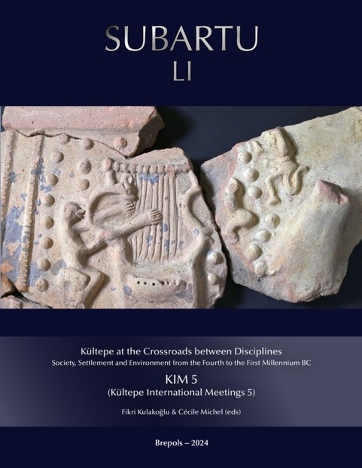
Kültepe at the Crossroads between Disciplines
Society, Settlement and Environment from the Fourth to the First Millennium bc
This fifth volume of a collection devoted to the interdisciplinary meetings held one every two years at Kültepe ancient Kaneš brings together eighteen contributions dedicated to the archaeology and history of this Central Anatolian site and its surroundings. Each chapter within the volume presents the results of current research into Kültepe thus continuing the holistic approach first demonstrated in earlier volumes of the Kültepe International Meetings sub-seriesof revitalizing one of the most important cultural centres of early Anatolia and of emphasising its importance as a pilot site for interdisciplinary studies. Drawing on Kültepe’s unique textual and archaeological data the studies gathered here are organized into four key thematic sections devoted respectively to politics law and religion; women family and correspondence; human and animal skeletons; and to the most recent archaeological excavations in Kültepe covering a period from the Chalcolithic to Hellenistic times.
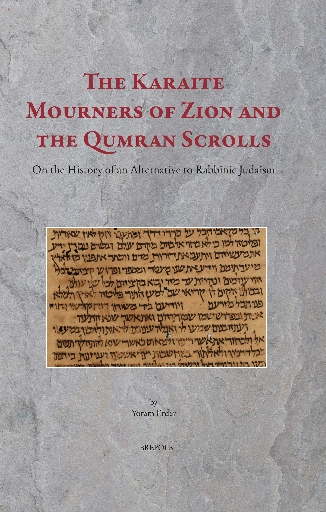
The Karaite Mourners of Zion and the Qumran Scrolls
On the History of an Alternative to Rabbinic Judaism
This book is dedicated to studying the Karaite Mourners of Zion - the leading faction within the Karaite movement during its formative period (9th - 11th century). Like all Karaites the Mourners claimed that the Rabbinic Oral Law was not given by God but is rather the ‘commandment of man’ (Isaiah 29.13). Therefore they called for a return to the Hebrew Bible.
According to the Karaite Mourners neglecting the Bible caused also the neglect of the Land of Israel. For them the Oral Law was a tool of the Jewish people to strike roots in the exile. Therefore they developed a Messianic doctrine which encouraged the Jewish people not only to return to the Bible but also to immigrate to the Land of Israel in order to accelerate the redemption.
The Karaite Mourners’ leadership practiced what they preached. From their cradle in the exile of Babylonia and Persia they came to Jerusalem where they created a community that was called Shoshanim (lilies). This community became the most important community that ever flourished in the history of Karaism. They left behind prolific work most of it written in Judaeo-Arabic.
Coming to Palestine and maybe before that the Karaite Mourners were exposed to some of the Qumran scrolls that were discovered at their time. They did not hesitate to adopt some of the Qumran doctrine and halakha despite the fact that main Qumran beliefs were not acceptable to the Karaites.
Studying the Qumranic influence on the Karaite Mourners sheds light simultaneously on early Karaism and the Jewish sects of the Second Temple period.
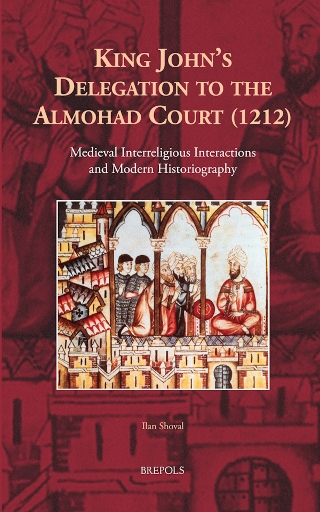
King John's Delegation to the Almohad Court (1212)
Medieval Interreligious Interactions and Modern Historiography
Is Matthew Paris’s story of an English diplomatic delegation sent by King John to the caliph of Morocco in the summer of 1212 nothing more than fiction or does it report actual historical events? Did King John really offer to subjugate his kingdom to the Muslim caliph and did he consider converting to Islam? Was one of John’s diplomats genuinely a converted Jew with whom the Muslim ruler conversed about theological issues? And how may a new reading of this medieval chronicle in its appropriate historical context contribute to our understanding of the professionalization of diplomatic practice the emergence of European bureaucratic kingship Christian–Muslim political interaction interreligious polemic and conversion? In this book these questions are explored as part of the first full-scale study of Matthew Paris’s report. The volume proposes an entirely new interpretation of the text and portrays a multifaceted and inherently complex picture of the interactions between Christians Muslims and Jews around 1200 that draws on law politics statecraft history culture and religion. This study also prompts a re-evaluation of the delegation story as a ‘test case’ for John’s measures during his reign. Matthew’s text is examined in its historical context of Christian–Muslim encounters on the frontier in order to advance our understanding of a crucial era of political and diplomatic transformation.
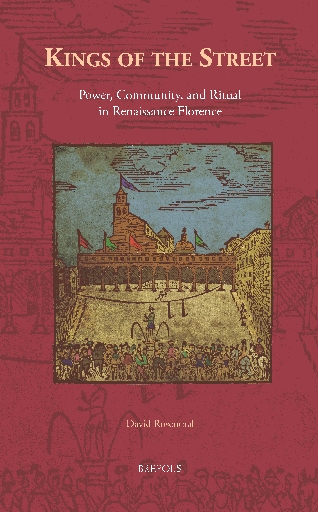
Kings of the Street
Power, Community, and Ritual in Renaissance Florence
For more than a century the artisans and labourers of Renaissance Florence turned the city into their own ‘empire’ during times of public festivity. From the republic of the late 1400s through to the grand duchy of the early seventeenth century up to forty brigades of men called the potenze or powers elected kings carved out territories and entered into a dialogue with citizens and with their Medici patrons.
This study traces the rise and fall of this carnivalesque subculture for the first time. It describes how workers represented themselves their neighbourhoods and their trades on the public stage through rituals such as stone-fighting and jousting and reveals how the politics of this festive world were closely linked to everyday patterns of social bargaining around the person of the prince. In the early 1600s the micro-states of the potenze were partially suppressed and they gradually disappeared from the Florentine urban stage. The account of this transformation presented here shows how Tridentine reform and economic crisis combined to undermine hypermasculine carnival ritual as a language of civic contract confining the potenze to making pilgrimages to shrines and convents in the Florentine countryside. At the same time it is shown how economic and religious change empowered groups of artisan women to take up the model of the potenze in order to make their own collective pilgrimages outside the city walls.
Through the story of the potenze this book provides fresh insights into the dynamics of class and gender relations and the nature of agency in early modern Italy.
Knowledge, Contemplation, and Lullism
Contributions to the Lullian Session at the SIEPM Congress - Freising, August 20-25, 2012
The philosophical questions and issues explored by the medieval masters continued to play a role in the thought of the Renaissance and Early Modern periods. The essays collected in this volume divided into three parts – Knowledge Contemplation and Lullism – study this influence through the lens of Ramon Llull’s Art. They represent the contributions made by scholars of Llull to the 2012 Congress of the Société Internationale pour l’Étude de la Philosophie Médiévale (SIEPM) held in Freising Germany. The contributions focus on the philosophical implications of Llull’s thought in areas such as geometry logic methodology and Early Modern law.
The SIEPM Congresses in Palermo (2007) and Freising (2012) both held meetings devoted to Llull’s thought. This continued interest in Llull reinforced the constitution of a Lullian Section supported by the SIEPM Bureau (Commission of Latin Philosophy). Since its foundation this research network has promoted academic research leading to new insights into Llull’s work as a vehicle for medieval philosophical concerns and into the history of its reception. The contributions gathered here reflect the preliminary insights and outcomes of this research. Moreover in view of the 700th anniversary of Llull’s death (1316-2016) the essays provide a pertinent example of the continuing significance of Llull’s thought for our time.
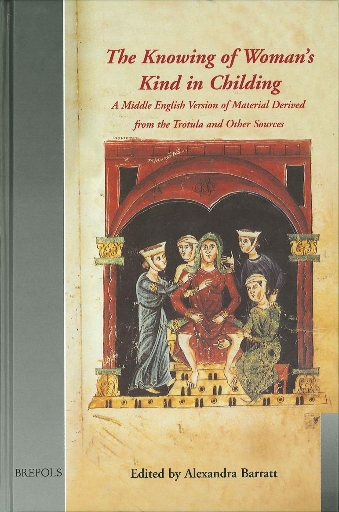
The Knowing of Woman's Kind in Childing
A Middle English Version of Material Derived from the Trotula and other Sources
This study comprises a critical edition using all the five extant manuscripts of the most popular of the Middle English gynaecological texts deriving from the Latin Trotula-text. The Knowing of Women's Kind in Childing is a short fifteenth-century prose treatise which claims to be translated from Latin texts (or Latin and French) that derive ultimately from the Greek. It has a unique importance as it was written by a woman for a female audience and on the subject of women. The text considers women's physical constitution what makes them different from men (primarily the possession of a womb) and in particular the three types of problem that the womb causes. That it was written for a female audience is made explicit in the Prologue where the writer explains that he has translated this text because literate women are more likely to read English than any other language and can then pass on the information it contains to illiterate women.The text is a translation no doubt by a man rather than a woman but one of his ultimate sources was a text attributed to 'Trotula' in the Middle Ages believed to be the name of a midwife or gynaecologist from Salerno who wrote extensively on women's ailments childbirth and beauty care. Recent work shows that such a woman probably named Trota did exist and that she did write a gynaecological treatise the Trotula or 'little Trota' which became closely associated with two other texts not by her. All three however became very popular and were widely disseminated under her name. Large sections of The Knowing of Woman's Kind come via an Old French translation from a version of one of these texts Liber de sinthomatibus mulierum.
Kleine Schriften zu den Konzilsakten des 7. Jahrhunderts
A collection of 22 articles by the author published in widely differing outlets in the period 1976-1996. All the articles are in German and a complete list of the author's publications is provided on pp. xi-xxi.
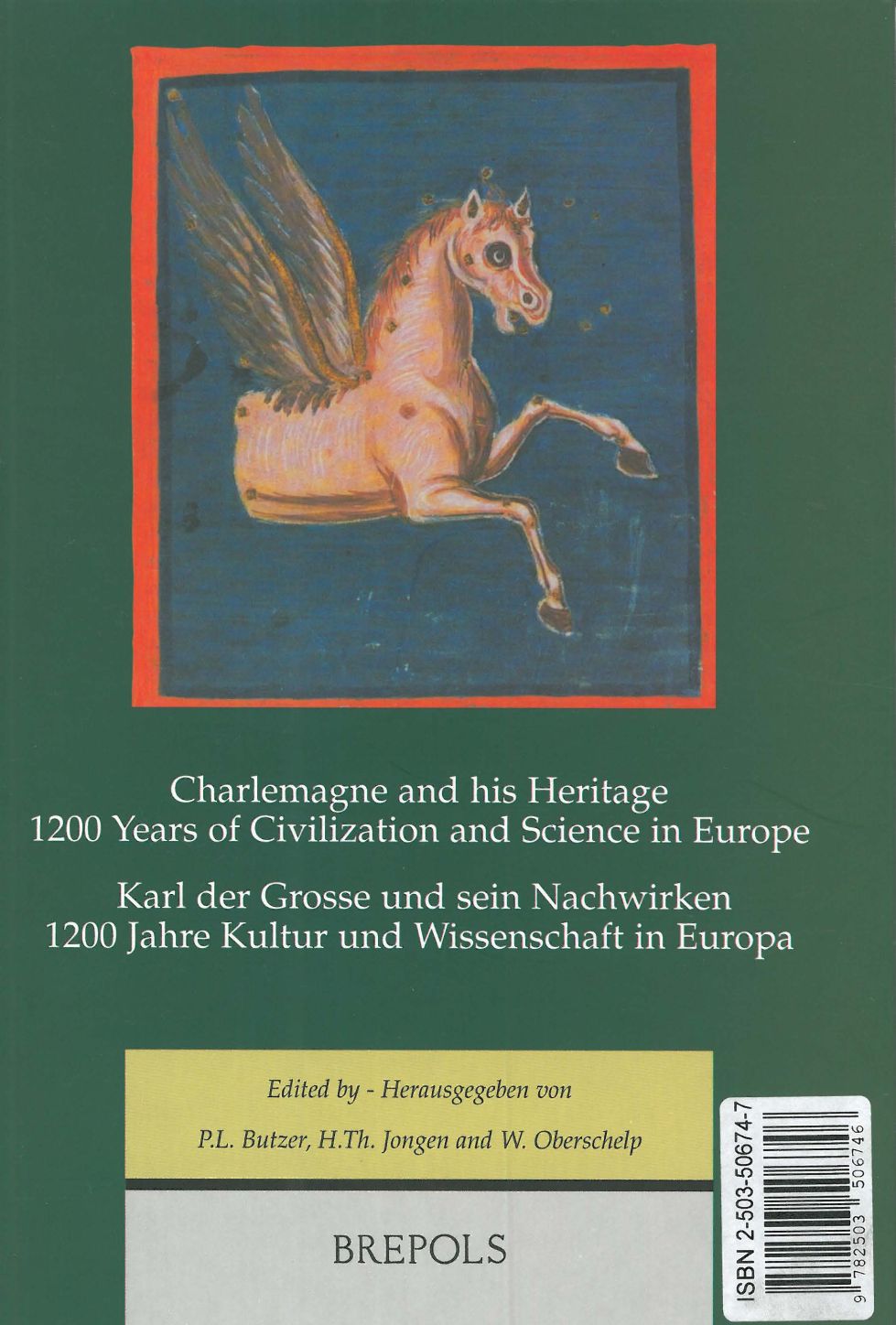
Karl der Grosse und sein Nachwirken. 1200 Jahre Kultur und Wissenschaft in Europa
Band II, Mathematisches Wissen
This volume includes 35 papers that deal with the heritage of Charlemagne in the mathematical sciences. It focuses on those fields which Alcuin of York and others introduced at the court school at Aachen founded some 1200 years ago and that continue to play a role in contemporary mathematics. The emphasis is on exemplary topics in modern geometry combinatorics operations research number theory and related fields. Selected topics in the history of mathematics since the Carolingian renewal are also covered.
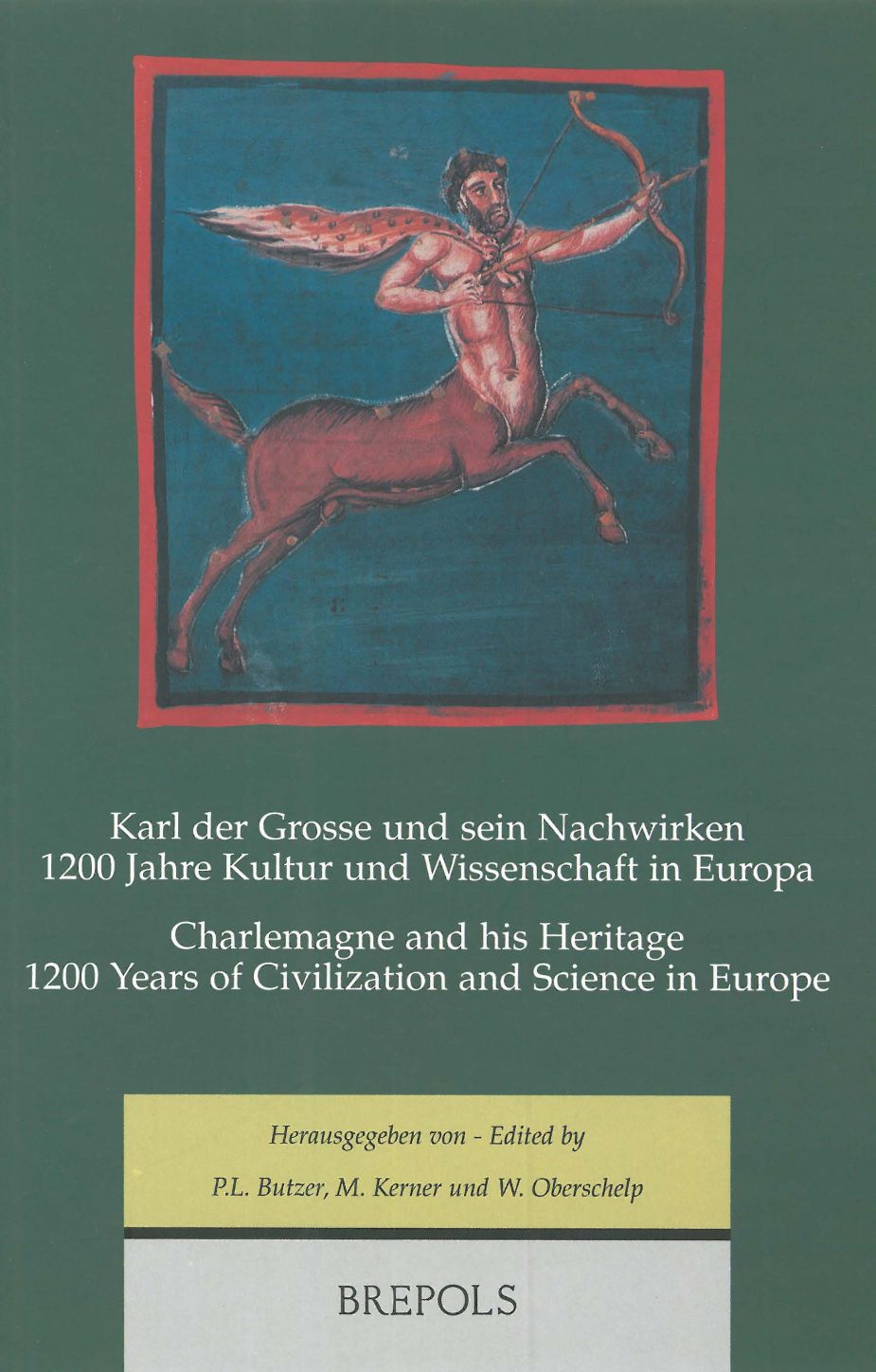
Karl der Grosse und sein Nachwirken. 1200 Jahre Kultur und Wissenschaft in Europa
Band I Wissen und Weltbild
This volume seeks to elucidate the intellectual world under Emperor Charlemagne its precursors and role models as well as the patterns and details of the educational reforms that set in train what has been called the Carolingian Renaissance. Against this broad background of intellectual stirrings and reform efforts the volume focuses on the scholarly activities during Carolingian times (the Artes Liberales) on the literary juridical and political sphere on the development of the church and the evolution of monasticism and their role in preserving the heritage of antiquity.